
Vaisheshika Philosophy is closely associated with the Nyaya Philosophy. It adopts a form of atomism and contends that every object in the physical universe is reducible to a finite number of atoms. This school of thought was expounded by sage Kanada. From the 6th century B.C. Nyaya and Vaisheshika are considered sister philosophies. It emphasises that a virtuous life guided by the principles of Dharma enables an individual to achieve a fulfilling life which has the spirit of highest good or Liberation. The two systems of philosophy maintain a dualistic concept which encompasses God and Jiva. Vaisheshika philosophy believed that only perception and inference are of prime importance. This is a theistic form of atomism. Vaisheshika philosophers tried to develop a theory to explain the properties of materials as the interaction of different types of atoms that make up the material. The Vaisheshika system of Philosophy categorises all objects of valid knowledge or Padartha into six.
According to the postulates of Vaisheshika Philosophy all things in the universe can be classified into padarthas or objects of experience. The six categories of the padarthas are guna, visesa, Dravya, karma, samavaya and Samanya.
Dravya (substance):
Nine components form an integral part of the Dravya system. They are prithvi (earth), jal (water), tejas (fire), vayu (air), akasa (sky), kala (time), dik (space), atma (self) and manas (mind). The first five among the dravyas are known as bhutas as they can be perceived and felt with the external senses.
Guna (quality):
Seventeen gunas have been mentioned by the Vaisheshika Sutra and a group of seven more gunas were added by Prasastapada. A guna is not able to exist independently. The core seventeen gunas which existed according to the Vaisheshika Sutras were rasa (taste), parthaktva (individuality), vibhaga (disjunction), aparatva (posteriority), dvesa (aversion), rupa (colour), sparsa (touch), parimana (size), samyoga (conjunction), gandha (smell), prayatna (effort), iccha (desire), sukha (pleasure), paratva (priority), duhkha (pain), samkhya (number) and buddhi (knowledge).
Karma (activity):
The element Karma does not have a separate existence. They are part of the dravyas. However karma is ephemeral in nature. For instance dravyas like akasa (sky), kala (time), dik (space) and atman (self) lack the element of karma within them.
Samanya (generality):
According to the Vaisheshika School of Philosophy there exists plurality of substances and because there is plurality of substances it is obvious that there will be common features among various substances. When such a common property is found between many substances it is referred as Samanya.
Visesa (particularity):
The element of visesa is opposed to the element of Samanya. It is with the help of visesa or particularity that one is able to distinguish things from one other. Visesa refers to the particular features of a substance.
Samavaya (inherence):
Samavaya refers to the inseparable relation between substances. Kanada had said that samavaya is the relation between the cause and the effect. Prasastapada had defined the concept of Samavaya more intricately. He had said that the relationship that exists between substances cannot be separated according to Samavaya. The Vaisheshika School of Philosophy states that even the smallest perceivable matter is composed of the finite structure atoms. It emphasises on the fact that atoms are the indivisible and eternal reality of all substances.
Thus, it can be said that Vaisheshika School of Philosophy gives emphasis on the atomicity of elements. It also states that every particle has an individuality of its own.
Vaisheshika Philosophy
Vaisheshika Philosophy states that all matter is made of finite reducible particles known as atoms. Vaisheshika is among the six Astika School of Hindu philosophies of India.
Recently updated articles in Indian Philosophy
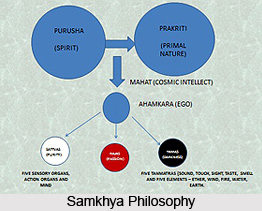
Samkhya Philosophy
Samkhya philosophy is one of India’s oldest intellectual traditions, explaining reality through the interplay of Puruṣha (pure consciousness) and Prak...
Maya, Prakriti in Hinduism
Maya or illusion is a very potent instrument of the Divine Prakriti, the Primal nature. In Hinduism one must be able to come out of Maya in order to a...

Samadhi in Hinduism
Samadhi is the result of meditation or that state of mind when there is an absence of all idea of individuality.
Samadhi in Buddhism
According to Buddhism, oen can only achieve samadhi through strict meditation and right concentration.

Abdul Rehman Jilani Dehlvi
Syed Abdul Rehman Jilani Dehlvi was a renowned Sufi saint of the Qadri Order in India.
Related articles in Indian Philosophy

Ajivika Philosophy
Ajivika philosophy is different from the mainstream religion
Indian Philosophy In The Vedic Period
Indian Philosophy in the Vedic Period was primarily based on the concepts of nature worship.
Achintya Bheda Abheda Philosophy
Achintya-Bheda-Abheda is a School of Vedanta that represents the philosophy of unimaginable one-ness and difference in relation to the power creation...
Samkhya Philosophy
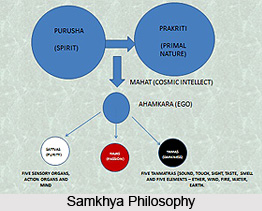
Samkhya philosophy is one of India’s oldest intellectual traditions, explaining reality through the interplay of Puruṣha (pure consciousness) and Prak...
Charvaka Philosophy
The Charvaka Philosophy believes that only those things that can be perceived is the ultimate reality.