Purva Mimamsa Philosophy - Informative & researched article on Purva Mimamsa Philosophy
  Indianetzone: Largest Free Encyclopedia of India with thousand of articles Indian Philosophy


in  
Art & Culture | Entertainment | Health | Reference | Sports | Society | Travel
Forum  | RSS Feeds  | Free E-magazine
Indian Philosophy : Indian Philosophy l Schools Of Indian Philosophy l Classical Indian Philosophy l Indian Religious philosophy l Buddhist Philosophy l Upanishad l Indian Philosophers l Atomic Theories l Hindu Philosophy l Satya
Home > Reference > Indian Philosophy > Schools Of Indian Philosophy > Purva Mimamsa Philosophy
Purva Mimamsa Philosophy
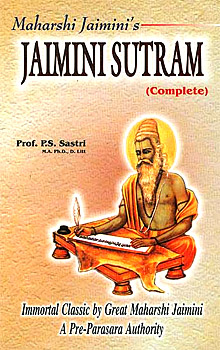
The foundational text for the Mimamsa school is the Purva Mimamsa Sutras of Jaimini.

Mimansa, a Sanskrit word meaning `investigation` is the name of an astika (orthodox) school of Hindu philosophy, whose fundamental research is into the nature of dharma, based on close hermeneutics (the developement and study of theories of the interpretation and understanding of texts. In present-day usage in religious studies, hermeneutics refers to the study of the interpretation of religious texts) of the Vedas. Its basic tenets are ritualism, anti-asceticism and anti-mysticism. The cardinal aim of the Purva-Mimansa school is elucidation of the nature of dharma, realised as a set ritual obligations and prerogatives to be performed in the right manner. The nature of dharma is not accessible to reason and observation, and must be deduced from the authority of the revelation contained in the Vedas, which are considered eternal, authorless (apaurusheyatva) and unfailing.

Mimansa is more appropriately known as P?rva M?m?ns? ("prior" enquiry, also Karma-M?m?ns?), whereas Uttara M?m?ns? ("posterior" enquiry, also Brahma-M?m?ns?) is the opposing school of Vedanta. This division is based on the notion of a duality of the Vedic texts into a karma-kanda, the section of the Veda treating of sacrificial rites (Samhitas and Brahmanas), and the jnana-kanda, dealing with the knowledge of Brahman (the Upanishads).

The foundational text for the Purva-Mimamsa school is the Purva Mimansa Sutras of Jaimini (ca. 3rd to 1st century BCE). A foremost commentary was composed by Sabara in ca. 5th or 6th century CE. The school reached its height with Kumarila Bhatta and Prabhakara (fl. ca. 700 CE). Both Kumarila Bhatta and Prabh?kara (along with Mur?ri, whose work is no more in existance) have penned extensive commentaries on Sabara`s Mimamsasutrabh?shyam. The school for some time, during the Early Middle Ages exercised near-dominant influence on learned Hindu thought, and is credited as a significant force contributing to the decline of Buddhism in India. But it had fallen into decline in the High Middle Ages and today is all but overshadowed by Vedanta. Purva-Mimamsa is still the only one of the six orthodox darshanas besides Vedanta to survive into contemporary Hinduism. There are two surviving traditions - the Bhattas and the Prabhakaras, following Kumarila Bhatta and Prabhakara, respectively.

Dhrama and Atheism in Purva-Mimansa philosophy
Dharma as understood by Purva-Mimamsa can be roughly translated into English as "virtue", "morality" or "duty". The Mimamsa school traces the source of the knowledge of dharma neither to sense-experience nor inference, but to verbal cognition (i.e. knowledge of words and meanings). In this respect it is connected to the Nyaya school.

The Purva-Mimamsa school held dharma to be equivalent to following the prescriptions of the Samhitas and their Brahmana commentaries pertaining to the correct performance of Vedic rituals. Seen in this light, Mimamsa is fundamentally ritualist, placing great weight on the performance of Karma or action as spoken by the Vedas. In this sense, it is a counter-movement to the mysticism of Vedanta, disapproving or de-emphasising moksha or salvation. To a certain extent, Purva-Mimamsa is atheist, placing all importance in proper practice as opposed to belief, rejecting a creator God as well as any scriptures on dharma outside the Vedic tradition, yet accepting svarga or heaven awaiting the person who has acted righteously in his or her life. In its rejection of belief in a God, it is related to the nastika Carvaka school.

(Last Updated on : 8/01/2009)
  More on Schools Of Indian Philosophy...
 
Nyaya Philosophy Vaisheshika Philosophy Samkhya Philosophy
Yoga Philosophy Purva Mimamsa Philosophy Vedanta Philosophy
Jain Philosophy Sufi Philosophy  
Recently Updated Articles in Indian Philosophy
  • Atman
    Atman or the Imperishable Soul within ever "Jiva" or living being, cast an eternal enigma in Hinduism.
  •  
  • Karma In Jain Philosophy
    Karma in Jainism says subtle matter particles of the infinite karma get synthesized in the vicinity of the spirit.
  •  
  • Svetasvatara Upanishad
    Svetasvatara Upanishad emphasizes that when a soul achieves unity with the Supreme Reality it attains immortality.
  •  
  • Influence Of Buddhism On Indian Philosophy
    Influence of Buddhism on Indian Philosophy has been strong enough to give birth to several new concepts.
  •  
E-mail this Article | Post a Comment
Free E-magazine
Subscribe to Free
E-Magazine on Indian Philosophy

 
Purva Mimamsa Philosophy - Informative & researched article on Purva Mimamsa Philosophy
Sitemap
Contact Us   |   RSS Feeds
Copyright © 2008 Jupiter Infomedia Pvt. Ltd. All rights reserved including the right to reproduce the contents in whole or in part in any form or medium without the express written permission of Jupiter Infomedia Pvt. Ltd.