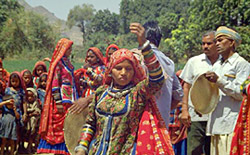
Meena, also spelled as Mina, is a community principally found in the state of Rajasthan. The name of this community has been derived from the word Meen, which means fish in Sanskrit language. At the time of the British ruling, the Meena tribal community had been acclaimed as the `Criminal Tribe`. This very act was taken to hold up their coalition with Rajput kingdom in Rajasthan, also revealing the fact these Mina tribes were still in war with Rajputs, indulging in guerrilla attacks to hold on to their lost kingdoms. The Minas mainly reside in northern part of Rajasthan including some areas like Sawai Madhopur District, Dausa District, Jaipur, Dholpur and Karauli districts in Jaipur and Bharatpur region. They also reside in Bharatpur district and Bayana district and from Jaipur-Sikar in Shekhawati region and Alwar in the northeast region of the state. The people of this community are also found in huge number in Kota, Jhalawar and Bundi including north-western parts of Madhya Pradesh.
Origin of Meena Tribe
The Meenas tell the story of their origin through numerous myths and legends in oral history. Mina mythology, traces their origin to Matsya Avatar or the tenth incarnation of Lord Vishnu. The Mina is numerically the largest tribe in Rajasthan. They once ruled over the former states of Jaipur and Alwar and are essentially an agricultural community. According to the Hindu calendar, the people of Mina community celebrate Meenesh Jayanti in the name of Vishnu on the third Tithi of `Chaitra Shukal Paksha`. This belief is mainly based on the scripture of the Matsya Purana.
History of Meena Tribe
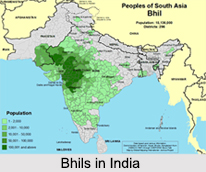
The ancient Indian scripture Rig Veda depicts that the kingdom of the Meenas was called Matsya Kingdom in Sanskrit. The people of Meena tribe of Rajasthan had been worshipping Lord Shiva, Lord Hanuman and Lord Krishna as well as the Devis (Mother goddesses) till date. Meena tribal community shares space with other tribes including the community of Bhil tribe. In fact these Mina tribes share a very good relation with the members of other tribal communities. The Mina people are the followers of Vedic culture and it has also been mentioned that the Mina groups had Bharman and Scythian ancestors. During the years of invasion, several fresh groups of Meenas have been formed under the stress of the frightful famine which desolated Rajputana in 1868.
The Meenas are an important part in the history of Rajasthan. Earlier, Rajput and Mina chiefs, ruled over a considerable tract of the country in subordination to the Taur kings of Delhi. The Mina community was ramified primarily in four basic sectors the Zamindar Mina, the Chaukidar Meenas, Parihar Meenas and the Bhil Meena. Formerly the Minas were scattered in different sects of the country and their characters differ due to the change in the vicinity. The Minas of the Karauli, Sawai Madhopur, Jaipur, Gangapur area are the most important cultivators for the last four hundred years. From a number of villages the Dhangars and Lodhis were routed out by the Minas and have managed to reinstate their possession.
Culture of Meena Tribe
The Meo population is said to have originated from Meenas and due to this reason there is a similarity in the ethics and culture of the Minas. The Rajputs are said to be the admixture of Meenas, Gujjar community, Jat and other warrior tribes. Festivals, music, songs and dance bear a proof of the fact that the culture and tradition of these Meena tribes are quite bright. Although the Mina tribes fete these festivals, they have incorporated their rituals and rites of the local origin. For example, the seventh day of Navratri is the time of the celebration for the Mina tribes who get together to rejoice with acrobatics, swordplay dancing and singing. Minas firmly believe in the institution of marriage. It is the Bhopa priests who are involved in matchmaking based on horoscopes. In this Rajasthani tribal community occasion such as these call for great festivities. A plethora of festivals are celebrated by the Mina tribes as well. This fact is confirmed by the hundreds of ancient culture of feting Meenesh Jayanti in the name of Lord Vishnu. They employ a Brahmin priest to perform all rituals related with birth, marriage and death in their community. Majority of the Minas follow Hinduism.
Costumes of Meena Tribe
The dresses of the people of Meena community are quite similar the other tribal people mainly the dresses of women are much similar in style with subtle differences in designs. The dress of a Mina woman comprises an odhna, ghagra, kanchli and kurti. Unmarried Mina girls wear a sari called lugda. The dabki-wali ludi is a special odhna worn by Mina women and is always coloured red and green. The ankle-length ghagra, which is usually made of deep red cloth with blue designs, is the distinguishing mark to identify a Mina woman. The ghagra, which is heavily gathered at the waist, is also known as a `palla ghagra`. The sleeves of the `kanchli` or the kurti are usually of elbow-length.
Jewelleries form an integral part of the costumes of Mina tribal women. The Mina women prefer to adorn themselves with jewelleries. The most prominent ornament of the Mina women is the `borla`, a symbol of her marital status. Women also wear a `hansli` round the neck, a `nath` in the nose, `timaniya` in the ears, `pnonchi`, `bangri`, `gajra` and bangles on the forearms and `bajuband` on the upper arms. All married women invariably wear `chuda` made of lac. They also wear `kadi` and `pajeb` on their feet. Silver is used for head and neck ornaments, while ornaments for the feet are crafted from brass. Mina women generally do not wear gold. Irrespective of marital status, a Mina woman does not wear her hair loose. Hair doing is a part of their regular lifestyle. It is usually parted in the middle of the forehead, which, is set off with a `borla`, which in the case of married women, is studded with imitation stones. Unmarried girls wear their hair in a single braid, which ends in a knot.
The dress of the Meena man consists of a dhoti, kurta or a bandi and a turban, although the younger generation has adopted the shirt, with pyjamas or trousers. During winter, the Mina men wear a shawl that covers the upper part of their body. Their usual headdress is the potia, which is wrapped around with decorative tape. Red-printed headgear with gota work is also worn. A shawl, which is worn around the neck, is also in colours of red and green. Interestingly, marriage brings a change in the costumes of Meena man. A long red upper garment is worn at the time of marriage. It is calf-length and straight, with long slits on the side and full sleeves. It has green piping on the ends of the sleeves, hem, slits, neck and front. It is also appliqu‚d and has a front-opening. They normally wear the dhoti as the lower garment, which falls just below the ankles. It is worn tight and is draped like the `dolangi` or `tilangi` dhoti. Mina men do not wear much jewellery. The most common ornaments are ear-rings called `murki`. Other accessories at the time of marriage include a large sword and a `kada` on the wrist. The men wear their hair short and usually, sport beards and small moustaches.
Tattoos are also popular with the Meena community. Mina women display tattoos on their hands and faces. The most common designs are dots, flowers or their own names. They wear kohl in their eyes and black dots on the face as a form of body ornamentation. Tattooing is popular with the men as well and they usually have their forearms tattooed with their names, floral motifs, figures and deities. Main languages spoken by Meena tribes include Hindi language, Mewari, Marwari language, Dhundari, Harauti, Malvi language, Garhwali language, Bhili language, etc.
Meena Tribe
Meena Tribes reside in every nook and corner of the country and have a rich cultural heritage. Meena is also spelled as Mina. Although the derivation of the word is obscure, it has been suggested that it is derived from the word mina, which literally means fish.