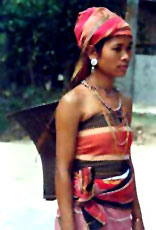
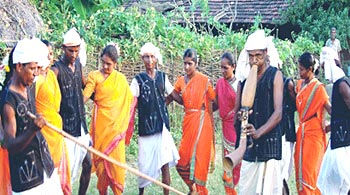
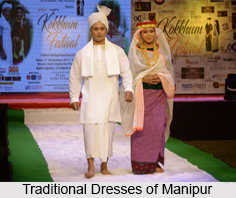
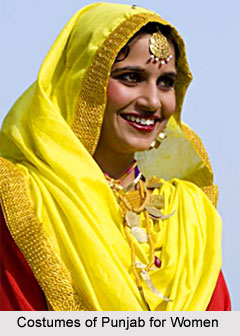
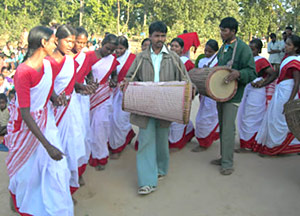
Traditional Dress of Mizoram resembles with that of the other hill-states of the Northeastern India. The fundamental patterns speak volumes for the prevalence of the ethnic heritage of the North East.
Women`s Traditional Dress of Mizoram
The favourite costume of a Mizo woman is Puan. The vibrant colour and the outstanding designs made the costume more beautiful. Puanchei, the gorgeous dress of Mizo girls is a must during weddings and festivals like `Chapchar Kut` and `Pawl Kut`. The shades in the attire are black and white. The black portion of the textile is originated from some kind of synthetic fur.
Kawrchei is a fabulous blouse for Mizo girls. This is usually used along with `Puanchei` at the time of performing any Mizo dance. In earlier times, all the cloths were hand woven but nowadays these are mostly machine made. They are made from cotton and the hues are made by a thing called `Ting`. Besides this, a blouse, which is of the same pattern, is usually worn.
The traditional cloth of the women of the Lusei tribe is dark blue cotton skirt, worn round the waist and tightly held by a girdle or belt of brass wire. This is the dress, worn by all women, stretches itself up to the knees. This skirt is worn with a short white jacket and a cloth, wrapped in the same way as the males.
However, the rapturous item in the Lusei girls costume is the headgear, worn during dances. This headpiece is built from brass and coloured cane, endowed with porcupine quills, and upper edges of these quills have green wing-feathers of the common parrot, carrying at their tips tussocks of wing covers of green beetles. Zakuolaisen is a blouse piece with crimson stripes used mainly by the unmarried girls. Puon Pie, a quilt woven cloth, is a must for every girl, while coming down to settle in her husband`s abode, post marriage.
Men`s Traditional Dress of Mizoram
Mizo men drape themselves in a 7 feet long and 5 feet wide cloth-piece. In cold season, some additional cloth is used, one on top of the other, along with a white coat, which comes down from the throat enveloping till the thighs. White and red bands, stuffed with designs adorn the sleeves of these coats.
During the hot months, people wear these clothes around the waist to feel comfortable. Moreover, at times to avoid the scorching sun, a Mizo man contrives a piece of cloth as a turban or Pagri. The entire dress of the male of the Lusei tribe is made of cotton, cultivated in the region itself. Usually, the costumes come in white colour, but sometimes men want to wear other shades, for example, blue colour bestowed with stripes. There is no difference existing in the costumes of the ordinary Lusei and the head of the community. Only during festive occasions, the costume differs from one another.
The fighter`s costume in Lusei society entails a cloth passed round the waist, a knapsack, fortified with a bear or tiger hidden over one shoulder, a gun in one hand, a weapon called dao on the other. The Hmars tribe of Mizoram is weaving-expert, deft in creating multiple designs. Puon Laisen is a red cloth with two black stripes at the middle. This cloth is gifted with several designs like Sakat Zang Zie, Disul etc. The handwoven Hmaram also called Kawkpui zikzial is very popular among the children and girls.
The little but praiseworthy costumes of Paiteis are attractive. Thangou Puon, ranks top as the costume of Paiteis community. Only, a brave warrior who has slaughtered rivals in inter-tribal tussle or in war is permitted to claim ownership of this costume.
The costume of the Riang tribe of Mizoram resembles to that of the other tribes. The colours, designs, cuttings and finally the style of dressing, associated with costumes, cast light on the artistic prowess of the people of Mizoram.