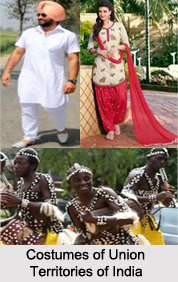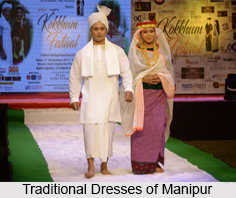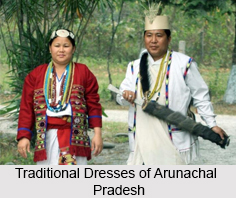
Indian ethnicity and tribal life finds its fullest expression in the serene hills and the sylvan surroundings of the picturesque Arunachal Pradesh. This eastern-most state on India`s northeast frontier, is crowded with 26 native tribes and several sub-tribes, residing in 3649 dispersed villages.
Generally, the Arunachal people have a Mongoloid descent, though one tribe is different from the other in terms of discrete vernacular, dress and costumes.
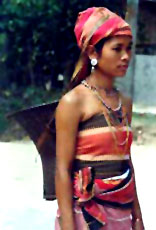
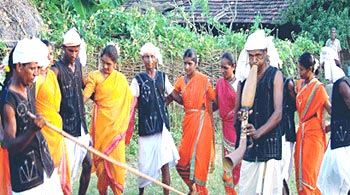
Costumes of the different tribes of Andhra Pradesh are endowed with fascinating vibrant colours and myriad patterns, characteristic of tribe culture. It signifies their aesthetic taste and zeal for embellishment.
The Monpas who live north of the Bomdila range, adhere to Buddhism, observed in the venerated Tawang monastery. This is obvious, as these tribes are under the direct influence of Tibetan traditions. Tibet is the holy land of Buddhistic spirituality.
Thus the traditional costume of the Monpas of Arunachal Pradesh is shaped by Tibetan culture. Besides, they also cover themselves with woolen coats and trousers, to shield themselves from the cold.
It is typical of tribe lifestyle, to use animal body-parts in their daily life, be it as their food, or in the making of their dresses or in other regular articles used by them. An apt example would be the Eskimos of the Greenland in the North Pole.
The Monpas also are no exception. They wear a skullcap made of felt with laces or tassels as adornments. The Monpas women wear a jacket, above a sleeveless chemise. They bind this chemise round their waists with a lengthy and narrow strip of cloth.
Accessories are a must for any woman, be she a tribal or a city-girl. The Monpa females beautify them with silver rings, earrings cut from bamboo-bits and appended with red beads or lovely turquoises. Another popular dress-item is a cap, endowed with a fascinating peacock-feather.
The Hill Miris inhabiting the lower Kamla valley look attractive in their costume. They tie the hair in a knot just above the forehead. Their women wear attractive "crinoline of cane rings" which serves the purpose of a blouse but now it is not seen in the urban areas.
The Sherdukpen, inhabiting , south of Bomdila in the Tengapanai valleys, bear striking resemblance with their fellow- Buddhist community, the Monpas. The usual apparel of Sherdukpen menfolk, is a sleeveless silk material, with its two edges, pinned at the shoulder region. The costume is normally knee-long. The hallmark of their dress-code is the gurdam skull-caps smeared with yak`s hair. The tassels protruding from he gurdam over the face, form a slope to glide away rain-water, as their residential-zone is subject to torrential rain, often. Again a truth that should be driven home is that,, costumes are contrived, keeping mind the climatic conditions. Men for protection, along with the maintenance of decency, invented dresses.
Sherdukpen men carry swords, in a sheath, on a strap , encircling their waist.
Furthermore, bogre, a cloth manufactured from natural fibres, is fastened round the shoulders in such a manner, that it turns out into a fold at the back.
The women, hailing from the women sect of Sherdukpen, clothe themselves in a collarless and sleeveless garment , stretching from the shoulders to the knees. Added to this, a full-sleeved jacket with nice embroidery and waist cloth, called mushaiks, is worn above the patent robe. The hair-style is also interesting . The women often tie their hair into a bun at the back . It is curious to note that Sherdukpen women are adept in weaving clothes with praiseworthy finnesse.
The Tangsa tribe, also , dwelling in the Tirap and Changlang district of Arunachal Pradesh, is a Naga tribe. These robust , middle-length people cater to the Burmese costume-style. They do not retain long hair, now-a-days. The Tangsa men, wear green lungi, skillfully seamed in with matching yellow, red and white yarns. A sleeveless shirt,acts as the upper garment.
Tangsa women puts in a very attrative -looking woven petticoat, along with a linen blouse to top it. What is amazing from their dress-concept is that the notion of skirt and blouse, was neither new to India .
Miji , living in the West Kameng and East Kameng districts , exhibt simplicity as well as refinement in their costume. The ankle-long white cloak gives the Miji women a pristine look. And the final touch is given by an ornate red jacket. Big-sized silver earrings and resplendent necklaces, commonly decked with jade , perfectly augments the beauty. A strip of silver chains is occassionaly, worn around the head by the wealthier Miji women. One will be awe-struck to learn that these tribal women knows the art to extract bio-chemical cosmetics from pine-resin .
The Ziro in the Apatani Plateau, of the Lower Subansiri district of Arunachal Pradesh is the habitat of the Apatani or Tanii tribal population , bearing the Sino-Tibetian genealogy.
The intricate design and colour-abundance of the costume of the Apatanis is indeed captivating enough. Tattoo-drawing and the attaching of conspicuosly big nose plugs called Yaping hullo are the major highlights of this group. It is said, that this peculiar costume-pattern evolved from the strategy of safeguarding , devised by the beautiful Aptani women. They were , since old times, keen, to appear unimpressive to the men of other tribes, to ensure safety. However, recently, young generation of this tibe has refrained from obeying this norm. The tattoo done by the women involve broad blue stripes painted from the forehead down to the tip of the nose, and five vertical lines, drawn under the lower lip in the chin. The women arrange their tresses into a ball, called Dilling on the head-top . A brass skewer, known as Ading Akh, is often passed through the Dilling , in a horizontal direction. Ading Akh thus functions as stylish hair-pins of a city-woman.
By custom, the Aptani men, make a knot of their hair just above the forehead . the local name of this hairstyle is as Piiding and the bras rod used in the cration of this knot is known as Piiding Khotu . Strands of neatly shaped cane belt are coloured in red (Yari)and and modified through bending into the mould of a horse-collar with an elongated finish . The loop of the horse-collar , fastened around the waist , holds loosely the strips of cane, together. This cane-accessory is a favourite among men. The men also like to apply tattoo or Tiippe on their chin. The tattoo-sketch resembles the shape of a `T` under the lower lip. So, going for make-up in their own unique manner was included in the heritage-laws of the Aptanis.
The Adi is a chief tribal community , staying in the Himalayan hills of Arunachal Pradesh , i.e., in the temperate and sub-tropical regions within the districts of West Siang, East Siang, Upper Siang, Upper Subansiri, and Dibang Valley. The topic of the costume of the Adi , instantly gives glimpses of the galae , a poly-utility garment , used by both the genders . A galae, which is tied around the loins, comes down in loose hanging down in narrow form. In accordance with the geographical circumstances of the region, men fortify themselves with helmets made from cane, bear and deer skin.
Senior women, already maried, embellish themselves with yellow necklaces and coiled earrings. But,the presence of beyop , an ornament compiled of five to six brass plates, stuck under their petticoats, signify the unmarried status of a young girl. Tattooing is a common feature among the older women.
We therefore notice the enchanting costume-paradigme of the plethora of tribes, thriving for ages in the hills and forests of Arunachal Pradesh . The costume of each of the tribes, namely, Monpa, Sherdukpen, Tangsa, Adi, Aptani, and so on, illuminate the mind with their ever-glorious aesthetic appeal. In fact it is the rare ribal artistry and indigenous caliber, that makes Arunachal Pradesh, stand on the high pedestals of fame and reputation.
|