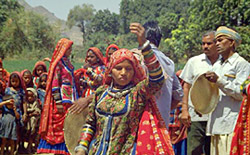
Bharia Tribe is a Dravidian tribe. They have been given the status of being one of the scheduled tribes of the Indian subcontinent. The name `Bhumia`, meaning Lord of the soil, is another name for this tribal group. Some of the tribal communities of the Indian subcontinent also identify Bharia Tribe as `Bharia Bhumia`. Bhumia refers to priest of the village Gods and is thus considered as a very respectable designation for the people of this tribe. Bharia Tribe is further categorized into clans like Thakaria, Angaria, Bapothia, Bhardia, Bijaraia, Mehania, Amolia, Papchalia, Nahal, Raotia and Gadaria. Several stories are associated with the origin of Bharia Tribe. Some records suggest that they belong from the phylum of Bhar tribe. Eminent anthropologists have conducted numerous researches on the lives of this Bharia tribal community and have revealed that this tribe is one of the indigenous tribes of the region.
Location of Bharia Tribe .
The state of Madhya Pradesh houses a number of Bharia tribal communities. Their main concentration is at the Patalkot valley in the Chhidwara district. Apart from this, Jabalpur district and its adjoining regions of the state are also inhabited by the people of Bharia Tribe. Patalkot valley is a nature`s wonder, surrounded by gorgeous hills. Doodhi River flows through this valley. About 12 villages and 13 hamlets are situated in this valley and, owing to its picturesque beauty especially during the rains, it has been also identified as an exotic tourist destination. The valley is completely secluded from the world; however several pathways are there to reach the villages.
Occupation of Bharia Tribe
Following the tradition of most of the tribal communities of the Indian subcontinent, the Bharia Tribe has adapted to the profession of cultivation. Mainly, shifting cultivation is practiced by them in order to sustain their livelihood. Thus, it is needless to say that the Bharia tribal community is agrarian. Apart from cultivation, many people of this tribe also collect various forest products like tubers, roots and fruits to meet the demands of their daily survival. Nowadays, they also work as labourers in the offices of the forest department. A recent survey has shown that these people are engaged with a variety of occupations. About 38.7 percent of the people are farmers, agriculture labourers comprise 37 percent of their population and the rest around 24.3 percent work as forest labourers. The region where this tribe dwells is quite rich in medicinal plants and the tribal people possess a deep knowledge about them. The people of Bharia Tribe have also set up their own treatment centres where they use herbal therapies for treating various heath hazards and ailments. `Bhagat` is the name given to the herbal healers of this tribe.
 Culture of Bharia Tribe
The cultural exuberance of the Bharia Tribe has been prominently reflected in all its socio-cultural elements such as festivals, songs and dances. Their societal structure is nuclear and about 78 percent of the Bharia households have nuclear families. Their tribal language like Dravidian tribal Language is known as Bharia. The Bharia tribal community lives in beautiful houses built by their own hands. Anthropologists of the Indian subcontinent have enumerated that most of these people pay least attention to education and learning. The literacy rate of Bharia Tribe is hence very low. They have a number of exogamous groups. The nuptial rituals of this tribe also have typical attributes and the marriage proposal always first comes from the boy`s side. Bharia people also follow several birth and funeral rites. They have a Panchayat for the maintenance of law and order in their community.
Religions of Bharia Tribe
People of Bharia Tribe are highly religious by nature and worship several Hindu deities. They celebrate festivals like Shivratri, Diwali, Holi, Akhati and many more. Most of the people have adapted to Hinduism. Like most other tribal communities, the Bharia Tribe is also greatly inclined towards religion and spiritualism.
Threats for the Bharia Tribe
Due to lack of education and advanced health care facilities, the women mortality rate in Bharia Tribe is quite high. The exposure of the herbal treasure of the Patalkot valley to the world has also posed dangers of exploitation of the natural resources of this valley. The beautiful valley is now facing threats of deforestation which is becoming a cause of concern for the tribal people who depend solely on the natural resources for their livelihood.
An interesting fact about the Bharia Tribe is that, over the years, the people of this tribe have maintained their originality without adopting the customs and practices of the modern world. Since years they have lived and developed an intimate relationship with the forest environment. Bharia Tribe is one of those tribal communities of the Indian subcontinent who are almost inaccessible and are completely detached from the modern civilized society.
Bharia Tribe
Bharia Tribe is one of the significant tribal groups of Madhya Pradesh. Major concentration of Bharia tribal community is in the Patalkot valley of this state.