 Monpa tribe constitutes of five percent of the total population of tribal communities throughout the whole Arunachal Pradesh state. Monpa tribe is considered to be one of the primitive tribes of Tawang District and West Kameng District. The Monpa tribe has a kinship with the Sharchops residing in Bhutan. Though the language of this tribal community is of Tibeto-Burman family, but it notably differs from the dialect of Eastern Tibet.
History of Monpa Tribe
Eminent anthropologists have penned down a lot of things about the role of Monpa tribe in trade during pre-colonial and colonial era of Arunachal Pradesh. Monpa tribe even proved to be really efficient in playing the role of intermediaries in trade that Assam had with a foreign country. Within Arunachal Pradesh also Monpas carried on trade exchanges of several products like butter, coats, shoes, carpets, blankets, masks and yak cap, salt and beetle nut with `Sherdukpen tribal group`. In lieu, they demanded of cows, `mithun` and `animal-skins` in exchange. According to few anthropologists, to facilitate this trading relation with Assam Monpas emphasized the role of trade fairs. These trade fairs further deterred to a great extent due to the enactment of inner-line regulations by forest regulators in Darrang frontiers of the Assam state. These `provisions` led Monpa of Twang and East Kameng districts curb their motions within `sub Montana forest`.
 In the year 1809, the fairs at Udalguri and Doimara in Assam clearly established the facts that animals and its various by products along with the forest based resources were the major items of trade. These were to be exchanged with finished products from other places.
Divisions of Monpa Tribe
The Monpa tribal society is divided into six sub groups in respect of their language. The sub groups are named as Dirang Monpa, Panchen Monpa, Bhut Monpa, Lish Monpa, Tawang Monpa and Kalaktang Monpa. The Monpa society is administered by the Trukdri which comprises six ministers. The members of Trukdri council are known by the name of Kenpo.
Buddhist Practice of Monpa People
The Monpa tribal people follow the characteristics with other people of Arunachal Pradesh as well as with many other tribes of `mongoloid characters` of adjacent north-eastern parts. Monpa tribes have also their own and unique system of the practices. The Monpa tribes are all ardent believers of Buddhist practices. Lord Buddha, the Dharma (righteousness) and the Sangha (order of monks) comprise of the `Buddhist Trinity`. These three sacred ideals of Buddhism are also hold in esteem and reverence by these Monpa tribal community people.
 Economy of Monpa People
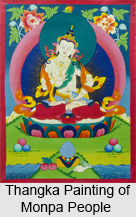
The people of Monpa tribal community are reckoned for their artistic creations that include beautiful Thangka painting, carpet making, weaving and wood carving. They are adept in making paper from sukso tree. Moreover, the people of this tribal community also practice shifting cultivation. Among their major crops, barley, rice, maize, chili, wheat, tobacco, pumpkin, beans, pepper, and indigo can be named. They also rear domestic animals like yaks, pigs, cows, fowl and ship. Monpa tribes have followed the tradition of depending on nature and its various products.
Customs of Monpa Tribe
Monpa tribal people follow the customs of animal sacrifices and also utilize the stuffs derived from the animal resources. Monpa tribe has wide faith on various superstition and magical powers. Animals that are utilized both as food and other purposes are tiger, leopard, musk deer etc. Monpa tribe also shows no reservations for consuming various kinds of birds as food.
 Costumes of Monpa Tribe
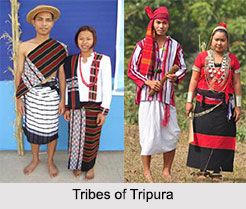
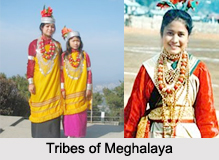
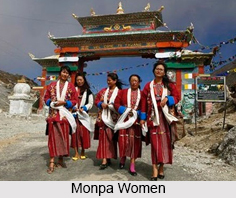
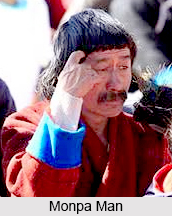
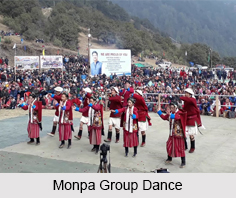
Monpa men wear Tibetan Chugba. Some of the people also wear trousers and coats along with a skull cap. The shirts of the men-folk are called `Endi` and it is worn in the Tibetan style. The short woolen trouser for men is called `Kangnom` and the full-length woolen trouser is known as `Dhorna`. The women of this community wear long length sleeveless chemise and warm jacket. They wear red coloured gown called `Shingka`. They also prefer to deck themselves with different types of ornaments of different materials. Rings, earrings, necklaces etc made of bamboo are sometimes embellished with turquoises and red beads.
Houses of Monpa People
The houses of the Monpa tribal community are constructed with wood and stones. Their floors are called plank floors and sometimes their doors and windows represent the art of excellent wood carving. Bamboo matting is used to make the roofs of their houses and it also keeps their room warm during the time of severe cold. Some houses also contain hearths and sitting platforms in the living room.
Festivals of Monpa Tribe
Several fests and festivals are celebrated by the Monpa people. Some of the major festivals of this tribal community include Losar, Ajilamu, Choskar harvest and Torgya. During some of these festivals including Ajilamu festival, the Monpa people perform pantomime dances. The people go to the Tawang Monastery during Losar festival.