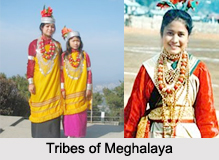
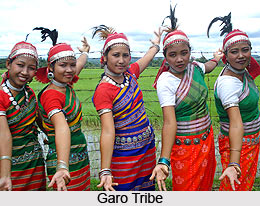
 Garo Tribes prefer to be called "A"chik" or "Mande". The Garos regard themselves as the descendants of a common ancestress, but scholars believe that Garos came from Tibet. The Garos are of the Mongoloid stock. By nature, the Garos are cheerful, peace loving and hospitable. Food, music and dance are the integral part of their lifestyle.
Garo tribes are located mainly in Meghalaya, Nagaland and districts of Assam like Karbi Anglong, Goalpara and Kamrup. They are also scattered in Cooch Behar, Jalpaiguri, Bardhaman and Dinajpur districts of West Bengal.
Origin of Garo Tribes
As per their earlier history, the Garos came to Meghalaya before 400 years from Tibet. They settled in the Valley of Brahmaputra River. The main language spoken by these tribes is Garo, also known as "Garrow" and "Mande".
 Language of Garo Tribes
The Garo language belongs to the Bodo branch of the Bodo-Naga-Kachin family of the Sino-Tibetan phylum. As the Garo language is not traditionally written down, customs, traditions, and beliefs are handed down orally. It is also believed that the written language was lost in its transit to the present Garo Hills. The Garo language has several divisions that are used among the Garos residing in each corner of India and abroad. The sub groups of Garo languages are known as Chibok, Megam, Matabeng, Ruga, Achik, Ganching, Abeng, Atong, Dual, Matchi and Gara. The Garo language has some resemblance with languages like Rava, Kok-Borok, Boro-Kachari and Dimasa.
Society of Garo Tribes
A matrilocal and matrilineal society is prevalent among the Garo tribes. Decent and inheritance are reckoned through the mother. The woman enjoys a higher status in the society. Community ownership of property prevails in the Garo society. The Garo tribe is sub-divided into different linguistic and cultural groups such as Aure, Chisak, Matchi-Dual, Metabeng, Ateng, Chibok, Ruga, Gara-Ganching, Megham, Dussani and Cheani. Monogamy is the general rule though Polygamy is allowed.
Traditionally women were excluded from the village administration. Widow Remarriage is prevalent amongst them. Among the Garos, the right of inheritance belongs to the female members of the family. The Garo society does not prefer inter-caste marriage. Youth dormitory is found among the Garos which is known as "Nokpanthes".
Occupation of Garo Tribes
Jhum cultivation is the main occupation of the Garo tribe during harvest. The economic life of the Garo tribes revolves around agriculture and farming. The hills in this region are suitable only for Jhum cultivation. Paddy, cotton, maize, millet and pulses are grown.
Religion of Garo Tribes
There are a huge section of Garo populace who has followed Baptism and Roman Catholicism. These Garo tribes follow almost all the rituals associated with this religion. Few of these Garo tribes are "Seventh-day Adventists, Anglicans" and the rest belong to some of the newly formed "denominations". Following the tradition of most of the tribes of the region, there are several of Garo tribes who still follow their conventional Animist-Hindu norms and customs.
Dances of Garo Tribes
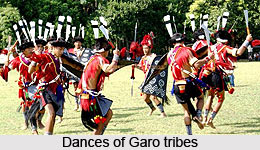
The Garo people are very fond of music and dance. Their dances can be categorized into 2 groups namely; "Santalo Chroka" and "Abani Kamrangko Mesokanirang". Moreover, Mi Sua, Koch, Napsepgrika, Kambe Toa, Rabha, Gaewang Roa, Ajema Roa, Chambil Moa, Dokru Sua, etc are the different dance forms of the Garo tribes. The Garos use different types of musical instruments like Chordophone, Aerophone, Idiophones and Membranophone.