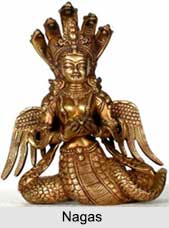
 Nagas are strange magical serpents often with human heads. Female Nagas are called Naginis. They can take on wholly human form if they so choose. The word "Naga" is a Sanskrit word and means snake and especially the cobra, which is a specific type of hooded snake. In Indian mythology, Nagas are serpent beings under the sea. They are human from the waist up and cobra from the waist down, and they have slate-coloured skin.
Origin of Nagas
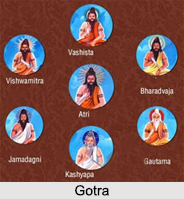
All Nagas are considered the offspring of the great sage Kashyapa and Kadru. Kadru was mother of one thousand Nagas. So the Nagas are also known as Kadrooja.
Legend of Rivalry between Garuda and Nagas
As a result of a foolish bet, Vinata, one of the wives of Kashyapa became enslaved to Kadru and her son, Garuda had to work for the snakes as a slave. When Garuda asked the snakes that what he would have to do in order to be released from his bondage, they told him he would have to bring them "amrita", the elixir of immortality. Garuda stole the elixir from the Gods and brought it to the serpents in fulfilment of their requirement, but prevented them from consuming it and achieving immortality. From that point onward, the arch-rivals of the Nagas became the gigantic bird-man Garuda.
Legend of Nagas in Indian Epics
In the great epic Mahabharata, Nagas are shown as creatures with negative character. They are also portrayed as the deserving victims of the snake sacrifice as described in the scriptures, the Puranas and of predation by the rapacious birdman Garuda. The Mahabharata describes them as "persecutors of all creatures", and tells us "the snakes were of virulent poison, great prowess and excess of strength, and ever bent on biting other creatures". The epic also describes Nagas having a mixture of human and serpent like trait.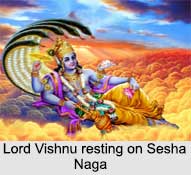
Religious Beliefs in Nagas
In India, Nagas are considered nature spirits and the protectors of springs, wells and rivers. They bring rain, and thus fertility, but are also thought to bring disasters such as floods and drought. The worship of the Nagas is believed to have emerged from the aboriginal inhabitants of the Ganges valley.
In South India, they are believed to be associated with fertility and prosperity and expensive grand rituals like Nagamandala are performed in their honour .The Nagvanshi of North India consider them as a descendant of Nagas.
According to both ancient and more recent belief, Nagas may be dangerous, but if treated with respect and won over with offerings of milk they might bring fortune and success for their patrons. Even today the real snake is also worshipped mainly in the country districts, at a special festival in the rainy season.
Famous Nagas in Indian Mythology
Some prominent names of Nagas are Sesha, Vasuki, Takshaka, Anant, Kanwal, Karkotak, Kalia, Aswatar, Padma, Mahapadma, Shankh, Kulik, Pingal, etc. Among the prominent Nagas of Hinduism are Manasa, Sesha and Vasuki.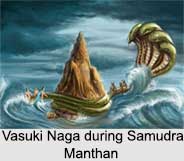
•Vasuki is regarded as the "King of the Nagas" who helped the Devas recover amrita from the Ocean of Milk.
•Sesha is the mighty seven-headed cobra on whose coils Lord Vishnu sleeps during the cosmic night-a wholly benevolent divinity, representing endless time.
•Manasa is the sister of both Vasuki and Sesha. She is an extremely furious Goddess for those who refuse to worship her while extremely kind to those who worship her with devotion.
Nagas in Buddhism
In Buddhist literature, Naga generally has the form of a large cobra-like snake, usually with a single head but sometimes with many. In Buddhist painting, the naga is sometimes portrayed as a human being with a snake or dragon extending over his head.
There are many stories involving the Nagas and they occupy an important place in the contemporary cultural traditions of Hindu religion.