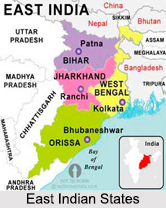
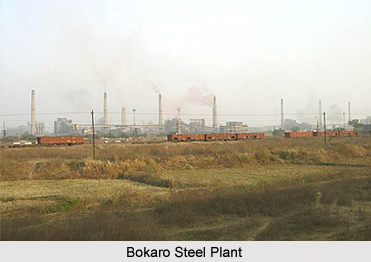
 Bokaro District is an administrative district of Jharkhand. This district was created in the year 1991 by carving out one sub-division consisting of two blocks from Dhanbad District and six blocks from Giridih District. The district headquarters, the Bokaro Steel City is having latitude of 23.29 and longitude of 86.09. Bokaro District has a geographical area of 2861 sq km. The average altitude of the district is 210 meters from mean sea level. Bokaro District is situated in the Chota Nagpur Plateau, the vast rolling topography of the city is typical, strewn by graded valleys and winding streams.
Geography of Bokaro District
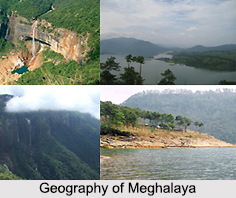
The district has a network of valleys and sub-valleys. Geography of Bokaro District includes Damodar River and its tributaries. They constitute an important source of water for the industries and townships, which have proliferated on the riverbanks in the last few decades. The gentle valley is interspersed by some hills and hillocks, which make it a magnificent landscape to view. Bokaro Steel City has a large steel plant managed by the Steel Authority of India Limited and several other medium and small-scale industries. The district is categorized into three natural formations and these are Central plateau, Lower plateau and Damodar River, Ganga River and Tenughat Valley. The district falls in tropic monsoon region.
Demography of Bokaro District
According to the Population Census in the year 2011, Bokaro District had population of 2,061,918 of which male and female were 1,076,270 and 985,648 respectively. The population of the Bokaro District constituted 6.25 percent of total population of Jharkhand. The average literacy rate of Bokaro in 2011 was 73.48 percent. If things are looked out at gender wise, the male and female literacy were 84.50 and 61.46 respectively. The total literates in Bokaro District were 1,306,155 of which male and female were 783,769 and 522,427 respectively.
Culture of Bokaro District
Culture of Bokaro District reflects the rich and indigenous traditions and beliefs of the people. Sarhul, Karma, Sohrai, Badna, Tusu, Id, Christmas, Holi, Dussehra, etc. are celebrated in the district. The different languages used by the people of this district are Santhali language, Mundari, Kurukh language, Khortha, Hindi language, Urdu language and Bengali language. The festivals are celebrated with immense enthusiasm and positive energy. Songs and dance forms are an integral part of the celebration of these festivals. The popular musical instruments used here are Bansuri, Arbansi, Shehnai, Madanvari, Singa, Sankh Mandar, Dhol, Dhak, Dhamsa, Nagara, Damama, Karha, Tasa, Jurinagra, Visamdhanki, Thapchanchu, Kartal, Jhanjh, Thala, Manjhira and Ghanta. The popular folk music of the district includes Akhariya, Domkach, Dohari, Domkach, Janani, Jhumar, Mardana, Faguwa, Udasi, Pawas, Jhumta and Pratkali.
Tourism in Bokaro District
Tourism in Bokaro District includes several places of interest like Bokaro Steel City, Garga Dam and Parasnath Hills, Bokaro Ispat Pustakalaya, Jawaharlal Nehru Biological Park, Chandrapura and Tenu Ghat. These places are worth exploring. Tourism in Bokaro District means a memorable experience that is filled with enjoyment and serenity. Bokaro District is well connected with other major cities of the state through roadways. Bokaro is popularly known as steel city, because the largest steel plant of the country is situated here.