Pravir Chandra Bhanj Deo - Informative & researched article on Pravir Chandra Bhanj Deo
 Indianetzone: Largest Free Encyclopedia of India with thousand of articlesHistory of India


in  
 Art & Culture|Entertainment|Health|Reference|Sports|Society|Travel
Forum  | Free E-magazine  | RSS Feeds  
History of India : Sources of History of India |Ancient History of India |Medieval History of India |Modern History of India |Indian Historical Dynasties |Indian Battles |Sepoy Mutiny 1857 |Indian Rulers |History of India |Indian Freedom Struggle |Indian Governor- Generals |British Indian Acts |Post Independence India |Iron Age in India
Home > Reference > History of India > Modern History of India > British Empire in India > Princely States of India > Indian Princes during British Rule > Pravir Chandra Bhanj Deo
Pravir Chandra Bhanj Deo
Pravir Chandra Bhanj Deo was the first Oriya ruler and the 20th Maharaja of the princely state of Bastar. Later the princely state was acceded to Union of India.

 Pravir Chandra Bhanj DeoPravir Chandra Bhanj Deo was the 20th ruler or Maharaja of the princely state of Bastar and the first Oriya ruler. The last ruler of the Bastar state, Pravir Chandra, ascended to the royal throne in the year 1936. Later the princely state was acceded to Union of India in the year 1948 during the Indian political integration. His Highness Maharaja Pravir Chandra Bhanj Deo was greatly admired by the tribals of the region. He was shot dead while leading a tribal movement in Bastar state on 25th March 1966. He was killed by the then Congress Government of Madhya Pradesh, as he fought for the cause of his subjects and supported the rights of the tribal people. Pravir Chandra was the last Kakatiya ruler of the princely state of Bastar and was venerated by his subjects.

Early Life of Pravir Chandra Bhanj Deo
Pravir Chandra Bhanj Deo was born on 25th June 1929. He completed his education from the Rajkumar College in Raipur, Madhya Pradesh. He succeeded the previous ruler and ascended to the royal throne on 28th October 1936.

Rule of Pravir Chandra Bhanj Deo
Maharaja Pravir Chandra Bhanj Deo of Bastar state was very popular among the people of the princely state, because he supported and encouraged the cause of the local tribal population. He also provided political leadership against exploitation of natural resources available in the region and corruption in land reforms. Therefore, the ruler of the princely state of Bastar was considered as a threat by the then ruling Congress party Government.

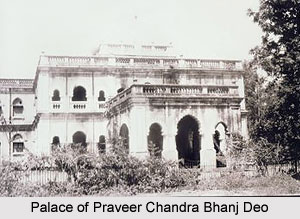
His Highness Maharaja Pravir Chandra Bhanj Deo was killed in police firing in 25th March 1966 at the steps of his own royal palace in Jagdalpur. Other than him, many other tribal people and the officials of the royal court were also killed. Officially the death toll was 12, including the Maharaja. The police had fired sixty one rounds and twenty people were severely wounded in the police action. Many of the other tribals and courtiers were murdered by the police too.

After the adverse incident, numerous tribals of the territory began to migrate to Andhra in order to escape the ruthless treatment of the local police force, with the support of the outside settlers. Due to the incessant Police violence and socio-cultural aggravation and harassment by the outsiders, who settled in the territory, the migration of the tribal people gained momentum. Further more, there was a steady decline in the tribal and native populations as a percentage of the total population.
(Last Updated on : 19/04/2012)
 
 
Dost Mohammad Khan Sayajirao Gaekwad III Krishna Raja Wadiyar IV
Chamaraja Wodeyar Jayachamaraja Wodeyar Krishna Raja Wodeyar II
Raja Sir Tanjore Madhava Rao Srikanta Datta Narasimharaja Wodeyar Maharani Kempa Nanjammani Vani Vilasa Sannidhana
Kanteerava Narasimharaja Wodeyar Bhupinder Singh of Patiala Saadat Ali Khan I
Saadat Ali Khan II Nawab Hamidullah Khan Ripudaman Singh
Sir Hira Singh Rana Ram Singh Rana Kirat Singh
Rana Nihal Singh Udaybhanu Singh Muhammad Ali Khan
Muhammad Mushtaq Ali Khan Hamid Ali Khan Raza Ali Khan
Pratap Singh Umed Singh II Umaid Singh
Jagatjit Singh Takht Singh Sadul Singh
Maharaja Ranbir Singh of Jind Raghubir Singh Ganga Singh
Swarup Singh Dungar Singh Bhim Singh II
Yadavindra Singh Shahoji II Tukojirao III
Krishnajirao III Rajaram II Bhagvat Singh
K. S. Digvijaysinhji Rajinder Singh Mahbub Ali Khan Asaf Jah VI
Jashwant Singh Ram Singh Afzal ad Dawlah Asaf Jah V
Mir Akbar Ali Khan Sikander Jah Asaf Jah III Nasir ad Dawlah Asaf Jah IV Daulat Singh
Fateh Singh Shahu IV Prabhu Narayan Singh
Zahir-ud-Daula Khengarji III Vijayaraji
Pragmalji II Deshalji II Madansinhji
Jai Singh Prabhakar Mangal Singh Prabhankar Tej Singh Prabhakar
Chithira Thirunal Balarama Varma Ali Khan Asaf Jah II Osman Ali Khan Asaf Jah VII
Azam Jah Ramachandra Tondaiman Vijaya Raghunatha Raya Tondaiman II
Pravir Chandra Bhanj Deo George Jivajirao Scindia Jayajirao Scindia
Muhammad Mahabat Khanji III Rasul Khanji Krishna Kumarsinhji Bhavsinhji Natwarsinhji Bhavsinhji
Mayurdwajsinhji Meghrajji III    
Recently Updated Articles in History of India
National Investigation Agency
National Investigation Agency (NIA) was created by the Indian Parliament to enable the detection, prevention, investigation and prosecution of terrorism-related incidents in India on a national scale.
Battle of Malpura
The crisis that developed in the relationship of Jaipur and Sindhia`s Government, nurtured the battle of Malpura.
Seige of Panhala fort
Seige of Panhala fort was undertaken by the joint forces of the Adil Shahi kingdom. Shivaji managed to successfully escape from this fort while it was still under siege by the Adil Shahi forces thus rendering the siege useless.
Purandhar Fort
Battle for Purandhar Fort saw a rather strong defence being provided by the Maratha forces. The battle ended in peaceful negotiations as it was realised by the offenders that they were merely losing their men and were nowhere near capturing the fort.
Battle in Poona
Battle in Poona saw a crushing defeat of the Mughals by the Maratha leader Shivaji. After the battle, the defeated Shaista Khan was transferred to the Bengal as punishment for embarrassing the Mughals with this defeat.
E-mail this Article | Post a Comment
Forum
Forum on History of India
Free E-magazine
Subscribe to Free E-Magazine on Reference
 
 
Pravir Chandra Bhanj Deo - Informative & researched article on Pravir Chandra Bhanj Deo
Sitemap
Contact Us   |   RSS Feeds
Copyright © 2008 Jupiter Infomedia Ltd. All rights reserved including the right to reproduce the contents in whole or in part in any form or medium without the express written permission of
Jupiter Infomedia Ltd.