 The Vedas are a large body of texts which originated in ancient India. Vedas are the oldest text of Hinduism and forms the most erstwhile layer of Sanskrit literature. The Shrutis` are known as the Vedas. The Vedas are the foundational scriptures of Hinduism. Since ages, the Hindus have received their religion through revelation and thus the Vedas stand as the direct intuitional disclosures, without any particular author to be credited.
Content of Vedas
The Vedas are thus eternal without a beginning and an end. The term Veda, originated from the root `Vid`, which means to know. The word Veda thus means knowledge. However when the expression "The Veda" is applied to scripture, it signifies the eternal book of knowledge. The storehouse of Indian wisdom the Vedas constitutes the fundamental principles of Hindu philosophy, a memorable glory to remember till eternity.
The Vedas mainly dealt with ritual, detailing religious ceremonies woven round gods and sacrifice. Brahmanism claimed to be the inheritance of the Vedic tradition. The Vedas are held to be divine truths revealed from time to time to the rishis in their supra-normal consciousness. All subsequent developments in Indian thought whether in the realms of religion, philosophy, ritualistic practices, civic conducts, social relations, and arts are to be traced to the Vedas. The whole life of a Hindu from the conception till the last rites on the funeral pyre has to be sanctified by the recitation of Vedic mantras.
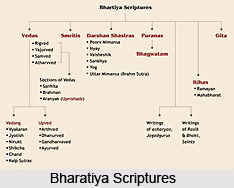 The subject matter of the whole Veda is divided into Karma Kanda, Upasana Kanda and Jnana Kanda. While the Karma Kanda or Ritualistic Section deals with various sacrifices and rituals, it is the Upasana Kanda or Worship Section which throws light about the various kinds of worship or meditation. The Jnana Kanda or Knowledge Section deals with the highest knowledge of Nirguna Brahman.
Significance of the Vedas
The Vedic philosophy was very synthetically and all embracing. All cosmic powers and manifestations are of the one nature. In each individual man is the divinity. All collective being is a form of the divine Narayana. God is in ourselves and we have to find him in ourselves. The Vedas have given us the living winds that still form the basis of Indian Culture - Brahma, is truth, Brahma is wisdom, Brahma is Infinite.
Vedas has given Indian culture the rich ideas associated with the concept of spirituality. God was visible to them in all animate or inanimate. One has to manifest the best, the divine, in themselves. This richer spirituality urged them to seek perfection in all arts, especially to systematise all branches of science and arts so that their inner and outer harmony may be fully brought out. Varnashrama Dharma was given by the Vedas. The social system was not based on any narrow ideology. All castes had their honourable place in society. Women also occupied an eminent place in the family, in the public, and freely participated in ceremonial functions and public debates.
The spiritual motive was continuously stressed. From the very commencement of life, people were initiated into the religious spirit. Education was imparted in Ashrams where love, duty and instruction were merged into each other that an integrated personality emerged. The Gurus provided guidance to the kings in administration and personal problems.
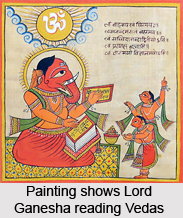 The Aryans have left rich psychological discoveries. The soul or the spirit never dies and before one could reach divinity there was number of planes like the `bliss` (Anand) Purusha and the Vigyana (super-mental) Purusha or planes of consciousness.
The Aryan culture was very dynamic and profound. Nothing could escape the intuitive vision of the Aryans. Matter, life, mind and world were analysed, dissected and studied. Aryans gave us the Sanskrit language which is regarded as the most perfect and scientific language in the world and has formed the basis of the science of philology.
Classification of Vedas
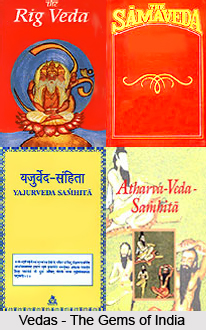
The Veda is divided into four great books: the Rig Veda, the Yajur Veda, the Sama Veda and the Atharva Veda. However, the general accepted historical chronology of the Vedas ranks the Rig Veda as the first, followed by the Sama Veda, Yajur Veda and finally the Atharva Veda. The Yajur Veda is further divided into two parts, the Sukla and the Krishna. Each Veda thus consists of four parts: the Mantra-Samhitas or hymns, the Brahmanas or explanations of Mantras or rituals, the Aranyakas, and the Upanishads. These four divisions signify the four stages in a man`s life.
Entwined with the rich philosophy, the Vedas are still regarded as the "accumulated treasury of spiritual laws discovered by different persons in different times".