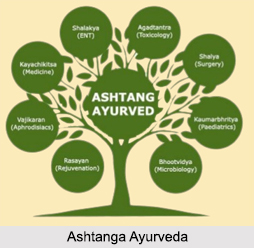
 Asthanga Ayurveda, the most ancient Indian medicinal science, dates back to more than 5000 years. It has its own way of imparting knowledge about how to lead a healthy life and avert diseases. Ayurveda explains the physiological conditions and pathogenesis of human beings on the basis of the humours, tissues and excreta. These constitute the basic fundamentals of Ashtang Ayurveda.
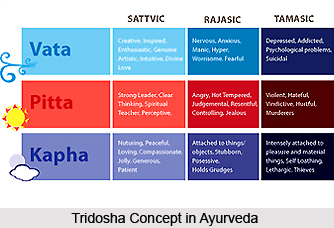
Doshas or humors are the bodily manifestations of the three supreme powers ---- air, fire and water. They effect coordination of all substances and structures of the body. Body types are regulated according to the three humors, namely vata, pitta and kapha. Vata initiates activity and motion and is concerned with perception, assimilation and reaction. In short, this humor is the basis for all communications within the tissues and cells. Pitta controls the chemical reactions taking place within the body, especially those associated with digestion. It initiates hunger, appetite, thirst and controls the emotions of hunger, fear and boldness. This humor is mostly predominant during the childhood and youth. There are mainly five types of pitta dosha. The third humour is kapha. It is the cohesive energy reserve of the body that solves problems, lubricates and provides support when needed. There are five types of kapha dosha, based on both anatomy and body functions. Anomalies in this humour may lead to feeble mindedness, respiratory disease, lethargy and weakness.
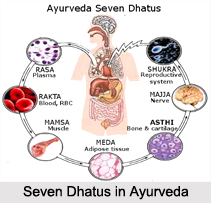
The tissues or dhatus are the foundation of the body which ensure growth and survival. There are seven tissues in all namely rasa, rakta, mansa, meda, asthi, majja and shukra. These tissues form a hierarchy within the body, each developing from its precursor according to the level of complexity. These dhatus are composed of the five mahabhootas or supreme powers-earth.
The Earth (prithvi ), water (aap), divine fire (tej), air (vayu) and universal space (akash). Agni or body fire plays a significant role in the creation of these tissues. The rasa dhatu, derived from digested food, nourishes each and every cell and tissue of the body. Rakta or blood, considered to be the basis of life, provides vigor and shine to the body by nourishing the muscles and intellect. Mansa, a derivative of blood, is concerned with providing physical strength and stamina to the body.
The meda dhatu is actually the adipose tissue that provides energy and lubricates the body. Bony tissues and cartilages are the components of the asthi dhatu. Asthi acts as a backbone to the muscular tissues. Majja is in fact the yellow and red bone marrow that fills the bone cavity. Its main functions include nourishing the semen, providing viscidity to the body thus increasing endurance and giving a shining appearance. The shukra dhatu originates from the core of majja. According to Ashtang Ayurveda, shukra is the most important of the seven dhatus because in it lies the seeds of new life. The primary function of this reproductive tissue is to help in reproduction.
The malas or excreta are those products, which the body needs to eliminate to assure proper metabolism. The excreta are removed from the body in three forms: mutra (urine), purisha(faeces) and sweda (sweat). Mutra, formed as a result of complex metabolic processes carried out by the kidneys, eliminates excess of fluids from the body. The undigested solid part that is left after absorption and assimilation is purisha. It is removed through the rectum. Sweda or sweat goes out of the body through the skin. It regulates body temperature and keeps the hair moist.
Thus, we can draw the conclusion that the humors, tissues and excreta form a cycle within the body maintaining the body in right condition. If this cycle is hampered, the bodily functions are hampered and the body needs immediate treatment.