Duties of Common Man, Jainism - Informative & researched article on Duties of Common Man, Jainism
 Indianetzone: Largest Free Encyclopedia of India with thousand of articlesIndian Religion


in  
 Art & Culture|Entertainment|Health|Reference|Sports|Society|Travel
Forum  | Free E-magazine  | RSS Feeds  
Indian Religion : Vastu Shastra |Indian Religions |Indian Myths |Indian Mythology |Gods of India |Goddesses Of India |Religious Thinkers of India |Types of Religion in India |History of Indian Religion |Indian Yogis |Ajivikas |Sacred Scriptures in Indian Religion |Tantrism |Shaivism |Indian Communities |Sacred Animals in India |Roman Impact on South Indian Art and Society |Bhattacharyas |Indian Classical Terms
Home > Society > Indian Religion > Types of Religion in India > Jainism > Duties of Common Man
Duties of Common Man, Jainism
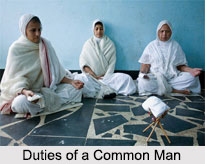
Duties of a Common Man hold a prominent position in the Jain Philosophy. The philosophical tenets of Jainism say that a layman should have complete faith in the teachings in the guru and necessarily must follow the path of righteousness.
More on Duties of Common Man, Jainism
  Daily Rites of a Common Man   Rites on Special Occasions    

 A common man who has the knowledge of the true doctrine of the true god (Deva or Jina) and the right master (guru) and who is free from 5 offences and does not have any doubt about the faith, the teachings and things does not have indecisiveness in acknowledging the truths of Jainism and has admiration and recognition of other believers such a layman can take upon himself to fulfil the 5 "small vows" (Anuvratas).

1. Ahimsa, not to kill or injure a living being intentionally. This precept does not apply to human beings alone, but also to animals which are not .allowed to be slaughtered for the purpose of eating meat or for the performance of sacrifices. Even immobile beings, like plants, should not, as far as possible, be harmed.
2. Satya, to say the truth, i.e. not to lie,
3. Asteya, not to steal, i.e not to take what is not given.
4. Brahmacharya, to live in chastity.
5. Parigraha-tyaga, not to desire new things greedily, but be satisfied with possession whose limit that is set by one is not crossed.

Observing the Auvratas mentioned above is supported by the observance of the following the Gunavratas.
1. Dig-vrata. The layman takes upon himself to extend his journeys in each direction only up to a definite point (e.g. Himalayas in the north).

2. Upabhogaparibhoga-vrata. He vows to make use of only number of things necessary for life, and to avoid the others. This vow also includes observance of the injunctions about food according to which nothing should be enjoyed that is obtained by harming living beings, and a number of activities are disallowed which cold harm the beings by practising them.

3. Anarthadanda-vrata. He vows to keep himself away from all that is harmful, neither to wish bad to someone, nor to cause others to do bad, neither to use weapons or other things causing injuries, nor to commit reckless acts.

Besides these there are 4 Siksa-vratas:
1. Samayika-vrata: A layman vows to meditate daily in imperturbable peace for one or several Muhurtas (i.e. 48, 96, 144 minutes). This happens in the morning, at the noon time and in the evening.

2. Desavakasika -vrata: He vows not to leave certain boundaries for a definite period, not to used things, eatables, etc.

3. Posadha-vrata: He vows to fast through 24 hours on (usually four times in a moon-month) and live is monk.

4. Atithisamvibhaga-vrata: He vows to offer to guests, particularly monks, what they need by right.

One more vow is taken by many pious people: they vow to accept death by starvation by voluntarily renouncing all foods. Vow is carried out mostly by old people who feel that their end has come, but also by persons who are completely healthy because they hope to attain mundane salvation by this act of highest renunciation for the sake of complete perfection, a layman is not satisfied by observing these vows; he also observes pratimas which bring him closer to asceticism. They are:

1. Darsana means belief in the Tirthankaras, right teacher and the Jaina-faith.

2. Vrata means accurate observance of the 12 vows.

3. Samayika means three meditations daily.

4. Posadhopavasa means fasting on full-moon and new- moon days and on the 8th and the 14th of every half of a lunar month.

5. Sacitla-tyaga means abstinence from eating of living beings, i.e. not only animals, but also fresh vegetables.

6. Ratri-bhukta-tyaga: Avoiding eating of living between sunset and sunrise.

7. Brahmacharya.

8. Arambha-tyaga. Giving up all worldly activities, involving injury to living beings (like building a house, etc.)

9. Parigraha-tyaga: Giving up possession (by distributing it to children and others, renouncing the service of house-servants, etc.).

10. Anumati-tyaga (Anumodana): Renunciation by a pious man of the proper food that is prepared for him and eating only that what has been left over.

11. Udista-tyaga: Acceptance of monk`s dress and looking for a temple or solitude to meditate there without being disturbed.

These 11 Pratimas are the stages of perfection. A layman obtains them one after the other, and while doing so, maintains the vow of the each preceding last stage corresponds practically to monk hood, only that the consecration of the order is missing. The significance of the persons who observe the precepts of the last Pratimas is especially great among Digambaras. They consider that those who have given up wearing of clothes are perfect ascetics. They are approximately equally respected like the ascetics among Swetambaras.
(Last Updated on : 24/05/2010)
 
 
Theories of Knowledge Vardhamana Teachings of Jainism
Digambara Sect Jainism in South India Jain Religious sites in Rajasthan
Arhatas King Siddartha Lord Parshvanatha
Avasarpini Kalpasutra Principles Of Jainism
Jainism in North India Jainism in Gujarat Jains under Islamic Rule
Jainism in the Deccan Jains under Hindu Rule Decline of Jainism in India
Duties of Common Man History of Jainism in India Jain Tirthankaras
Non-Canonical Jain Literature Jain Society Jain Sects
Rituals in Jain Temples Tattvartha Sutra Influence of Jainism on Indian Culture
Acharya Bhadrabahu Mukund Lath Somadeva Suri Acaranga Sutra
Jain Rituals Jain Reformers Jain Customs
Deities of Jainism Yakshas and Yakshanis in Jainism Religious Scriptures of Jainism
Arihant in Jainism Jain Pilgrimages in India Worship in Jainism
Sutras of Jainism Bhavnas in Jainism Moral Values in Jainism
Vows in Jainism Siddha, jainism Four Orders of Jainism
Origin of Jainism    
Recently Updated Articles in Indian Religion
Lord Subrahmanya
Lord Subrahmanya Swamy is considered to be the universal lord who blesses human beings and helps them get rid of their sins.
Gods of India
Gods of India form an inseparable part of the life of the people. Indian Gods are considered to be mysterious superhuman beings who are worshipped in this country in various forms.
Folk Gods of Kumaon
Folk gods of Kumaon have a rich history and they provide expression to the famous and popular ideas of the people.
Seven Sisters
Seven Sisters are the most famous among Dravidian deities in Southern India. The seven sisters also have a younger brother Potu Eazu.
Savitr
Savitr is a solar deity and off-spring of Vedic deity Aditi. Savitr has been mentioned in eleven hymns of Rig Veda.
E-mail this Article | Post a Comment
Forum
Forum on Indian Religion
Free E-magazine
Subscribe to Free E-Magazine on Society
 
 
Duties of Common Man, Jainism - Informative & researched article on Duties of Common Man, Jainism
Sitemap
Contact Us   |   RSS Feeds
Copyright © 2008 Jupiter Infomedia Ltd. All rights reserved including the right to reproduce the contents in whole or in part in any form or medium without the express written permission of
Jupiter Infomedia Ltd.