


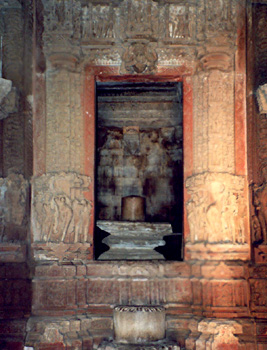
 The temple of South India is generally divided into various structures. The structures of the South Indian temples are namely Garbhagriha, Ekalinga, Alinda /Ekasala, and Dwisala. The temple of South India is generally divided into various structures. The structures of the South Indian temples are namely Garbhagriha, Ekalinga, Alinda /Ekasala, and Dwisala.
Garbhagriha: Garbhagriha itself fulfils the purpose of a temple. The annexures are only supplementary in nature and their presence is not out of necessity. The temple may Have no annexures also. The Padmasamhita explains the temple structure as one built like a chariot: Ratha consists of a single cell which represents Garbhagriha to house the sacred idol, i.e., a Charabera, surmounted by lofty Sikhara like structure. A simple curvilinear structure situated in front of Hucchappayya Matha at Aihole is another example. A chatuska with the top covered when used for the purpose of a temple serves as Garbhagriha; this structure is known as 'Dhruva' when no annexures are added to it. Ekalinda: The structure that was noticed earlier beside Ravalphade cave at Aihole had garbhagriha with four pillared porch or Mukhamandapa. There is also another flat-roofed sanctuary with an adjoining four-pillared porch in the same location. Scholars have identified similar structures from the Gupta period. These are known as Ekalinda-rachana. The porch or Mukhamandapa represents Ekalinga Similar structures are also seen at Mahdkuta with curvilinear Sikhara Sangamesvara temple structure is with a Garbhagriha and a porch. The porch is provided with Kaksasana. The MdnasoUasa has described four types of Ekalinda-rachana of which Purvalinga is of common occurrence. Alinda or Ekasala: When Alinda is situated on all the four sides it is known as 'Vijaya'. Such a temple structure is a rare occurrence. However, presence of Alinda on the four sides leads to formation of Parikrama or Paribhrama. Devakosthas are also seen in this space: (Alindena pariksipta sasima devakosthakam). Ekasala consists of a Chatuska in the middle portion surrounded by Alinda and a Mukhamandapa in front. This is almost a Sabha structure. Sabha is a general term technically adopted by Vastu to mean specific public place. Ekasala structure when adapted to a temple, the central Catuska is covered by Bhitti and a door-frame fixed in the east. Alinda is also covered by Bhitti or Jalaka on the three sides, adding Chatuska to form Mukhamandapa in the east. Mukhamandapa is also provided with Bhitti or Kaksasana. Dwisala: In Dwisala structures two Ekasalas are added one in front and the other on the rear side. The rear side Chatuska will be a closed structure with Garbhagrha shifted to this portion. The central Chatuska remains with Alinda form Navaranga. The front Chatuska will be the usual entrance to the temple. There are several other temple structures which are evolved from Sabha. One such example is Gaudaragude at Aihole. This has been developed by reduction of Alinda space side wards as well as in the back portion. |
| |||



Home > Art & Culture > Indian Monuments > Arts in India > Indian Architecture > Religious Influences on Indian Architecture > Hindu Architecture > Temple Structures of South India
Temple Structures of South India
| Temple Structures of South India have been divided mainly into four parts. Each of the four parts within the temple has a different function and is also structurally different from each other. |
| ||||||||||||||||||||||||||||

