
 Folk Paintings of Bengal emerged as a popular medium of cultural expression developing comparatively with a stroke of independence from the conventions of temple art and free from the influences of a royal court. The Patachitra scroll painting, a form of folk art comes from the eastern part of India mostly from the state of West Bengal and Bihar. The Bengali scroll tradition is a very old one, featuring single picture paintings or long perpendicular multi panelled scrolls recognized as `patas` (paintings) or `jorana patas` (scroll paintings).
Rural Bengal`s painted scrolls and pats are one of the few genuine folk traditions surviving down to the present century. In the villages of Bankura district, Birbhum district, 24 Parganas and Burdwan district, one can still see the patuas (the makers of the pats) selling their pats and selling these paintings at the various village fairs.
History of Folk Paintings of West Bengal
The history of `patachitra` or scroll painting in Bengal goes back to more than 2000 years. Rustic bards and story-tellers in previous times would use these scrolls which had pictures representing a variety of events and themes of the stories they would tell. It was the only school of painting which flourished in Bengal in the 19th century and was the traditional art of scroll paintings which was admired in the rural areas. These paintings were done on cloth or patas. They depicted conservative images of gods and goddesses and scenes from epics like Tulsidas"s "Rama Charita Manas". The artists were villagers who travelled from place to place with their scroll paintings and sang the scenes commencing the epics depicted in the paintings in village meetings and festivals. These artists, called patuas or "painters on cloth" were said to be half Hindu and half Muslim and practised Islam. 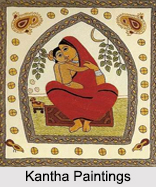
Types of Folk Paintings of West Bengal
There are different types of Folk Paintings of West Bengal and these are mentioned below:
Patachitra: It is the painting generally made on tasar silk cloth. The traditional colours used in the patachitra art are red ochre, indigo, green, black and white all obtained from the usual sources like Hingula, Ramaraja, Haritala, lamp black, and shells. Though, all draw pictures in a traditional way unusual to them about Hindu mythology and different social issues.
Bengal Pat: The original art form which developed in Bengal came to be recognized as Bengal Pat. Paintings are made with dyes made from spices, earth, soot, etc. and replicate the life and times of the society and myths. The usual colours used in Bengal Pat are red, indigo, green, black and ochre. Bengal Pat has a very exciting approach to it. Some paintings represent spoofs on traditional social practices, hence attempting to highlight them for change. Some of these artists started depicting these stories on cloth scrolls for conservation and beatification.
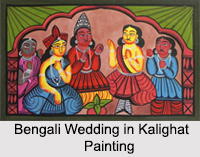
Kalighat Pat: Kalighat Pat was invented in the 19th century Bengal, in the locality of Kalighat Kali Temple, Kalighat and Kolkata and from being items of reminder taken by the visitors to the Kali temple, the paintings over a period of time developed as a separate school of Indian painting. From the interpretation of Hindu gods and other mythological characters, the Kalighat paintings developed to reproduce a variety of themes.
Batik paintings: These are very popular in West Bengal and artists create some striking paintings depicting village life and Hindu Gods. Artists now produce colourful Batik paintings not only as paintings but also as designs on Sarees, Kurtas and other clothing.
Kantha: It is a traditional embroidery form of Bengal which is done both on cotton and silk materials and involves mainly floral, birds and animal motifs. It is used mainly on Dhotis and Sarees which form the traditional male and female attire of the locals. Apart from these, Kantha motifs are also used on blankets, bedspreads, table cloths, etc.
The folk paintings of Bengal represent a sense of collective identity of the artists of Bengal beyond the barriers of cultural racism once faced by Bengal. Folk paintings of Bengal truly express such.
Folk Paintings of West Bengal
Folk paintings of Bengal are known as Pats and their creators are the patuas. The pats comprise pictures arranged in rectangular panels, usually dealing with mythological themes.