


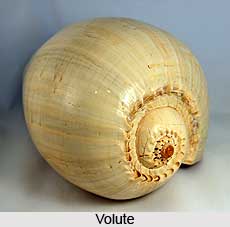
 Volutes are deep-sea gastropods principally found in tropical seas. They are famous for their smooth and shining shells of bright and varied colours. They differ exceedingly in form and size; some are globular, others oval; some turreted and other with a small spire. They have no operculum. The animal inhabiting the shell has a distinct head and two short triangular tentacles with eyes at the base and long proboscis or trunk. The foot is large. Under this large group India has some unique and beautiful representatives - the Melon shells, the Harp shells and the Olives. Volutes are deep-sea gastropods principally found in tropical seas. They are famous for their smooth and shining shells of bright and varied colours. They differ exceedingly in form and size; some are globular, others oval; some turreted and other with a small spire. They have no operculum. The animal inhabiting the shell has a distinct head and two short triangular tentacles with eyes at the base and long proboscis or trunk. The foot is large. Under this large group India has some unique and beautiful representatives - the Melon shells, the Harp shells and the Olives.
The Melon shell is familiar - a large, long ovoid, dome-shaped, smooth, yellowish orange shell generally carried by hermits and sadhus to receive alms, drinking water etc. The animal that owns this shell is Melo indica. It lives in waters five to seven fathoms deep in Palk Bay and Pamban area. The shell measures over twenty centimetres and the animal is often larger than the shell. It prefers a bottom where sand and mud are mixed. It is carnivorous and its radula contains s small number of formidable teeth. In adult shells the spire is hidden by the inflated and overgrown body whorl. The inner lip of the shell mouth has strong folds or pleats. The animal - its foot, mantle and head - is striped like a tiger with yellow and black. While crawling, the shell is engulfed in the folds of its gorgeous mantle. 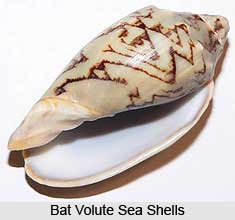 Melo deposits her eggs in capsules, hundreds of them arranged in a honeycomb-like fashion, attached to a vertical stem, thirty centimetres in height and the whole structure resembling an elongated pineapple - the capsules representing the bracts. The animal carries this curious looking egg-mass with her until the young ones are free.
Harp shells (genus harpa) are so called because the shells have a short spire and the longitudinal ribs on the body whorl look like the strings of a harp. The shell is thick-walled, large, exquisitely polished and the interspaces between the ribs are ornamented with crescent-shaped patches of golden yellow. The inner lip is smooth and polished. The foot is enormously developed - broad in front and pointed behind and with a lappet on either side. The expanded foot can be seen clearly when the animal moves. The head is small with thick, close-set, sharply pointed tentacles. The mantle lobes turn back over the shell, so protecting it from abrasion and scratched and accounting for its high polish. The animal lives in rock pools among coral reefs in the Gulf of Mannar and Lakshadweep, feeding on sea organisms. Like certain snailsand razor-fish, Harpa also has the habit of amputating part of its foot to escape from the grip of dangerous enemies. It presses the shell lip over the foot and cuts off the exposed part. The animal is capable of reproducing the lost part in due course. Olives are all handsome volutes ranging from one to five centimetres in length. The shell has a conical, short spire and a long ovoid or cylindrical body whorl. The mouth opening is narrow and there is no operculum. The animal is larger than the shell and when it moves the folds of the mantle cover the shell to a great extent. The mantle is produced into a tentacle behind, which serves as a rudder while the animal moves. Olives are all carnivorous and very active. They burrow in wet sand in quest of bivalves on which they feed. Certain species can also swim by expanding the lobes of their foot. Olives are famous for their glazed polish and fantastic colour design. Along the Indian shores and around Lakshadweep several beautiful species are common. Fishermen collect them from knee-deep water below low-tide mark by turning the sand over with their feet. Among them all Oliva porphyrea is the most attractive. It has a depressed spire and a prominent body whorl measuring five centimetres long. The surface colour is cream with black zigzag streaks. Sacred Chanks, belonging to the genus Xancus, are the most prized and popular volutes in India. The shells are heavy, pear-like in shape and snowy white in colour. The living shell is invariably covered by a golden brown periostracum. It has a narrow operculum. The chank (often called conch) is not merely a volute but a happy combination of a grace of a volute and the sturdiness of a whelk. In anatomical details, habits and larval development the Chanks resemble Whelks; but in elegance, grace and weight they are unique. Chanks are found only in Indian waters and that too in the Gulf of Mannar, Palk Bay, and coasts of Tinnevelly and Tuticorin and on the Kathiawar coast. The mouth of the shell is wide, ending in a hollow beak. The beak encloses the animal's siphon which can sense its prey, particularly sea worms. The inner margin of the aperture (the columella) is thickened and bears three or more prominent ridges. |
| |||



Volutes
| Volutes are sturdy and compact shells which are found in parts of Gulf of Mannar and various other places like the Lakshadweep in India. |
| ||||||||||||||||||||||||||||

