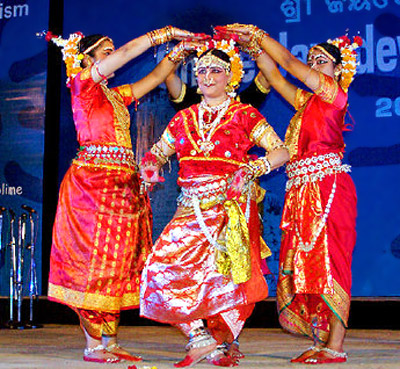
In the Jagannath Temple of Puri the dancing girls were appointed for the essential ritual service of the deity. All the female attendants of the temple are known as Mahari devadasis. They are again divided into several groups according to their services. The dancing girls are known as Nachuni and the others are Bhitara Gauni and the Gaudasani are those whose duty is to fan the lord. Their accompanists are all males. They are Veena-kara, the Veena player and the Madala, the Mardala or the Pakhwaj player. The nachunis perform in the nata mandir or hall of dance which is a part of the temple building or near the Garuda Stambha or the ceremonial flag staff outside the temple. The Bhitara Gaunis who constitute an exclusive group are permitted to the sanctum sanctorum of the temple and it is they who are allowed to dance and sing at the time of Bada singara or bed-time every night. The Bahara Gaunis are on the other hand not permitted to enter the innermost sanctuary of the temple.
The Mahari devadasis are forbidden to enjoy the company of men. They are to dance for ceremonies and festivals connected with Lord Jagannath. After the initiation, they are always to adorn themselves with the mark of tilak. They are not supposed to partake of food prepared at home. They are to wear clean clothes on the days on which they have to dance; they are not to speak with any man. The Mahari devadasis are to be conducted to the temple by the Mina Nayak. At the time of performance, they are not to look at the audience. Their dance must strictly follow the shastras. The Maharis must dance in the following talas: Pahapata, Sarimana, Parameswara, Malashree, Harachandi, Chandan Jhoola, Shreemangala, Bachanika and Jhuti Atha-tali. They are to perform bhava only from the Geeta Govinda.
The Maharis are initiated into the order after a compulsory marriage with the God. In a simple ceremony a piece of new cloth is taken out from the idol and is tied around the neophytes head. After this ceremony, a Mahari devadasi begins her service as a dancer. The Maharis dance in the temple according to their terms. Whenever they have to dance they come to the temple after a purificatory bath. The Rajguru always presents himself during the dance as a representative of the king. Holding gold mounted cane as a symbol of authority, he stands near the dancer. The Mahari devadasi prior to her performance pays her obeisance to the deity and then bows to Rajguru. Then she begins her dancing to the accompaniment of Mardala and Gini. The dance that takes place in the nata mandira during the morning offering conforms to pure dance that is nritta.
 There is no song accompaniment to this dance. The second dance takes place during Bada Singar or bed-time in the innermost sanctuary exclusively for the deity. Here the dance is expressional and the songs used for accompanying the dance are taken from Geeta Govinda alone.
Another class of Maharis were known as Samprada Niyoga whose duty was to dance during the ceremonial processions of the deities.
Mahari devadasis are not attached to the Vaishnava shrine of Jagannath alone. They are also attached to the Shakti shrines of Mangala at Kakatpur in Puri District and a temple at Khambakul in Cuttack District. They not only dance in the temples but also dance on social and religious festive occasions. In some other parts of Odisha they are also known as Guni. But the Gunis had no connection with the temples. They used to sing and dance during social festivals or in the courts of rajas and zamindars.
But in the present days, the class of dancing girls is almost completely extinct and only a few old Mahari devadasis are continuing the tradition of dancing in the temples.