 Snails form the largest group of molluscs with only one shell. They are present in a diverse range of environments which include deserts, ditches and abyssal depths of the sea. A large variety of snails can also be seen in freshwater. Several snails are herbivorous. But some land species and a large number of marine species of snails are predatory carnivores and omnivores. Snails possess thousands of tooth-like structures, which help them to rip off the food into pieces.
Classification of Snails
Snails breathing with the help of lungs belong to the pulmonata group and snails breathing with the help of gills belong to the paraphyletic group. It can also be said that snails having gills are segregated into several taxonomic groups, which are not closely related to each other. Snails possessing lungs and gills are scattered in abundance. Several species having lungs are seen in freshwater, while a very small number of species possessing lungs are seen in the sea. Lesser species of snails having gills are seen on land.
Types of Snails
There are many kinds of snails, varying widely in habits and structure. There are lung-breathing land snails or terrestrial snails, freshwater snails and sea snails. All these different kinds of snails are widely distributed throughout the world. People are more familiar with terrestrial snails. The marine snails form a huge majority of snail species and possess a large diversity and a bigger biomass. Land snails form a minority. The different types of snails are described below.
•Land Snails
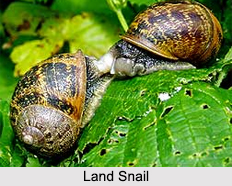
Land Snails live on land and depend on moisture for survival. These snails have two pairs of tentacles on the head; a short pair in front and a long pair a little behind. The hinder pair has an eye at the tip of each tentacle. These snails can contract and completely withdraw these tentacles into a hollow in the head. They have slime-coated and trailing body which comes out of a roundish spiral shell. This kind of snail has strong muscular foot. Land snails use mucus for two reasons. Mucus allows them to crawl over rough surfaces. It helps them to keep their soft bodies from drying out. A land snail moves so slowly that in English `a snail`s pace` is often used for very slow movement. Land snail, Indrella Ampulla is brightly coloured and has been traced in the Western Ghats.
•Freshwater Snails
Freshwater Snails or pond and river snails are lung-breathing snails, similar to the land snails. In these molluscs, the eyes are situated at the base of the tentacles, of which there is a single pair. The tentacles are capable of contraction but cannot be completely withdrawn into the hollow of the head. Two genera of pond snails are common. They are Lymnaea and Planorbis. Lymnaea has an elegant shell. This shell has a conical spire. This snail species is known for its worldwide distribution and unlimited capacity to adapt to physical extremes. One species has been recorded at an elevation of over 5000 metres in the Himalayas. Although Lymnaea has reacquired the habit of living in water, its lung is still functional. Visits to the surface are necessary for the snail to obtain air. The shells of Planorbis are flat-coiled and sinistral. This species also has a worldwide distribution.
•Sea Snails
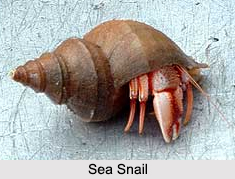
Sea Snails vary widely in shape, habits, etc. There are top and turban snails and perwinkles and violet snails. Top and turban snails are familiar univalve molluscs found on all seashores. They live on mud-covered rocks of the intertidal region. Considering their internal structure, they are reminiscent of the primitive gastropods, like limpets. They possess a radula and have numerous tiny teeth for grinding sea plants. Their shells are fairly heavy, usually brightly coloured, ornamented outside and pearly within. Species like Trochus Radiatus and Clanculus Depictus have conically spiral shells carrying rows of small smooth tubercles and coloured designs of red and greyish blue. They have a flat base. Their shell-lids are thin and made of lime. Turbo is a large turban-shaped shell with rounded whorls. It is brownish or greenish in colour. It is rounded at the base and have circular, thick and hemispherical upper column. The shells of turbo have commercial value for the "mother-of-pearl" contained in them.