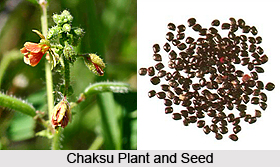
 Chaksu is known as an Indian medicinal plant and has been used among the people of India for umpteen numbers of medicinal properties. It is an erect and annual herb mainly used for its medicinal properties. Though this plant has a foreign origin, it is found throughout most of India, commonly in open habitats and wasteland, ascending up to 1500 metre in the Himalayas. The botanical name of this plant is Cassia Absus L. In India, people of different regions use this plant for treating diseases.
This plant is commonly known as "Chaksu"; in Hindi, Bengali, Punjabi and Urdu and "Chakshushya" in Sanskrit. The flowers of Chaksu are yellow or red-dish-yellow in colour and borne in narrow leaf-opposed. Fruits of Chaksu are compressed, thin, linear oblong, and are clothed with bristly hairs, elastically dehiscent. Chaksu bears flowers during August to February depending on locality. It is sticky plant that attains a height of about 1-2 foot. Leaves are combined, leaflets are four in number.
Chemical Constituents
The seed of this herb contains various oils, alkaloids and minerals like calcium, phosphorous, iron and zinc. Besides these it also contains vitamins like thiamine and riboflavin.
Parts of Plants Used
Almost all parts of this plant are used for medicinal purposes. All in the form of paste or powder are used to cure several diseases.
Uses of Chaksu
It is very helpful in urinary tract disorders and acts as diuretic. It also helps in avoiding the loose stool and binds the digested material. It finds its application when it is used locally. Its alkaline nature helps in scrapping of the extended skin. It is very effective in skin related problems. In the Unani System of Medicine, the plant forms a constituent of a compound drug used to treat leprosy. It is also helpful in reducing body fats. It is also helpful in elimination of poison from the body. Apart from these qualities, the Chaksu plant also helps in the following health ailments:
•The leaves and the seeds are used for treatment of anaemia, asthma and hiccups.
•The seed extract is used to purify blood and to treat mucous disorders. A decoction of the seeds is used to treat certain eye diseases.
•The baked, powdered seed kernels are used in the treatment of ophtlialmia and conjunctivitis.
•The bitter, astringent leaves are used as a purgative and as a remedy for coughs, asthma and bronchitis.
•Application of the powdered leaves is reported to heal venereal ulcers and haemorrhoids.
•They are used as a cathartic in cases of habitual constipation, and for the treatment of ringworm, venereal ulcers and other skin diseases, for relieving pains, headache, bronchitis, leucoderma, asthma, haemorrhoids and as an anthel-mintic.