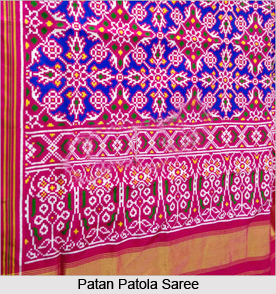
 Patola is the "Queen of "Silk". The name patola is derived from the sanskrit word "Pattakulla". From AD 700, "Patt" is used to describe silk cloth. Thus, patola saree creation is an age old art and was extremely famous among the royal families and aristocrats. A typical patola saree is a single or double ikat silk saree and requires the resist dyeing process of warp & weft technique. Patola sarees symbolizes fervent craftsmanship not only in terms of skill, variety and innovation but dedication and patience. It is not only hand woven, but extremely laborious as creation of one patola sareee by 3 people would take almost 4 to 6 months. The time consumption also depends on the complexity of the design and its length. This saree is generally used for festive clothing.
The Patola fabric has Gujarati origin. Patola silk is the contribution of a community called the Salvis, a class of Jains. They were the first people to manufacture patola fabric. This saree is also known as "Patan Patola" as the skill of producing this saree originated in a small town of Patan, which is 127 kilometres North of Ahmedabad, capital of Gujarat.
History of Patan Patola Saree
Religious texts of Ramayana and Narsinha Puran are believed to have the earliest mentions of patola. These texts also highlight that patola was a part of the South Indian culture too. Even today there is a huge demand for patola silk sarees in South India.
Patola sarees are of great antiquity. Around twelfth century, the Salvi weavers from Karnataka and Maharashtra settled in Patan under the patronage of the royal Solanki Rajputs. Since fourteenth century, Gujarat started exporting patola sarees to South East Asia. With the fall of the Solanki dynasty, the Salvi"s were patronized by the wealthy Gujarati merchants. Since then, patola sarees became a vital part of Gujarati women"s clothing.
Features of Patola Sarees
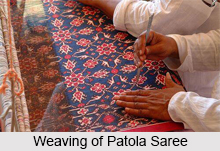 The most unique feature of this saree is that even after one wears and washes this saree frequently it will never fade in color and design. This is because of the use of resist dyeing process of tie and dye on both the warp and weft silk fibres. One would be able to see animal, bird, human figures and flowers typically on this saree. These sarees are remembered for their vibrant colors. Presently, well defined geometric patterns interwoven with folk motifs dominate the creation of this saree. More specifically, there are three kinds of designs. Pure geometric designs and Islamic architectural embellishments are found on these sarees and ajrak. Ajrak is the complex geometric print of the Sind. Therefore, various geometric shapes like squares, boxes and strips characterize patan patola saree. These shapes and patterns on the patola sarees symbolize clarity and precision. Another noteworthy feature of this saree is that it is endowed with a unique combination of art silk sarees and printed silk sarees. It is possible because of the presence of same design on both sides of the saree. Today these sarees are also laiden with kundan and zardosi sequins, owing to which these sarees look heavy.
Process of Making Patola Sarees
The process of tie and dye involved in making patola silk sarees uses natural dyes like cochineal, indigo, kesudo, catechu, marigold flower, turmeric, katha, madder roots, ratnajyot, kesudo, pomegranate skin, manjistha and henna to name a few. Vibrant colours of the silk saree or fabric is a result of these various kinds of dyes. Mordents like potassium dichromate, ferrous sulphate, alum, copper sulphate and tin chloride are also used in this process. The warp and the weft threads are tied to stop the dyeing in those areas according to the pattern of the design. This process is repeated for all of the colors that would be there in the final woven fabric. This special technique of dyeing both the warp thread and the weft thread is known as double ikat. It requires one to be extremely skilled, experienced and immensely patient to tie the warp and the weft threads, so that a particular pattern emerges neatly and beautifully.
Types of Patola Sarees
The resist dyeing process of warp & weft technique is used to produce two different kinds of patola sarees, namely, "Rajkot Patola" and "Patan Patola". While the former is vertically resist dyed, the latter is horizontally resist dyed. The former technique is called double ikat and the latter technique is called single ikat
These sarees are extremely expensive and are highly valued by their owners. However, presently its affordability is no longer an issue due to changing market trends and cheaper substitutes of Patola.
Related Articles:
Indian Silk Sarees
Weaving and Dyeing Craft
Ikat Fabric
Silk
Sarees of South India
Silk Weaving in South India