 Medieval Indian Poetry became the medium of literature and the instruments of thought in medieval India. It is marked by the presence of the Delhi Sultanate and the Mughal Empire between the 13th and 16th centuries that witnessed a remarkable degree of cultural exchange between the Hindus and the Muslims. It is well known that Indian classical music deeply had influenced their musical traditions and Mughal architecture had left a lasting impression upon the Hindu traditions.
Development of Medieval Indian Poetry
The subjugators of India brought with them several languages from abroad. Among them were Arabic, Persian and Turkish. Arabic, as the language of religion and of law, was developed by the educated. Indian literature during the medieval period had emerged onwards from several dissimilar strands. It is known that the regional court poets were of the habit to compose poems by eulogising the emperors and kings and warriors; many poets had given rise to works based upon themes borrowed from the Sanskrit epics and Puranas; and Persian-speaking Muslim courts had introduced elements of intrinsic Islamic culture to India.
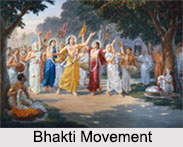
In a particular manner, the spread of Hinduism had given rise to enormous amounts of religious literature, often dedicated to the divinities Rama and Krishna. This was the literature of `bhakti` (devotional religion), based upon the magnitude and substance of a loving relationship between the worshipper and the Almighty. The "Bhakti" literature was mostly reverberated in the language of poetry, the most trailblazing a movement of Hinduism and Islam - clearly upholding medieval Indian poetry.
Bhakti Literature of Medieval Indian Poetry
"Bhakti" literature is the most important and significant development of the medieval period and its intimate association with Indian medieval poetry. Lords Krishna and Rama - the two principal incarnations of the great Lord Vishnu - had begun to be worshipped widely. Numerous temples had begun to be erected in honour of them and their worshippers began to establish a number of different sects, each one espousing a particular religious teacher. Much of bhakti literature was penned in the form of poetical hymns, still sung in contemporary times. These hymns were of the habit to extol the deities and their deeds, or modestly and respectfully had focuses upon his rollicking activities with the gopis - the cowherd girls amongst whom Krishna had spent his youth.
The stories arrive mostly from the Bhagavata Purana and the Gitagovinda. They delineate and account a very dissimilar aspect of Krishna from the stately and majestic Krishna of the Mahabharata. His worshippers are indeed captivated by his pranks. Rama, on the other hand, is venerated as an idealistic and heroic king and his wife, Sita, is the exemplar of Hindu womanhood. The monkey God Hanuman - the faithful collaborator of Rama in the war against Ravana - comes forth as the ideal devotee.
Bhakti lyric poems as a generic domain of medieval Indian poetry, do share a number of characteristics. Unlike earlier Indian literature in Sanskrit, they delineate works of a personal and emotional character. Sung by devotees, Bhakti poems often emote from the perspectives of `marginalised` and `barred` groups in Indian society, vocalising social criticism. Some of the major bhakti poets were women and men of the lower castes also.
Islamic influence on Medieval Indian Poetry
 The Islamic influence is yet another tremendous genre which was successful to enhance and stress its magnification upon the medieval poetry of India. Several Muslim dynasties had ruled much of India from their advent during the 1100`s and 1200`s. Most of them had versed in Persian or Turkish. These were the principal languages utilised, in a somewhat `Indianised` form, for the business dealings of government and court. Muslim poets Malik Mahammod Jayasi, Raskhan, Rahim and others had penned a voluminous amount of Sufi and Vaishnava (pertaining to Vishnu) poetry. The religious and cultural synthesis of Islam and Hinduism that was a special concern of medieval Indian poetry, finds frequent expression in their literature. Bulleh Shah, the most celebrated Muslim Punjabi poet had popularised Sufism (Islamic doctrine of divine love) through Punjabi kafi (verse form). Shah Laatif, a Sindhi Muslim poet, is also known to have penned an important Sufi text, Risalo.
During the medieval period, Urdu literature had come into being in India in an overwhelming manner. Amir Khusrau (1253-1325), the great and most august Sufi poet and an early architect of India`s `composite culture`, had experimented with poetry in a language that was a mixture of Persian and Hindi. This was the primary origin of Urdu language, especially its intense connection with Islamic courts of kings. Urdu poetry has largely espoused Persian forms and metres, but it has also embraced some of the purely Indian forms, which primarily had formed the basis of medieval Indian poetry. The ghazal (lyrical couplet), qasidah (ode of praise), and marsia (elegy) are of strict Iranian origin. The poet Sauda (1706-1781) had lent cogency and true versatility to Urdu poetry. Mir Dard (1720-1785) and Mir Taqi Mir (1722-1810) yet some more gifted contributors to Indian medieval poetic genres, had lent Urdu language maturity and had ushered it into the modern period of literature. The most legendary Mughal Empire of the 1500`s to the 1700`s also had offered a livelihood to numerous poets.
During medieval times, a succession of Islamic dynasties had conquered umpteen territories in north and central India. Some Indian languages were thoroughly influenced by Islamic religion and culture, as well as by the Persian and Arabic languages and the literatures of these two tongues. These influences had impressed upon the development of the Hindi language, thus resulting in the emergence of Urdu - a particular form of Hindi. The Urdu language possesses a large number of Persian and Arabic words, and is written in the Arabic script.
Popular Medieval Indian Poets
Some of the popular Medieval Indian poets are as follows:
Ramanuja: The first proponent of the Bhakti movement was Ramanuja who was appointed the descendant of his teacher Yamunamuni. He wrote "Sribasya" and "Gitabhasya".
Namadeva: Namadeva flourished in the first part of the 14th century. His poetry which was written in Marathi exhales a spirit of strong love and devotion to God.
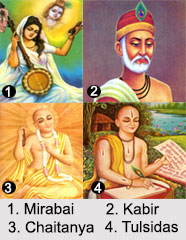
Chaitanya: He was responsible for the recognition of Vaishnavism. He adored Krishna and Radha and attempted to spiritualise their lives in Vrindavan.
Mirabai: She was extremely religious from her childhood and a devotee of Krishna faction of Vaishanavism. Mirabai is said to have composed many devotional songs and poems.
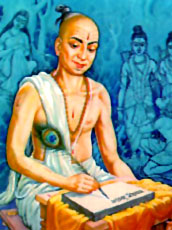
Tulsidas: He was a great poet and a devotee of Rama. He composed the famous Ramcharitamanas in Hindi, explaining the various aspects of Hindu dharma. His other creations are Vinaya-Patrika and Kavitavali.
Surdas: As a poet, he preached the religion of love and devotion to a personal God. Surdas was a follower of Lord Krishna and Radha. He made use of Brajbhasa in his works which comprise Sursagar, Sahitya Ratna and Sur Sarawali.
Shankar Dev: Sankardev popularised Vaishanava bhakti in Assam. He was a great poet.
Kabir: His dohas and sakhi (poems) are found in the Bijak (compositions of Kabir). He robustly denounced the caste system, especially the practice of untouchability.
Medieval Indian Poetry was the medium of Indian literature and the instruments of expressing thoughts in medieval India.