Culture of Ladakh, Jammu and Kashmir - Informative & researched article on Culture of Ladakh, Jammu and Kashmir
  Indianetzone: Largest Free Encyclopedia of India with thousand of articles Indian Cities


in  
Art & Culture | Entertainment | Health | Reference | Sports | Society | Travel
Forum  | RSS Feeds  | Free E-magazine
Indian Cities : Ancient Indian Cities l Metropolitan Cities in India l Indian hill stations l Indian Capital Cities l Indian Holy Cities l Port Cities in India l British Cathedrals in India l Indian Cities l Pilgrimages In India l Tourism in India
Home > Travel > Indian Cities > Indian Cities > Cities of Jammu and Kashmir > Ladakh > Culture of Ladakh
Culture of Ladakh, Jammu and Kashmir
Culture of Ladakh encompasses the forms of arts derived from religious and racial influence since the outset.
  Art and Crafts in Ladakh   Music of Ladakh   Cuisines of Ladakh

The culture of Ladakh is an intriguing mixture of Tibetan and non-Tibetan elements. Ladakh is an extension of the great Tibetan plateau, and is separated from Tibet`s religious and cultural centre at Lhasa only by a matter of distance. The population of central and eastern Ladakh is of preponderantly Tibetan racial stock, and their language is an antediluvian form of Tibetan.

In the field of religious culture, the Tibetan influence remained paramount. The religious diversifications have enriched the land of Ladakh with different cultures and developing distinctive forms of the parent culture. This seems to have come about due partly to a unifying and centralizing tendency in the organization of the religion itself, and partly because of the line of kings and the ancient Tibetan dynasty that ruled over the land. The cultural forms of Ladakh were, thus, dependent on religion and thus Ladakh constitutes a cultural as well as a religious stranglehold. Religious painting is a living tradition of Ladakh. Every gesture of the figures represented, every detail of the background, every choice of colour, has a symbolic meaning, and there is no room for individual interpretation. There is equivalence about the murals in almost all the gompas, whether they depict the divine beings in their terrible or their benign aspect. The artifacts with ravening jaws, flaming tresses, skull head-dresses, trampled and bleeding foes; with plump white clouds, five-pointed crowns, delicate hand gestures, the multiplicity of limbs and heads, evokes an awe inspiring effect to the people who envision them.

One of the most important forms of art and culture of Ladakh is the `thangkas`. It is devotional paintings on cloth, a kind of Buddhist icon made with repeating the same motifs endlessly. The various styles of painting that an art historian can trace down the centuries have either been abandoned, like the presumed Kashmiri style so amazingly exemplified at Alchi, or absorbed into a single style. Among the earlier wall-paintings, particularly the little scenes of secular life that appear now and then, especially at Alchi, also the court scene in which Tashi Namgyal`s portrait appears in the Gon-Khang at Namgyal Tsemo are exemplary of the tradition of Ladakh. Besides these, the carpets came from Yarkand and Tibet; decorative metal-ware, some of it very fine, from Yarkand and elsewhere in central Asia; brocades and other kinds of silk from China; and fine shawls from Kashmir are also included among the art and crafts of Ladakh.

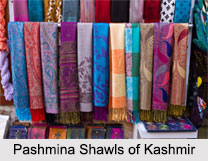
Traditionally, every household of Ladakh spun and wove its own woolen cloth, and in the villages this tradition exists even today. Ladakh`s most famous product is the warm soft winter under-coat of the pashmina goat, was used to be known as `shawl-wool`. The fine pashmina shawls justified the name by which they were world-famous, `cashmere`, by being manufactured in Srinagar by the more nimble-fingered and artistic Kashmiris. Even now, when not all the pashm leaves Ladakh raw, without value added, the best `Ladakhi pashmina` shawls can hardly compare with genuine `cashmere`. Among the Ladakhis, in apparent contrast to the Tibetans, knitting is not an old-established skill. It was introduced about a hundred years ago by the Moravian missionaries, and Ladakhi women knit European-style with the wool wound round the fingers of the left hand. Moreover, the handicrafts centre has a design department, whose products verge on the `folksy`, running largely to clay models of women sporting peraks, and panels with brightly coloured Chinese-type dragons. Carpets are manufactured according to the Tibetan technique; but a finer product may be found at the Tibetan refugee camp at Choglamsar. The embroidery on the carpets involves crewel-work, stylized flower patterns, Tibetan-style geometrical borders and some other patterns that were derivative of the other regions and now, a form of hybrid culture.

Authentically Ladakhi are the low carved and painted tables, `chogtse`, which are an essential part of the furnishing of every Ladakhi home. Wood-carving has also been mastered by the people pf Ladakh by which the Ladakhis embellish their home with decorative designs. The practice of metal crafts is done by the blacksmiths, Gara of Ladakh. As well as the utilitarian objects of everyday use, like ploughshares and other agricultural implements and cooking pots, they turn out more decorative items like tea- and chang-pots from metal. The finer decorative work, in copper or brass embellished with silver, applied to prayer-wheels and other objects used in worship, as well as the household utensils found in the houses of the well-to-do, is done by the goldsmith community, Sergar. Even much of the elaborate and ornamental pieces of jewellery worn by the Ladakhi women are created by the people of Sergar community. Some of the other communities create exclusive copper pots that seem to be of a workmanship rather superior to that of the local craftsmen in most other areas.

Apart from the exclusive artifacts, the Ladakhi people are also brilliant in dance, music and literature. Indeed, given its position at the very edge of the Tibetan plateau, Ladakh was exposed to cultural influences other than those of Tibetan Buddhism. The religious dance-dramas performed in the `gompas` are in their entirety an import from Tibet, in which no local element intrudes. But the social dance of Ladakh is a different form of art. The beauty of the Ladakhi dance is that it is a living tradition. Even now, in the accelerating tempo of the modern world, it remains an important part of every Ladakhi Buddhist`s training in the social graces. With the music of Ladakh too, there is a clear division between the religious and the secular traditions. The gompa music, used in worship and as an accompaniment to the dance-dramas, and it follows Tibetan forms. It`s most characteristic instrument is a horn and has to be supported at the bell end in a loop of cloth carried by an acolyte marching ahead. Of secular instrumental music there are two main strains. The earlier one is derived from Tibet; its instruments are the flute, also an unusual kind of double flute, and the damnyen, an instrument of plucked strings akin to the Indian sitar. Another form of instrumental music which is performed in public and ceremonial occasions involves the `surna` (an oboe-like instrument related to the Indian shehnai) and `daman` (a pair of drums like the Indian tabla).

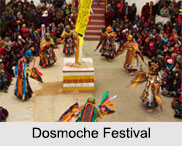
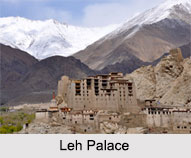
The masterly form of Ladakhi music is called `lha-rnga`, or music of the gods. It is played at the beginning of any auspicious occasion such as sowing, or the arrival of spring, and also when serving food to incarnate lamas, or to members of the aristocracy. It also accompanies the dance of the oracle at Shey, the ancient royal capital, at an immediately pre-harvest festival in celebration of the ripening of the crops. This is said to be the most complete lha-rnga played, and to consist of 360 tunes. In addition to the `lha-rnga`, there are musical forms proper to every ceremonial occasion: a form for the arrival of dignitaries, and one for their departure; a form for exorcizing evil spirits, or getting rid of evil men; special music for polo, rising accelerando crescendo when a goal is scored, and similarly for archery to celebrate a bull`s-eye. There is music for ploughing and for harvest; and music for every different kind of dance. Religious mask dances occupy an eminent part of Ladakh`s cultural life. The Hemis monastery, a leading centre of Drugpa Buddhism, is a centre for an annual masked dance festival. The dances typically narrate a story of fight between good and evil and the war ends with the eventual victory of the almighty. The blend of dance, music and song that went into the Ketuk-chenmo festival is the essence of Ladakh`s popular culture. The cycle of Ketuk-chenmo songs is also a pointer to the strength of an oral tradition which includes a body of unwritten poetry whose richness is only now getting the scholarly attention it deserves. Apart from these festivals, Ladakh Harvest Festival, Sindhu Darshan, Losar Festival, Dosmoche Festival, Hemis Festival are also celebrated with great enthusiasm and delectation. The architectural ethnicity has been enriched with a composite culture and the environmental conditions also played a vital role for creating the architectural monuments that prevail in Ladakh. The Leh Palace and the gompas, for example, clearly belong to the same architectural tradition as the Potala. The houses of the two countries too are built to withstand the same climate, using the same sun-dried bricks, and on the same basic pattern. Similarly, the `goncha`, is certainly a variant of the Tibetan `chuba`. The beautiful monasteries scattered in Ladakh like the Thiksey Monastery, Alchi Gompa, Spituk Monastery, Phugtal Gompa, Phiyang monastery and Lamayuru monastery (the oldest one) worth the appraisal of the beholder foe their arresting architecture and splendid interiors. Weaving is an important part of traditional life in eastern Ladakh. Both women and men weave, on a different loom. Typical costumes include Gonchas of velvet, elaborately embroidered waistcoats and boots, and gonads or hats.

The predominant feature of Ladakh`s instrumental music is its beat, derived it seems from exposure to traditions originating in the Islamic world. The folk-verse, which has entirely indigenous roots, has no fixed forms, though it does have a strong sense of rhythm, relating to the tunes to which it is sung, usually without instrumental accompaniment. The imagery is rich and powerful and much of it relates to the sun, many songs starting with an invocation to it. Ladakhi songs can be classified on the basis of content. One or two are associated with particular groups, or regions, such as the `zhabro` songs of Chang-thang, which have little literary merit. These songs are actually composed as a musical accompaniment to the vigorous foot-stamping dance of identical name. The words of the `zhabro` are usually suggestive, if not downright bawdy. Very different is the `ghazal`, the classical form of Urdu and Persian poetry. The introspective, romantic and melancholy `ghazal` become popular in Ladakh due to the serenity it provides. Apart from these songs, the Ladakhis are also adept in satirical songs, marriage songs, folk songs, work songs, harvest song etc that redefine the culture of Ladakh. The Ladkhi culture is also ameliorated with the tradition of myth, folklores and oral literature by the local bards.

In the early years of the twentieth century, the Moravian missionaries laid the foundation of Ladakh studies, and versions of the Kesar Saga, the national epic, as well as collections of songs and proverbs were published. Later the attention was concentrated on the fields of ecology and agriculture, social anthropology, history and religious art. Moreover, the Ladkhis have bettered their culture with their propensity towards sports and Archery is a popular sport in Ladakh. Archery festivals are held during the summer months in villages. The sport is conducted with strict etiquette, to the accompaniment of the music of Surna and Daman (oboe and drum) in Ladakh and enjoyed by the entire region. Polo, which was introduced into Ladakh in the mid-17th century, has earned a distinct position in the list of traditional sport of Ladakh. The cuisine of Ladakh is also included in the culture. The great dish of Ladakhi, `haute cuisine` which otherwise shows traces of Chinese influence derived from the Tibetan connection. This cuisine relies largely on noodles and meat-filled dumplings or mok-mok is Yarkandi ptilau. This is made by cooking the rice richly with meat and spices, and is a creation again in the great Islamic tradition.

Ladakh is also fructified with the tradition of Tibetan medicine that has been in practice for over a thousand years among the Ladakhis. This traditional healing system involves the elements of Ayurveda and Chinese medicine, combined with the philosophy and cosmology of Tibetan Buddhism. For centuries, `Amchi` medicine has been occupying an important part of public health till date in Ladakh and the adjourning regions. The government is in their way to regenerate this ancient traditional system of healing. This traditional healing system of has ameliorated the culture of Ladakh and separated it from the cultures of other regions.

With the celestial repose of mind and soul, the culture of Ladakh enriches the tradition with art, songs, paintings, oral and written literature. Apart from these, the wonderful Buddhist festivals are celebrated in Ladakh with great enthusiasm and joy and are the important feature of Ladakh culture. The cultural shows, exhibitions, feasts, handicrafts and unique rituals are the highlights of the festivals. The Hemis festival, Losar festival and Ladakh harvest festival have great cultural impact in Ladakh.

(Last Updated on : 8/06/2009)
  More on Ladakh...
 
History of Ladakh Tourism in Ladakh Padum
Demographics of Ladakh Culture of Ladakh Education in Ladakh
Economy of Ladakh Mountain Passes in Ladakh Flora and Fauna of Ladakh
Agriculture of Ladakh Monasteries in Ladakh Geography of Ladakh
Costumes of Ladakh Religion of Ladakh Leh District
Architecture Of Ladakh    
Recently Updated Articles in Indian Cities
  • Panchgani
    Panchgani is one of the prominent hill stations located in the state of Maharashtra in India.
  •  
  • Panaji
    Panaji is the capital city of Goa and also one of the major tourist destinations in India.
  •  
  • Idukki
    Idukki is a prominent hill-station and one of the districts of the state of Kerala.
  •  
  • Urayur
    Urayur was the capital of the early Cholas until the dynasty was revived by Vijayalaya Chola in 850CE.
  •  
E-mail this Article | Post a Comment
Free E-magazine
Subscribe to Free
E-Magazine on Indian Cities

 
Culture of Ladakh, Jammu and Kashmir - Informative & researched article on Culture of Ladakh, Jammu and Kashmir
Sitemap
Contact Us   |   RSS Feeds
Copyright © 2008 Jupiter Infomedia Pvt. Ltd. All rights reserved including the right to reproduce the contents in whole or in part in any form or medium without the express written permission of Jupiter Infomedia Pvt. Ltd.