|
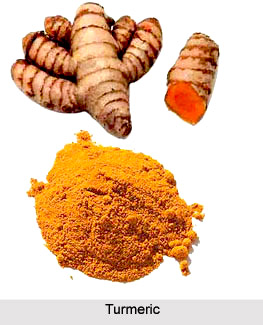
Turmeric belongs as a member to the Curcuma botanical group, which is part of the ginger family of herbs - the Zingiberaceae. The root and underground stem of the Curcuma longa L. plant is crushed and powdered into a ground format, to obtain the classic and characteristic turmeric powder. Ground turmeric is used worldwide as a flavouring, to make scrumptious curry and for its medicinal properties. Curcumin, composing 3 percent of turmeric, is the herb`s most biologically active phytochemical compound. It is distilled and researched for its illustrious range of therapeutic results. In India too, uses of turmeric are found to be of an everyday occurrence, heavily utilised for each and every single purpose in every kind of household. The various uses of turmeric however perhaps are overshadowed by its splendid culinary and cooking usages, for which `Haldi` (as turmeric is rather popular in Hindi in India) is the most popular and most admired. Turmeric is also used as a dye in the Indian textile industry. It is utilised in the preparation of medicinal oils, ointments and poultice. It serves as a stomachic, carminative, tonic, blood purifier and an antiseptic. Uses of turmeric in cosmetics industry are basically due to the aqueous extracts, possessing excellent biopesticidal properties. The historical Indian and indigenised plant turmeric also finds its usage in alternative medicine, in the Ayurvedic domain. Indeed, uses of turmeric in ayurveda is one such sparkling existence, which has even fascinated ancient Indian gurus and sage practitioners.
Culinary Uses of Turmeric
In India, turmeric is used to tinge numerous sweet dishes. The spice`s principal pride place however lies in the assorted Indian a la carte of curries and curry powders. It is used literally in uncountable fish curries, possibly due to it successfully masking the raw pungent odour of fish. Besides, fish, use of turmeric can also be witnessed in the variety of meat and vegetarian dishes, each exuding a distinct aroma due to Haldi`s quintessential taste as powder or paste. When employed in curry powders, it is usually one of the principal ingredients, providing the related yellow colour.
In Indian cuisine turmeric is added to nearly every dish, be it non-vegetarian or vegetarian. Its bright yellow colour imparts a further orangish yellow tinge to curries. It is also used to tint umpteen sweet dishes in India to impart a pale yellow colour to the dish, making it only turn delicious further. The Indian indigenous pickles and mustard also use turmeric to compensate for the archetypal and characteristic odour, which soon poses the chance to loose its flavour. Turmeric is also used for colouring cheeses, salad dressings, margarine, yoghurt, cakes, biscuits, popcorn, cereals, sauces, fruit drinks, table jellies, fruit dishes and an assortment of delectable food items.
However the uses of turmeric for its delightful cuisine contrivings happen mainly for some its compositional purposes. Turmeric is widely cultivated for its rhizomes, which are used as a bright yellow-orange culinary spice. It has rather ironically been touted as `poor man`s saffron`, because it is known to offer a much less expensive alternative yellow colouring. Curcumin is the primary pigment in turmeric and is mostly used in various food industries as a food colour. Uses of turmeric in the food industry mainly can be found in the likes of dairy products, beverages, cereal, confectionary, ice cream, bakery and savoury products. Turmeric, quite astoundingly, also finds its usage in flavoured milk drinks, cultured milk and desserts to obtain lemon and banana colours in dairy. Turmeric is added at higher levels to sausages, pickles, relishes, sauces, dry mixes and fish due to its original usage as a spice. It can authentically be stated that turmeric and its uses in the gastronomical world virtually can go to unlimited meridians, with cooks experimenting with every new kind of recipe that can indeed be concocted in the universe.
In order to absolutely exploit the perfect uses of turmeric, the powder`s essential colour properties need to be preserved in a strategic manner. However everlasting they are known to be in flavour; yet, the aroma is lost quickly if not stored rightly. Hence, it is always advised to store turmeric in airtight containers, away from sunlight. Additionally, uses of turmeric can also be best tapped if stored in cool, dark and dry places. Turmeric plays the most mandatory role, acting as one of the principle ingredients of curry powder. Turmeric is mostly recommended to be used as an ultimate substitute for saffron. When blended with melted butter and later drizzled over cooked vegetables, pasta, or potatoes, the redolent aroma that exuded form the dish, is just irresistible. Turmeric oil is also used to impart the flavour in food and perfume industries. It adds a warm, mild aroma and distinctive yellow colour to foods.
Medicinal Uses of Turmeric
The medicinal world in India is known to make resounding use of turmeric in the sphere of home remedies as well naturopathy and of course, Ayurveda. Turmeric is known to act as a mild digestive, serving also as an aromatic, a stimulant and a carminative. `Turmeric water` is an indigenous Asian cosmetic applied to lend a golden glow to the complexion. Curcumin has been shown to be vigorously active against Staphlococcus aureus (pus-producing infections). Uses of turmeric (Curcuma longa) have been tapped as a powerful medicine that has long been used in the Chinese and Indian systems of medicine as an anti-inflammatory agent to treat a wide variety of conditions, including flatulence, jaundice, menstrual difficulties, bloody urine, haemorrhage, toothache, bruises, chest pain and colic.
Usage of turmeric by adding in small quantities essentially as a colouring agent, has some additional health benefits besides the everyday ones. Turmeric is a mild digestive which is supposed to aid in stomach problems and other ailments. In southern India, buttermilk spiced with turmeric is considered a digestive aid that helps curtail stomach ailments.
As has already been seen previously, turmeric is used in food and cooking not only for colouring and flavour, but also because it aids digestion by helping to decompose fats during the digestion process. It also has been proven useful for stomach problems, ranging from gastritis to stomach problems caused due to stress or too much of alcohol consumption. Indeed, the medicinal uses of turmeric also have gained so much significance, that the Indian aboriginal version of curative has changed entirely under turmeric and its uses. Raw turmeric juice is used to treat hyper acidity and indigestion. Turmeric is understood to possess antiseptic properties, making it expensively utilised to heal cuts, burns and bruises. A pulp of turmeric and Asian basil is at times applied as an antiseptic against insect bites.
Curcumin, an active component of turmeric, is known to possess anti-oxidant properties and so turmeric is used in the domain of alternative medicines too. Curcumin also induces an anti-inflammatory effect by reducing the histamine(hormone) levels. Studies have exhibited that turmeric brilliantly decelerates the spread of breast cancer into lungs and other body parts. Turmeric also voraciously speeds up the effect of taxol in reducing metastasis of breast cancer.
Curcumin is conceived to be a powerful antinociceptive (pain-relieving) agent. Exhaustive research studies have convinced and established the effective use of turmeric in the reduction of joint inflammation and counselled clinical trials as a possible treatment for the alleviation of arthritis symptoms. Bodies responding to seasonal changes together with influenza, coughs and running noses, are immediately administered with honey mixed with turmeric, or turmeric mixed in milk by Indian homemakers and mothers to soothe and cure. The roots are thumped hard and pressed to extract a juice that, when coalesced with water, is helpful in ear-aches and to cleanse the sinuses through nasal application. The astringent qualities of turmeric are also useful in instances of treating pulmonary tuberculosis, tuberculosis, bronchitis, colds and asthma, the root being lightly cooked and eaten. So right from home remedies and wives` tales to internationally researched studies, uses of turmeric have proven to be more than just a spice and colourant, making it very popular and sought after in the west nowadays.
Uses of turmeric in digestive disorders are looked at as a bitter digestive and a carminative. It can be added into foods including rice and bean dishes to augment digestion, reduce gas and bloating. The spice serves as a cholagogue, stimulating bile production in the liver and encouraging excretion of bile through the gall bladder. This betters the body`s ability to digest fats. For chronic digestive weakness and/or congestion, through use of turmeric is recommended. It can be have as a single extract or in the form of digestive bitters, which combine turmeric with other bitter and carminative herbs. Turmeric is beneficial for people who feel exhausted and sleepy after consuming meals or who experience gas and bloating. Whatever way turmeric is consumed, it is advantageous to both the digestive system and the liver. During the spring time, more consumption of herbs and foods related to this herb can strengthen the liver. Turmeric shares similar liver protectant compounds that milk thistle and artichoke leaves contain. It is believed to shrink engorged hepatic ducts, so it can be useful to treat liver conditions such as hepatitis, cirrhosis, and jaundice.
Scientific researches confirm that regular use of turmeric can cure host of chronic diseases, amongst them, restraining the growth of various kinds of cancer. Turmeric is used for the treatment of skin cancer or pre-cancerous skin conditions. Both topical and internal uses are beneficial. Use of turmeric may be helpful in preventing the blockage of arteries that can gradually stimulate a heart attack or stroke in one of two ways. Turmeric makes cholesterol levels low and strictly curbs the oxidation of LDL (bad cholesterol). Oxidised LDL deposits in the walls of blood vessels and conduces to the formation of atherosclerotic plaque. Usage of turmeric is also known to prevent platelet build up along the walls of an injured blood vessel. Platelets collecting at the site of a damaged blood vessel cause blood clots to form and blockage of the artery as well. Turmeric can just also aid in relieving the symptoms of osteoarthritis, due to its ability to lessen pain and disability.
In the world of female diseases, especially for women who experience monthly menstrual cramps, using a turmeric extract or bitters twice daily for two weeks prior to expected menstruation is strongly counselled for alleviation. Usage of turmeric acts as an antispasmodic to smoothen muscles, so it reduces digestive and menstrual spasms. If not ease such womanly pain entirely, it is sure to reduce the severity of pain. Using of regular turmeric is also beneficial as an external antibiotic in preventing bacterial infection in wounds.
Using of the most active component in turmeric, Curcumin, can also prove to be as effective as corticosteroids in the uveitis (inflammation of the uvea, the middle layer of the eye between the sclera - white outer coat of the eye and the retina - the back of the eye) the type of eye disorder. Turmeric decreases congestion and inflammation from stagnant mucous membranes. Turmeric is anti-inflammatory to the mucous membranes, which coat the throat, lungs, stomach and intestines. Regular use of turmeric can benefit from Colitis, Crohn`s disease, diarrhea, and post-giardia or post salmonella conditions. The itching and inflammation that accompanies hemorrhoids and anal fissures can reduce by use of turmeric. Turmeric can also benefit skin conditions including: eczema, psoriasis and acne, for those it is potent detoxifier.
Clinical Uses of Turmeric
Not only in the world of homemaking, everyday remedies, naturopathy or Ayurveda, uses of turmeric can seriously be witnessed in the arenas of clinical diagnoses, wherein doctors or other medical professional practitioners are known to make use of this Indian herb wonder to the fullest.
Taken internally or used externally, turmeric acts as an anti-viral, anti-bacterial, anti-fungal, anti-parasitic and anthelmintic.
Turmeric is a powerful anti-inflammatory and antiseptic, useful for bronchial asthma, chronic cough.
One of the main causes of eye disorders, especially cataracts, is the oxidation of lens in the eyes. Turmeric taken internally decreases the oxidation of the lens by causing a significant induction of glutathione-S-transferase isozyme rGST8-8 in the lens epithelium.
Oxidation by free radicals is linked with accelerated aging and virtually every major chronic disease comprising atherosclerosis, cancer, cardiovascular diseases, cataracts and rheumatoid arthritis. One way to stop this is with anti-oxidants like Vitamin C and E and of course, use of turmeric.
Turmeric has an anti-coagulant action, keeping the blood thin. Turmeric prevents platelets from clustering within blood vessels, making it effective in the prevention of atherosclerosis and its complications. Turmeric diminishes cholesterol levels by preventing and removing oxidised cholesterol.
Use of turmeric performs its protective action upon intestinal flora. Curcuma is also quite beneficial in Crohn`s disease and ulcerative colitis.
Applied topically, turmeric is also useful in treating skin conditions such as eczema, psoriasis, fungal infections and athletes` foot.
Turmeric is considered to be anti-cancerous agent due to it holding a threefold action - it neutralises those substances and conditions which can cause cancer; it directly helps a cell keep back its integrity if jeopardised by carcinogens; if a tumour does grow the Curcumins can often destroy it. Ayurveda especially recommends turmeric for cancers of the female reproductive system, namely breast and uterine cancer and to treat benign tumours as well. Turmeric is also useful in cancers of bowel and colon. Curcuma can indeed prevent prostate cancer.
Turmeric accelerates the flow of bile and is beneficial in the prevention of gallstones.
Clinical use of turmeric finds itself being used as a much enriched source of iron, highly indispensable for anaemia.
External application of turmeric (especially if a paste of turmeric can be administered piping hot) is quite beneficial for sprains and swellings.
Turmeric helps in stretching the ligaments and thus is useful for regular hatha yoga practitioners.
Turmeric prevents the formation of gas, particularly when it is added to a high protein meal.
Turmeric is an important herb in most Ayurvedic treatments of diabetes, as it lowers blood sugar, augments glucose metabolism and potentates insulin activity over threefold. It serves both diabetics and those of the individuals who engorge on sweets. A portion of the action might be however due to its chromium content.
Turmeric allays inflammation of the tonsils and congestion in the throat. This also works for halting nosebleeds, helps to clear the sinuses, rejuvenate a more keen sense of smell and helps purify the mind and brain.
In vitro and in vivo studies show curcuminoids can help with HIV in a number of processes, including acting as biological response modifiers, resulting in path-breaking increases in CD-4 and CD-8 counts.
|
