Months of Hindu Calendar - Informative & researched article on Months of Hindu Calendar
 Indianetzone: Largest Free Encyclopedia of India with thousand of articlesIndian Religion


in  
 Art & Culture|Entertainment|Health|Reference|Sports|Society|Travel
Forum  | Free E-magazine  | RSS Feeds  
Indian Religion : Vastu Shastra |Indian Religions |Indian Myths |Indian Mythology |Gods of India |Goddesses Of India |Religious Thinkers of India |Types of Religion in India |History of Indian Religion |Indian Yogis |Ajivikas |Sacred Scriptures in Indian Religion |Tantrism |Shaivism |Indian Communities |Sacred Animals in India |Roman Impact on South Indian Art and Society |Bhattacharyas |Indian Classical Terms
Home > Society > Indian Religion > Types of Religion in India > Hinduism > Months of Hindu Calendar
Months of Hindu Calendar
Months of Hindu calendar are derived from the system first enunciated in Vedanga Jyotisha of Lagadha.
More on Months of Hindu Calendar
  Madhava-Madhu   Ashahra    

 Months of Hindu CalendarMonths of Hindu calendar are the distinctive feature that has undergone many changes in the process of regionalisation, and today there are several regional Indian calendars, as well as an Indian national calendar.

Hindu Calendar is inherited from a system first enunciated in Vedanga Jyotisha of Lagadha, a late BCE adjunct to the Vedas, standardized in the Surya Siddhanta (3rd century CE) and consequently reformed by astronomers such as Aryabhata (499 CE), Varahamihira (6th c. CE), and Bhaskara (12th c. CE). There are differences and regional variations that thrive in these computations, but the following is a general overview of Hindu lunisolar calendar. When a new moon occurs before sunrise on a day, that day is said to be the first day of the lunar month. So it is obvious that the end of the lunar month will correspond with a new moon. A lunar month of Hindu calendar has 29 or 30 days (according to the movement of the moon).

The tithi at sunrise of a day is the only indication of the day. There is no running day number from the first day to the last day of the month. Sometimes two successive days have the same tithi and in such a case, the latter is called an adhika tithi where adhika means "extra". Sometimes, one tithi may never reach a sunrise, and hence no day will be labeled by that tithi. It is then said to be a tithi kshaya where kshaya means "loss".

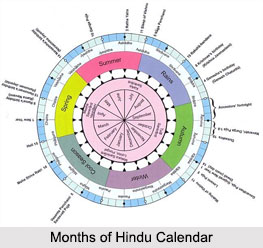
The months of Hindu Calendar are known as the lunar months that are twelve in number. They are as follows -
Chaitra Ashadha Ashwin Paush
Vaishakh Shravana Kartik Magh
Jyaishtha Bhadrapad Margashirsha Phalgun


Determining which name a month of Hindu calendar takes is somewhat indirect process. It is based on the rashi into which the sun moves within a lunar month, i.e. before the new moon ending the month. There are twelve rashi names, according to the months of Hindu calendar. When the sun moves into the Mesha r?shi in a lunar month, then the name of the lunar month is Chaitra. When the sun moves into Vrishabha, then the lunar month is Vaishakh. Thus the phenomena of naming the months of Hindu calendar continue.

The Sanskrit grammatical derivation of the months of Hindu Calendar, Chaitra and others is the (lunar) month which has its central full moon occurring at or near the nakshatra Chitr? is called Chaitra. Similarly, for the nakshatras Vishakha, Jyeshtha, (P?rva) Ash?dh?, Shravan, Bh?drapad, Ashvin? (old name Ashvayuj), Krittik?, Mrigash?rsha, Pushya, Megh? and (P?rva/Uttara) Phalgun? the names Vaish?kh and others are derived. The months of Hindu Calendar are split into two pakshas of 15 days. The waxing paksha is called shuklapaksha, light half, and the waning paksha the krishnapaksha, dark half.

There are two different systems for structuring the months of Hindu Calendar:
  • amanta or mukhya mana system - a month begins with a new moon, mostly followed in the southern states.

  • purnimanta or gauna mana system - a month begins with a full moon, followed more in the North states.


  • The extra months of Hindu calendar are the ones when the sun does not at all move into any r?shi but simply keeps moving within a rashi in a lunar month, then that lunar month will be named according to the first forthcoming transit. It will also take the epithet of adhik or "extra". For example, if a lunar month moves beyond without a solar transit and the next transit is into Mesha, then this month without transit is to be labeled adhik Chaitra. The next month will be labeled according to its transit as usual and will get the epithet nija ("original") or shuddha ("clean").

    An adhik masa occurs once every two or three years (meaning, with a gap of one or two years without adhik masas Extra Month, or adhik mas masa (mas = lunar month) or purushottam mas). It is known so to give it a religious name, purushottam = Krishna and comes every 32.5 months. Thus 12 Hindu mas (m?sa) is equal to approximate 356 days, while solar year have 365 or 366 (in leap year) which create difference of 9 to 10 days, which is divided every 3rd year. But no extra months of Hindu Calendar falls during Kartik to Maha.

    If the sun transits into two rashis within a lunar month, then the months of Hindu calendar will have to be labeled by both transits and will take the epithet kshay or "loss". They are considered to be a "loss" because in this case, there is only one month labeled by both transits. If the sun had moved into only one rashi in a lunar month as usual, there would have been two separate months labeled by the two movements in question. For example, if the sun moves into Mesh and Vrishabh in a lunar month, then it will be called Chaitra-Vaishaakh kshaya. There will be no separate months made Chaitra and Vaishakh. Akshay masa occurs very rarely. Known gaps between occurrences of kshaya masas are 19 and 141 years. The last lost month of Hindu Calendar was in 1983. January 15 through February 12 was Pausha-M?gha kshay. February 13 onwards was (adhik) Ph?lguna.

    Among normal months, adhika months, and kshaya months, the earlier are considered "better" for religious purposes. That means, if a festival will fall on the 10th tithi of the ?shvayuja month (this is called Vijayadasham?) and there are two ?shvayuja months caused by the existence of an adhika ?shvayuja, the first adhika month will not see the festival, and the festival will be observed only in the second nija month of Hindu Calendar. However, if the second month is ?shvayuja kshaya then the festival will be observed in the first adhika month itself.

    When two months of Hindu calendar are rolled into one in the case of a kshaya m?sa, the festivals of both months will also be rolled into this kshaya m?sa. For example, the festival of Mah?shivar?tri which is to be celebrated on the fourteenth tithi of the M?gha krishna paksha was, in 1983, observed on the related tithi of Pausha-M?gha kshaya krishna paksha, since in that year, Pausha and M?gha were rolled into one, as mentioned above. When two months of Hindu calendar are rolled into one in the case of a kshaya m?sa, the festivals of both months will also be rolled into this kshaya m?sa.

    (Last Updated on : 16/02/2011)
     
     
    Aghora Vaishnavism Nath Siddhas
    Sarvam Khalvidam Brahma Aham Brahmasmi Ayam Atma Brahma
    Ekam Evadvitiyam Brahma Tat Tvam Asi Prajnaman Brahman
    Brahma Satyam Jagan Mithya Mahavakyas Mahavidya Goddesses
    Theory Of Creation Hindu Gods Hindu Goddesses
    Shraadh Yajna Havan
    Gotra Aarti Agnihotra
    Devadasis Ishvara In Hinduism Devi
    Grihya Sutras Dvija Hiranyagarbha
    Brahman Cremation Puja
    Janmotsava Shradh Anteshti Kriya
    Homa Hindu Vrata Days of the Week
    Ahalya Kachwaha Jyotirlinga
    Brahmin Castes in India Panchangam Ashta Dikpalas
    Astomi Brahmaloka Sannyasi
    Samakara Hindu Sacred Places Origin of Hinduism
    Hindu Religious Texts Hindu religious leaders Marudeva
    Sarvesvara Lokas Papa
    Maharudra Swahaakaar Yagna Conch Shell Punarjanam
    Aghori Heaven Parting with money after sunset
    Shraavana Sashtanga Kshama
    Agrasya Sanskaras Libation
    Kerari Kusha Maharajas
    Chandrayana Bhagat Jiva
    Devarshis Months of Hindu Calendar Varna System in Ancient India
    Purohitas Hindu Rituals Pancharatra
    Gorakhnathis Citta Ramanandi Sampraday
    Omkara Cult of Draupadi in South India Development of Hinduism
    Shaktism Places of Worship Mantra
    Hindu Iconography Teachings of Hinduism Kalpa Sutras
    Saura Goddess Tara in Hinduism Vaikhanasa
    Matangi System Basvi System  
    Recently Updated Articles in Indian Religion
    Lord Subrahmanya
    Lord Subrahmanya Swamy is considered to be the universal lord who blesses human beings and helps them get rid of their sins.
    Gods of India
    Gods of India form an inseparable part of the life of the people. Indian Gods are considered to be mysterious superhuman beings who are worshipped in this country in various forms.
    Folk Gods of Kumaon
    Folk gods of Kumaon have a rich history and they provide expression to the famous and popular ideas of the people.
    Seven Sisters
    Seven Sisters are the most famous among Dravidian deities in Southern India. The seven sisters also have a younger brother Potu Eazu.
    Savitr
    Savitr is a solar deity and off-spring of Vedic deity Aditi. Savitr has been mentioned in eleven hymns of Rig Veda.
    E-mail this Article | Post a Comment
    Forum
    Forum on Indian Religion
    Free E-magazine
    Subscribe to Free E-Magazine on Society
     
     
    Months of Hindu Calendar - Informative & researched article on Months of Hindu Calendar
    Sitemap
    Contact Us   |   RSS Feeds
    Copyright © 2008 Jupiter Infomedia Ltd. All rights reserved including the right to reproduce the contents in whole or in part in any form or medium without the express written permission of
    Jupiter Infomedia Ltd.
