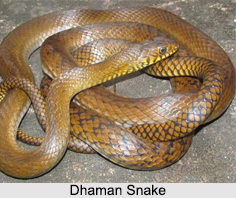
 Dhaman snake is also known by the name of common rat snake. It is a harmless variety of snake and its species name is Ptyas mucosus. It is olivaceous brown in colour. Some of the species of this snake are dark as sepia while others are mustard yellow in colour. The scales on the posterior part of its body are irregularly margined with black colour forming a reticulate pattern. The skin is blackish spotted with fawn or whitish transverse streaks that are hidden by the scales. Its lips and ventral circles are margined black. Its belly is greyish white, dirty white or yellowish in colour. Its head is elongate, neck constricted and eyes are large and lustrous. Nostrils are large. Its body is tough, compressed and tapering towards both ends. Its tail is cylindrical. Majority of the adults vary from 1.65 to 2 m but specimens up to 3.52 m (11 ft 9 in.) have been recorded. The males are longer than the females. In young ones light bluish grey irregular crossbars are striking anteriorly. Local names of this snake in India are Dhaaman in Marathi; Sarai pamboo in Tamil; Chera in Malayalam; Daransh in Bengali; Jerothana in Kannada etc.
Behaviour of Dhaman Snake
Ptyas mucosus though a snake of the plains is found in all parts of the country. Usually in populated areas, it is not seen out during the days. It swims readily and vigorously with its head above the water. It is equally skillful in climbing trees and can jump from a height of 6m. Usually it tries to escape very fast on facing danger but if it is provoked, it fights with courage. When it is furious, it retracts, compresses the body, slightly erects the head and body into a "S" shape with throat distinctly pouched, strikes upwards and the tip of the tail vibrates producing a peculiar mewling sound like a cat.
Eating Habits of Dhaman Snake
It devours almost everything that comes within his reach but has a marked preference for frogs and toads. It swallows its prey at once and the inoffensive creatures like frogs reach its stomach alive and kills it by pressing the prey against the surface of its body. Lizards, birds and other small vertebrates are taken when available and the recorded food includes, lizards, toads, frogs, young pond turtles, nestling birds, skinks, agamid lizards and bats.
Breeding Season of Dhaman Snake
The breeding season of Ptyas mucosus varies with climate. It lays eggs that varies in a clutch from 6 to 14. The eggs are glazed white in appearance. It is domed at both sides and with a crisp, thick, parchment-like shell. The female coils up with the eggs. Hatchlings measure 371 to 472 mm. When the hatchlings are about three months old they are sexually mature.
Enemies of Dhaman Snake
Dhaman Snake usually does not have any predators except King Cobra. Juveniles fear of birds, larger reptiles and mid-sized mammals etc. Dhamans are hunted by humans in some areas for skins and meat.
Geographic Range of Dhaman Snake
This snake is seen in Afghanistan, Bangladesh, Myanmar, Cambodia, China, India, Sri Lanka, Indonesia, Iran, Laos, West Malaysia, Nepal, Pakistan, Thailand, Turkmenistan, Vietnam, Nepal etc.
Dhaman Snake
Dhaman snake is also known by the name of common rat snake. Scientific name of this snake is Ptyas mucosa.