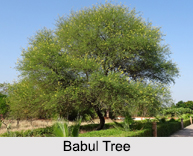
 Scientifically known as Vachellia Nilotica, the Babul Tree is in the Fabaceae or Leguminosae family, which basically means that the tree belongs to the legume, bean or pea family. It is a flowering plant with multiple medicinal benefits and usage in daily life.
Taxonomy of Babul Tree
Originally, the Babul Tree was the type species of the Acacia genus, which is derived from the Greek word for its characteristic thorns. Known by varied names in different languages, the Babul Tree is known as Babul or Kikar in Hindi, Babla in Bengali and Karuvelam in both Tamil and Malayalam. And in Telugu, the Babul Tree is known as Natta Tuma.
Description of Babul Tree
In the interiors and waterless regions, the Babul Tree is one of those very few trees that is able to find adequate nourishment and attains an average height of 5 m to 20 m. The Babul Tree is a slow growing species but is moderately long-lived and preferably grows in sandy or sterile regions, with the climate dry during the greater part of the year. The species can withstand extremely dry environments and can also endure floods.
The crown of the Babul Tree is somewhat flattened or rounded, with a moderate density and the branches have a tendency to droop downwards if the crown is roundish. The Babul Tree makes a good protective hedge because of its thorns. In part of its range small stock consumes the pods and leaves, but elsewhere it is also very popular with cattle. The pods are strongly constructed, hairy, white-grey, thick and softly tomentose and its seeds number approximately 8000 per kg. These pods are used as a supplement to poultry rations in India, where the branches are commonly lopped for fodder.
The Babul Tree has some straight, excellent grey-downy branchlets. During the months of July and November, the aromatic tiny, golden yellow globes appear in groups. In some localities, they appear all through the year and also contain several minute blossoms. The blossoms rest in small calyxes and have distinct stamens as well. There remain some large bracts and occasionally developed leaves halfway down the flower stalks. The leaves contain two or many pinnas. Each of the leaves bear a lot of small leaflets and gives the tree a delicate, feathery appearance. There is a long, white, rising thorn at the base of each leaf stalk.
Distribution of Babul Tree
The Babul Tree mainly occurs in plains on flat or gently undulating ground and ravines. It grows best on the alluvial soils in riverain areas subject to periodic inundations. Babul Tree flourishes even in alkaline soils and a considerable amount of moisture in the soil is essential for its successful growth. This tree is indigenous to the Indian subcontinent as well as in tropical Africa, Burma, Sri Lanka, Saudi Arabia, and Egypt and in West and East Sudan.
 Uses of Babul Tree
Almost every part of the Babul Tree is utilized for some purpose. The sap wood of Babul is sharply demarcated from the heart wood and is white, whitish, and turns pale yellow on exposure. The heart wood is pinkish brown and turns reddish brown on ageing. While the wood is strong and durable, it is used for various constructional purposes.
Forage and Fodder
In India, branches of the Babul Tree are commonly lopped for fodder and the pods are used for poultry ration. The pods are best dry as a supplement and not as green fodder. While in West Africa, the pods and leaves are considered to have anthelminthic properties on small ruminants and this has been confirmed by in vitro experiments on nematodes.
Tooth-Brushing
The tender twig of the Babul Tree is used as a toothbrush in south-east Africa, Pakistan and India.
Medicinal Uses
The leaves, bark, gum and pods of the Babul Tree are used for medicinal purposes. The tender growing tops and leaves are used as a douche in cases of gonorrhoea, dropsy and leucorrhoea. Pulp of leaves, decoction of bark and the gum are prescribed in diarrhoea, dysentery and diabetes. A paste made of the burnt leaves with coconut oil makes a very efficacious ointment in cases of itch. The leaves and the gum are used for gargling for relaxing sore throat and spongy gums. Decoction of leaves is also used as wash for bleeding ulcers and wounds.
Gum Arabic
The exudates gum of the Babul Tree is known as gum Arabic and has been collected since the ancient times for the collection of medicines, dyes and paints. The gum of Acacia Nilotica is referred to in India as the Amaravati gum.
Timber
The wood of the Babul Tree has a density of about 1170 kg per metre cube is widely used for construction as posts, rafters, beams and in door frames. It is one of the most favoured timbers for all types of agricultural implements like ploughs, harrows, crushers and rice pounders, and is extensively used in card building, for yokes, shafts, wheels and body work. The Babul wood is also recommended for certain types of sports and athletic goods like clubs, wall bars, parallel bars, etc.
Fencing Material
The thorny branches of the Babul Tree are useful as fencing material. The trees are also planted closely along the field boundary as live fence. The spines of the Babul Tree are also used as fishing hooks and as a substitute for pin.
One of the most multi-purpose species of trees, the Babul Tree is currently being introduced on a large scale under various components of social forestry programmes in many Indian states.
Babul Tree
Also known as gum Arabic tree, Babul is a small tree species native to Africa, the Middle East and the Indian subcontinent. Babul tree is useful as herb in India due to its immense medicinal benefits as well as other utilities.