





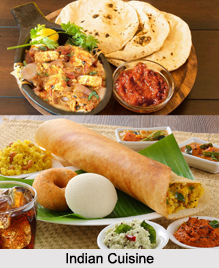
 Indian Regional Cuisines reflect miscellaneous taste. India is a country with different states that have been demarcated according to language, culture, tradition and most importantly geography. These factors influenced the cuisine of the country too, besides religion and foreign invasions. Though, such contradictions, the basics of an Indian meal are similar. Indian Regional Cuisines is thus myriad, different religions and culture intermingles and produces the taste of India. Indian Regional Cuisines reflect miscellaneous taste. India is a country with different states that have been demarcated according to language, culture, tradition and most importantly geography. These factors influenced the cuisine of the country too, besides religion and foreign invasions. Though, such contradictions, the basics of an Indian meal are similar. Indian Regional Cuisines is thus myriad, different religions and culture intermingles and produces the taste of India.
Various Influences on Indian Cuisine With a 3000 year old religious heritage, India is a home to many religions such as Buddhism, Hinduism, Sikhism, Islam, Jainism, Christianity, Zoroastrianism and the Baha’i religions. All these faiths demonstrated on the choice of food. Vegetarianism and non-vegetarianism also originated from these beliefs. This dictated in the choice of culinary in the states of India and thus became the Indian Regional Cuisines. The Jains are restricted from eating garlic or any kind of living thing. Besides, Jainism other religious beliefs do not abstain from eating meat. However, different religions have different restrictions on the type of meat. Such as Hindus, Parsis and Sikhs abstain from eating beef and Muslims regard eating of pork going against their religious belief. North Indian Cuisines Apart from the religious beliefs, foreign invasions have also played a vital role in deciding the culinary of a particular state. The Punjab was situated in Pakistan. Though, the Punjabis have their own distinct cuisine, as with any other Indian state and region, yet much of their cuisine has been influenced by the refugees who fled to India. It is here in Punjab products like milk and ghee, parathas stuffed with radishes and pomegranate seeds, mustard greens, corn bread, complete the richness of dishes. Kashmir on the other hand is a Muslim dominated state. It is, therefore, a region reflects Mughal influence. Various Muslim dishes are enjoyed in the region which involves meat and cream dishes. West Indian Cuisines Gujarati Cuisine is another example of miscellany. Among the Indian Regional Cuisines, Gujarati cuisine refers primarily vegetarian cuisine. This region is solely influenced by the religious faiths of Hinduism and Jainism. The authentic Gujarati Thali includes Roti, daal or kadhi, rice and sabzi or shaak, which is a dish made up of different combinations of vegetables and spices. Gujarati cuisine varies widely in flavour and heat and is the example of variations. East Indian Cuisines Odisha cuisine is presented with affluent usage of spices and local ingredients. According to history, in the 17th and 18th Century, during the Bengal Renaissance, Oriya cooks were influenced by the cooking style of West Bengal. Another example of the richness in Indian Regional Cuisines is presented through the West Bengal Cuisine. The cuisine of West Bengal has been developed through different rulers through the ages. In addition to that this region was the abode of different culture including Jews, Afghans and Chinese, the Dutch and the French. All these had a great impact on the cooking style of Bengal. Food habits in the state changed with the Anglo Indians and the Christian Community. South Indian Cuisines A wide assortment in Indian Regional Cuisines is seen in the southern part of the country. Kerala presents a separate taste of its own. The richness in spices adds flavour to the dishes. Furthermore, the region is inhabited by the occupied by the Syrian-Christian community, along with Chinese traders and Jewish settlers. Kerala is thus a region to produce cosmopolitan taste. Thus the state produces archetype Syrian Christian dish. |
| ||||||||||||||||||||||||||||

