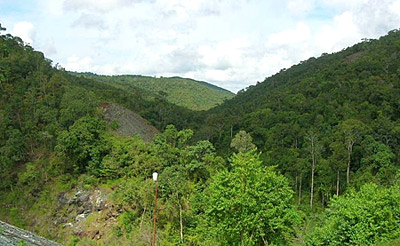
Bahira is a plant found in India which is used throughout the country as a medicinal herb. This Indian medicinal plant possesses botanical name Terminalia bellirica. This plant is indigenous to India and originates commonly in the deciduous as well as semi-evergreen forests. Bahira, an Indian medicinal plant grows in an elevation of about 900 m and is usually scattered not gregariously in the moist valleys.
 Bahira is known in different native names such as bahera, bahira, bhairah or boira in Bengali; bedda nut tree or belliric myrobalan (fruits) in English; behada, behedamunjhad, bahedo, behaza, behedan or bero in Gujarati;: bahera, behada, behera, bhaira, bharla or sag-ona in Hindi, santi, tari, thani, thare, tharo, vibhita or vibhitaka in Kannada; gotting or gutting in Konkani; tanni, thani or tusham in Malayalam; aska, bibhi-taka, vibhitaka, vibhitaki in Sanskrit; akkam, kattuelupay, tani, tanri, thandi, thandri, thani or vibidagam in Tamil,bahera, baira, balra, beheda, bhirda, sagwan, vavara or yehelabehada in Marathi; bahada, bhara or thara in Oriya; bahera or birha in Punjabi; bhutavasamu, tandra, tani, thadi, thadra or vibhitakamu in Telugu; behera in Urdu.
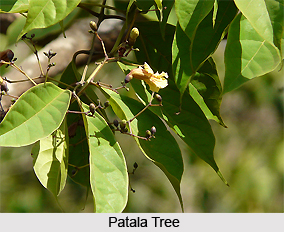
The Indian medicinal Plant, Bahira varies from medium-sized to large size. This tree reaches up to a height of 40 meter and is available with a straight stem. When the plant grows large, it sometimes is buttressed. Bahira features bluish-grey bark with many fine vertical cracks. The pubescent young branches and young leaves are appressed and are rufous. The leaves of this Indian medicinal plant are clustered simply and sometimes spirally arranged or whorled at the ends of branches. They are coriaceous in nature and are available broadly in elliptic to elliptic-obovate shape. Bahira have leaves that are 10 to 20 centimeter long and 4 to 15 centimeter wide. They are broadly rounded at base and rounded to emarginate at apex. The leaves of this medicinal plant margins entirely and the main nerves are available within 6 to 8 pairs. These nerves are spreading and prominent with 2.5 to 10 centimeter long petiole, without glands at apex.
Bahira is found with flowers which are pale greenish-yellow or creamy-white in colour. These flowers come with an offensive odour. The flowers are borne on solitary with simple axillary spikes which are 7 to 11 centimeters long. Those flowers in the upper part of the spike are male and are very shortly pedicelled. The flowers in the lower part of this Indian medicinal plant are hermaphrodite and sessile. They are bract linear and have the feature of early caduceus. The calyx is pubescent outside and woolly inside with long brown hairs and teeth broadly triangular as well as acute. In peninsular India, the flowers are available from March to May.
In the Indian Medicinal Plant, Bahira the fruits are broadly ellipsoid to sub-globose in shape. They are within 2.5 to 3 centimeters long and 1.5 to 2.5 centimeters in diameter. Each fruit is grey in colour and obscurely longitudinally with 5 to 6-ridged, densely fine yellow or brown-pubescent. These fruits of Bahira mature between January and April of the following year. In central India, these medicinal plants are found in the deciduous forests where they remain leafless from February and March to April and May.
Bahira has huge medicinal properties and uses in India. In Ayurveda, the fruit of the plant is considered to be laxative and anthelmintic. The fruit is used to treat diseases such as bronchitis, sore throat, biliousness, inflammations, strangury, asthma and ailment of the eye, nose, heart and bladder. The ripe fruit is used as an astringent, usually in combination with chehulic myrobalan from the fruits of Terminalia chebula and those of Phyllanthus emblica (Euphor-biaceae). When the fruit of the Bahira is combined with fruits of Terminalia chebula and Euphor-biaceae it forms Triphala or `three fruits`, a well-known Ayurvedic drug which is prescribed for a variety of diseases.
The fruit is also consumed half ripe. It is used as a purgative, due to the presence of oil with properties similar to those of castor oil (from Ricinus communis: Euphorbiaceae), mixed with honey, the pulp is used in an application to treat ophthalmic purposes. In Punjab, the fruit pulp finds great importance. It is used to treat dropsy, piles, diarrhoea and leprosy. The fruit peel is reportedly chewed to relieve coughs and colds by the Garasias in Rajasthan. The oil obtained from the fruits is used as hair oil and as an external application for rheumatism. In southern Orissa, the ash of the burnt fruits from this Indian medicinal plant is taken with rock salt to treat diarrhoea. The seed kernels possess narcotic properties. In Konkan, coastal districts of Maharashtra, it is sometimes eaten with betel-nut (Areca catechu: Arecaceae) and betel leaf (Piper betle: Piperaceae) for treatment of dyspepsia. The fruit pulp is also used for tanning and the seed oil for soap manufacturing.
In Siddha practice, the fruit, leaf and seed of Bahira are extensively used to treat guinea-worm infestation, leucorrhoea, venereal diseases, hypertension, pox and dyspnoea. The bark is used as a diuretic, and the gum as a demulcent and purgative. Bahira, Indian medicinal plant is known commercially as belleric myrobalan.
Bahira Plant
Among the Indian medicinal plants, Bahira has great importance as its leaves and fruits contain remedial properties.