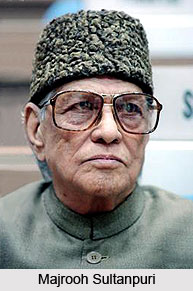
 Majrooh Sultanpuri, an Urdu poet, lyricist and songwriter, was born in 1919. Majrooh Sultanpuri had been one of the most powerful musical forces in Indian Cinema during the 1950s and early 1960s. Majrooh Sultanpuri was an important figure in the Progressive Writers` Movement. He was born as Asrar ul Hassan Khan in Sultanpur, Uttar Pradesh. Majrooh Sultanpuri`s father was a police sub-inspector. Sultanpuri completed the seven year course of Dars-e-Nizami in Arabic and Persian language and went on to attain the degree of becoming an Alim. Majrooh Sultanpuri then joined Lucknow`s Takmeel-ut-Tib College of the Unani System of Medicine. He became an established Hakim when he once recited one of his ghazals at a mushaira in Sultanpur. The ghazal became well known with the audience and he decided to drop his affluent medical practice and begin writing poetry in full-fledged. Very soon, he became a fixture at mushairas and also great friends with the renowned Urdu poet, Jigar Moradabadi.
Film Career of Majrooh Sultanpuri
In 1945, Majrooh Sultanpuri went to Mumbai and attended a mushaira at the Saboo Siddique Institute. Here his ghazals and poetry were highly commended by the audience and critics as well. Film producer A.R. Kardar was one of the impressed listeners and he contacted Jigar Muradabadi who helped him to meet Majrooh Sultanpuri. However, he initially refused to write for films but later agreed to the proposal.
 Sultanpuri met music composer Naushad who put the young writer to a test. He gave Majrooh Sultanpuri a tune and asked him to write something in the same meter, and he wrote Jab Usne Kesu Bikhraye, Badal Aaye Jhoom Ke.... Naushad was over whelmed with what he wrote and Majrooh Sultanpuri was signed on as the lyricist of the film Shah Jahan (1946). Sultanpuri was next jailed for his provocative writings during the partition. After his release he wrote for other hit movies like, Andaz, Daayra, Paying Guest, Nau Do Gyaarah, Kala Paani, to mention a few. Sultanpuri has to his credit of working with almost the popular music directors of his time like Khaiyaam, Kishore Kumar, Laxmikant-Pyarelal, Madan Mohan, Naushad, O.P.Nayyar, R.D.Burman, S.D.Burman, and Salil Choudhury. He has also worked with Bappi Lahiri, Basu Chakravarty, Ghulam Mohd., Hemant Kumar Mukhopadhyay, Husnlal-Bhagatram, Kalyanji Anandji, Shanker-Jaikishan, and many others.
Sultanpuru has also written poems which have been compiled and named `Ghazal` which contained 33 ghazals created in the period from 1944 to 1953. The anthology was published in 1959. Majrooh Sultanpuri had a severe attack of pneumonia and died in Mumbai on 24 May 2000.
Awards and Honours of Majrooh Sultanpuri
Majrooh Sultanpuri was considered the most notable ghazal writer and he won his only Filmfare Award for the song "Chahunga mein tujhe sham savere" in Dosti. He was also awarded the Dadasaheb Phalke Award in 1993. Majrooh Sultanpuri was the first lyricist to win the prestigious award named after Dadasaheb Phalke.
List of Majrooh Sultanpuri`s Masterpieces
Phir Wohi Dil Laya Hoon
Teesri Manzil
Baharon Ke Sapne
Pyar Ka Mausam
Caravan
Yaadon Ki Baraat
Hum Kisi Se Kum Nahin
Zamane Ko Dikhana Hai
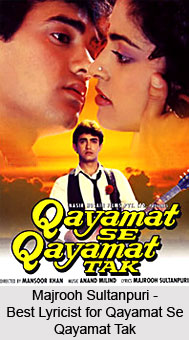
Qayamat Se Qayamat Tak
Jo Jeeta Wohi Sikander
Akele Hum Akele Tum