





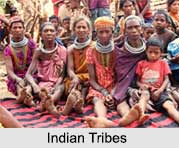
 Indian Tribes are abstract sections which hold in an astounding number of tribal populations in the country, meticulously assimilating each characteristic speciality. The distinction in the variety of the tribal people in India enriches the Indian culture and art. The tribes of India reflect a very unique and colourful picture of Indian culture. Indian Tribes are abstract sections which hold in an astounding number of tribal populations in the country, meticulously assimilating each characteristic speciality. The distinction in the variety of the tribal people in India enriches the Indian culture and art. The tribes of India reflect a very unique and colourful picture of Indian culture.
Origin of Indian Tribes First traces of tribes in India can be traced to the species known as ‘Ramapithecus’, discovered in the Shivalik Hills of the north-western Himalaya Mountain. This species, held to be the first in line of hominids, lived approximately 14 million years ago. Researchers have established that a species corresponding to the Australopithecus romped about in India roughly 2 million years ago. Demography of Indian Tribes According to Article 342 of the Constitution of India, at present, there exist 697 tribes notified by the Central Government. Indian tribal people amount to an 8. 6 percent of the nation’s total population, over 104 million people according to the 2011 census. These tribal people reside in approximately 15 percent of the country's area. Habitation of Indian tribes Indian tribes primarily reside in various ecological and geo-climatic conditions ranging from plains, forests, hills and inaccessible areas that perhaps lie dotted in the panoramic Indian terrain. These Indian tribal groups of people have been notified to reside in more than one State. More than half of the Indian tribal population is concentrated in the States of Madhya Pradesh, Chhattisgarh, Maharashtra, Odisha, Jharkhand and Gujarat. Division of Indian Tribes Research scientists opine that the population of India, including Indian tribes, is derived from six primary ethnic groups namely:  Negritos: The Negritos from Africa were the earliest tribesmen to populate India. They presently survive in their original home-ground in the Andaman and Nicobar Islands. The Jarawas, Onges, Sentinelese tribes and Andamanese Tribe are the perfect examples. Studies have indicated that the Onges tribes have been living in Andaman for the last 60,000 years. Pro-Australoids or Austrics: Some hill tribes like Irulars, Kodars, Paniyan Tribe and Kurumba Tribe are found only in patches among the hills of south India. This group of Pro-Australoids or Austrics was the subsequent bunch to arrive in India after the Negritos. They symbolise a race of people with wavy hair, prominent eye ridges, low foreheads and long heads. The Austrics are proudly known to be the main founders of the Indus Valley Civilisation. These people were of agrarian culture and they lived on cultivating vegetables and rice. Mongoloids: Mongoloids bear features that are common to people of Mongolia, China and Tibet. These tribal groups are located in the North-eastern portion of India in states like Assam, Nagaland and Meghalaya and also in Ladakh and Sikkim. Generally, these people are of yellow complexion, oblique eyes, high cheekbones, thinning hairline and medium height. Mediterranean or Dravidian: This group of tribesmen arrived in India from South-west Asia and appears to be people of the same bloodline as the people of Asia Minor and Crete and the pre-Hellenic Aegeans of Greece. They are presumed to have constructed up the city civilisation of the Indus Valley, whose remains have been discovered at Mohenjo-Daro and Harappa and other Indus cities. The Dravidians are believed to have circulated in the entire part of India, replacing Negritos and Austrics equally. Dravidians incorporate the three sub-types namely the aloe-Mediterranean, the true Mediterranean and Oriental Mediterranean. Western Brachycephals: The bunch of Western Brachycephals includes the Alpinoids, Dinaries and Armenois. The Coorgis and Parsis of Indian tribal origin fall into this category. Nordics: Nordics or Indo-Aryans are the last immigrants into India. They were a division of Indo-Iranians, who had originally left their homes in Central Asia, approximately 5000 years ago and had settled in Mesopotamia for some centuries. The Aryans must have arrived into India within 2000 and 1500 B.C. Their first home in India was western and northern Punjab, from where they scattered to Ganges Delta and beyond. These tribes are now mainly witnessed in the Northwest and the Northwest Frontier Province (NWFP). |
| ||||||||||||||||||||||||||||

