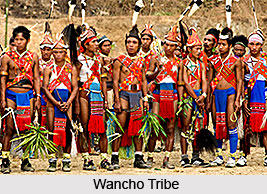
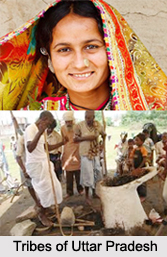
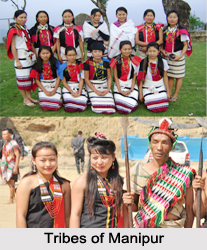
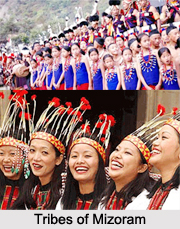
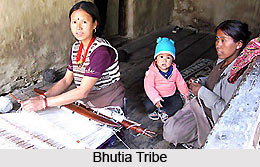
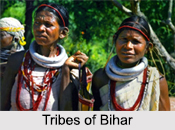
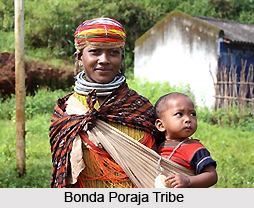
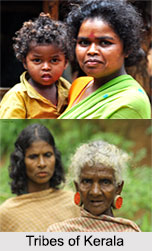
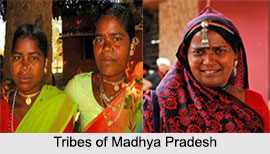
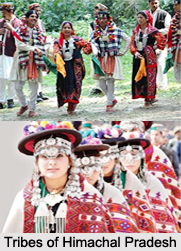
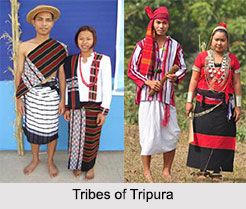
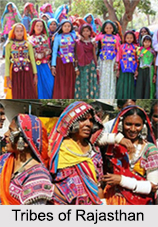
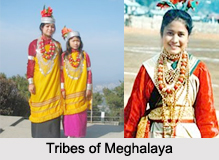
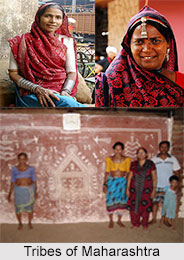
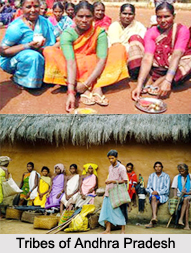
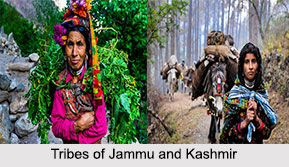
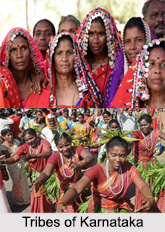
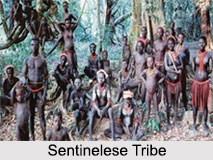
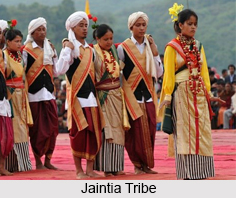
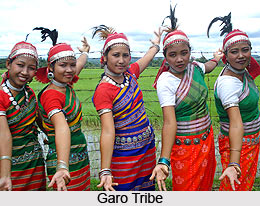
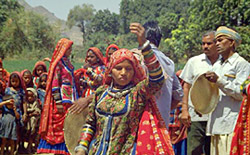
Indian Tribal Society is an imperfect segment or a social group with strict territorial affiliation. They possess characteristics of endogamy, with no specialisation of functions ruled by tribal officers. They are united in language or dialect recognising social distance with other tribes. According to Indian aboriginal traditions, the tribal societies inhabit and remain within a definitive and common topography. These members generally marry within their own group, but now due to heightened contact with outsiders there are instances of tribal tying the knot outside as well. A typical Indian tribal societal group believe in ties of blood relationship amongst its members. They have faith in their having descended from a common, real or mythical, forerunner and thus believe in blood relationships with other members. Tribes follow their own political organisation which preserves eternal harmony. Religion is of supreme importance in an Indian Tribal Society. A tribal political and social organisation is always based upon religion, because they are granted religious sanctity and appreciation.
History of Indian Tribal Society
Tribal people in India are called "Adivasi". They generally live outside the mainstream of Indian Hindu and Muslim society. They are regarded as the original inhabitants of the forest of India. Tribals have a long and rich cultural past which they have maintained their way of life throughout the years.
Prior to the caste system, people were divided into different tribes. At that time, each tribe was a homogenous and self-contained unit without any hierarchical discrimination. Each tribe had a chief for its protection. Gradually, the chief assumed political and military power and was recognized as the ruler. Thus, there emerged the republics and monarchies. Tribes were associated with large kingdoms. Each tribe had its own system of administration.
Education in Indian Tribal Society
Educationally, the tribal population is next to illiterate. This permanent settlement has witnessed some reformatory changes owing to the steps taken by the Government, as for example the reservation policy. Formal education is rarely considered to discharge their social obligations.
Occupation of Indian Tribal Society
When it comes to India, mainstream tribes live under poverty line. Their inherent occupation consists of civilization"s archetypal occupations such as hunting, gathering and agriculture.
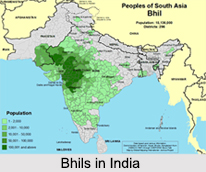
An enormous section of Indian tribal societal population depends on agriculture as their sole way for survival. Some of the agricultural tribes are: Oraons, Mundas, Bhil tribe, Santhal tribe, Baigas and Hos. In some parts of India tribal people are engaged in shifting cultivation. Many auxiliary occupations, like handicrafts are undertaken in various tribal societies of India. These include basket-making, spinning and weaving. For example, the Tharu tribe depends upon furniture making, manufacturing musical instruments, weapons, ropes and mats. The Korw and Agaria tribes are well known iron-smelters producing tools for local use.
Language of Indian Tribal Society
Indian tribal society possesses own set of languages, which are unwritten. Hence the degree of communication both in time and space is predictably narrow. Members of a tribe possess an awareness of mutual unity speaking a common language. The continual amalgamation with other tribes, the tribal culture is undergoing a revolutionary change. Influence of the Christian missionaries has administered the growing problem of bilingualism which has developed progressively leading to indifference towards tribal language.