


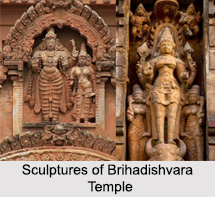
 Sculpture of Brihadishvara Temple at Thanjavur, Tamil Nadu is one of the finest examples of Chola art and architecture. This South Indian Shiva temple, dedicated to Lord Shiva, has been built with the help of granite. Sculpture of Brihadishwara Temple is built by following the features of Dravidian sculpture and architecture. Besides the foliage sculpture and the images of Hindu Gods and Goddesses the gopuram or gateway, leading to the temple complex, is worth checking out. The sculpture of Brihadishwara Temple is unique in its enormity. Sculpture of Brihadishvara Temple at Thanjavur, Tamil Nadu is one of the finest examples of Chola art and architecture. This South Indian Shiva temple, dedicated to Lord Shiva, has been built with the help of granite. Sculpture of Brihadishwara Temple is built by following the features of Dravidian sculpture and architecture. Besides the foliage sculpture and the images of Hindu Gods and Goddesses the gopuram or gateway, leading to the temple complex, is worth checking out. The sculpture of Brihadishwara Temple is unique in its enormity.
Gateway Sculptures of Brihadishvara Temple There are three gopurams or gopuras that mark the gateway of the Brihadishvara Temple. These gopurams have their names: the Rajarajan-tiruvasal (the innermost gopuram), Keralantakan-tiruvasal (the middle gopuram) and the outermost one. These gateways, too, are built of the hard granite. While the inner and the middle gopurams were built with the temple, the outer one dates back to the Maratha period. The first two gateways have been intricately carved. The sculpted figures of Hindu deities adorn the walls of these massive structures. Some of the images that are found on the Rajarajan-tiruvasal are the marriage of Lord Shiva and goddess parvati, Arjuna winning the 'pasupata' weapon and the Lord Shiva giving shelter to Markandeya. It is interesting to note that all these events are related to Shaivism. Sculptures inside the Brihadishvara Temple The niches of the 'bhumi' portion have been adorned with sculpted figures of Durga, Shiva and Vishnu. While the upper nooks have been filled with these figurines, the lower ones have been decorated with the well carved images of Lord Ganesha, Lord Vishnu with Sridevi and Bhudevi, Godddess Lakshmi, Vishnuanugraha-murti, Bhikshatana, Virabhadra, Dakshina-murti, Kalantaka and Natesa. On the north side of the temple, there is a big panel in which Shiva is depicted showing kindness to his servant, Chandikeshvar. Also one can see the Shiva Bhikshatan Murti or Shiva begging in order to atone for his sin for having cut off one of Brahma's five heads. Shiva Kalantak, Mahish-asur-mardini or Goddess Durga with ten arms, Lord Bramha with his consorts Savitri and Saraswati, Shiva Bhairav with eight arms and Shiva Madanantak are the other images. On the outside of the central shrine, that falls under the southern part, there are fine sculptures of Chandesh-anugrah Murti, Lord Ganesha, Ardh-narishvar, Harihar and Nataraja. In this scene, Vishnu is shown beating a drum, while Ganesha and Kartik arrive on their mounts; Devi is looking on, one arm resting on the Bull Nandi. Shiva is depicted here as Dakshina Murti or teacher of the South. On the west side of the temple there is Shiva Gangadhar (receiving the Earth on his hair), while Devi stands on one side and the ascetic Bhringi does penance in order to bring about the fall of the Earth. Then there is image of Vishnu worshipping Shiva with flowers. Lord Vishnu is portrayed with his consorts here. In a dark corner of the temple there is a sculpture of the Nine Planets. Paintings have also been handsomely used to decorate the temple walls. Besides these, the upper ambulatory shows Lord Shiva in various dance postures or in the form of Nataraja. Other sculptures that beautify the temple walls are the images of Ardhanarisvara, Gangadhara, Virabhadra, Alingana-Chandrasekhara, Saraswati, Mahishamardini, Ganesha, Vrishavahana, Bhikshatana, Narasimha, Varaha and Bhairava. The Hindu mythological tales come alive on the stone walls of Brihadishvara Temple. |
| |||



Home > Art & Culture > Indian Sculpture > Indian Temple Sculptures > South Indian Temple Sculpture > Chola Sculptures > Sculpture of Brihadishvara Temple
Sculpture of Brihadishvara Temple
| Sculpture of Brihadishvara Temple reveals the typical features of Chola art and architecture. This temple was built in the 11th century. |
| ||||||||||||||||||||||||||||

