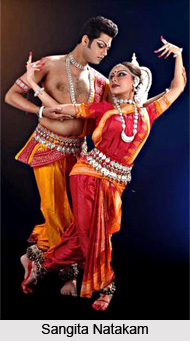
 Sangita Natakam is a musical drama which is known as Geya Natakam in Sanskrit, Isai Natakam in Tamil and Opera in English. It is a type of musical form popular in South India which contains a story, set with songs in Carnatic Music and verses with intermittent Vachanna rendered in a dramatic way, by using conversational style besides indirect passages.
History of Sangita Natakam
From ancient times, the Tamil language was classified under three distinct categories, iyal or prose, icai or lyric, and natakam or drama. The widespread tradition of Panars or minstrels can be discovered in sangam works. On more formal stages, however, dance performances giving expression to songs passed for theatre. From commentaries on the Cilappatikaram, it can be learnt that numerous texts on natakam dealt with the grammar of music and dance.
Epigraphic evidence testifies that one Rajarajesvara natakam i.e. `Drama of Lord Rajaraja` was performed in the Brihadeswara temple. It precinct`s at Thanjavur during the reign of Rajendra Chola eulogizing his father, Rajaraja Chola. It seems to have been a story presented by a dancer to musical accompaniment. During the time of the Telugu Nayak chieftains who ruled Tamil Nadu in the seventeenth and eighteenth centuries, the Yakshaganam of Andhra was introduced and many such librettos composed. Some survive in palm-leaf manuscripts at the Madras Oriental Library and Saraswati Mahal Library, Thanjavur, such as Nili yakshaganam or `Nili`s Yakshaganam`, Saratigadeva yakshaganam i.e. `Sarangadeva`s Yakshaganam`, Sirutonda yakshaganam or `Sirutonda`s Yakshaganam`, and Narasimha vijaya yakshaganam i.e. `Yakshaganam of Narasimha`s Victory`, etc. Vattala Rajan yakshaganam i.e. `Vattala Raja`s Yakshaganam`, Madana Sundara vilasam i.e. `Madana Sundara`s Vilasam`, Pandiya Keli vilasa natakam i.e. `Vilasam Drama of Pandiya Keli`, and Pururava natakam or `Pururava`s Drama` have been published. These, as distinct from Kannada Yakshagana, can be classed as operatic, since their stories unfold in the form of dramatized songs. Bhagavata Mela uses similar Telugu texts.
Sangita Natakam and Cinema
In this form, all discourse was in classical Carnatic music, there were hardly any prose dialogues, and the actors vied with one another in exhibiting their singing art. Cinema (movies) lifted this musical form of presentation lock, stock, and barrel while succeeding and replacing theatre as favoured entertainment. Hit productions were made into films and singing stars of the stage became film stars. But the theatrical trend continued till the late 1940s.
Popularity of Sangita Natakam Music
The music of sangeeta natakas kick started with the introduction of Tamil sangeeta natakas such as Pavizhakkodi, Valli tirumanam, and Nandanar caritram to name a few about a hundred years ago. The popularity of the Tamil dramas incited many native writers and musician-scholars to compose Malayala natakas in their model.
Thus, there began an age of sangeeta natakas like Sadarama, Dhruvacaritam, Parijata pushpaharanam, Harischandra caritam, Sangeeta naishadham, Nalla thankai etc., which beautifully captured the whole of Kerala stage.
People Famous for Sangita Natakam
To its credit, Sangita Natakam gave a platform to legendary exponents of Carnatic classical, in turn making that music not the exclusive preserve of elites and connoisseurs, but popular among the untutored masses. It threw up names like S. G. Kittappa, K. B. Sundarambal, M. K. Thyagaraja Bhagavathar, and P. U. Chinappa, and employed giants of the classical concert establishment like Maharajapuram Vishwanatha Iyer, Rajaratnam Pillai, M. S. Subbulakshmi, Dandapani Desikar, N. C. Vasantaka Kokilam, and G. N. Balasubramaniam, creating a golden era for classical music.