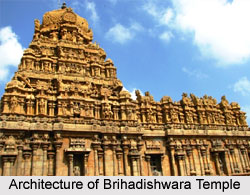
Architecture of Brihadeeswarar temple symbolizes the summit of Dravidian architecture in its purest form: meticulous ideas and impeccable execution of architectural layout. The
Shiva linga is placed in the sanctum. The `pradakshinapata` consists of three massive sculptures of
Lord Shiva. The Brihadeswara Temple at Thanjavur symbolizes the summit of the Dravidian sculpture and architecture in its purest form: meticulous ideas and impeccable execution of the carved figures. The temple consists of
garbhagriha, ardhamandapa, mahamandapa and mukhamandapa. The entire complex is protected by an enclosed wall. This wall has been decorated with low two-storeyed cloistered structure. These structures are also known as the `prakara.` At an elevated level the temple comprises the adhishthana, bhumi (wall), prastara (entablature) that includes talas, griva (neck), shikara and is topped by a kalasha.
The temple is made up of many structures that are aligned axially. One can enter either one axis through a five-storey gopuram or to the huge main quadrangle through a smaller gopuram. The temple has a huge shikhara with sixteen articulated stories. Every surface of shikhara is covered with Pilaster, piers and attached columns. The main temple is situated in the center of the spacious quadrangle that consists of a sanctuary, a
Nandi, a pillared hall, assembly hall and many sub-shrines. The inner mandapa is surrounded by huge walls that are divided into different levels. Each side of the sanctuary has a bay that stresses the chief cult icon. The inner most chamber takes the form of a miniature vimana with other features resembling the southern Indian temple architecture. The garbhagriha is square that houses the deity. The royal bathing-hall is located to the east of the hall of Irumudi-Soran.
The inner mandapa leads to a rectangular mandapa and then to a twenty-columned porch which has three staircases that lead downwards. There are two walled enclosures that surround the main temple.
The vimana of this temple is 60.96 m high and stands on a plinth that measures 45.72 metre square. None other Dravidian temple in India has such a high vimana as Brihadeswara Temple. Further the `adhishthana` has inscriptions running all around it.
There are several subsidiary shrines that are located within the temple complex. One of these shrines is the Chandikeswara temple that is located to the north of the garbhagriha. A Nandi shrine is also to be found here but it was probably a later addition made by the Nayaks in the 16th century A.D.

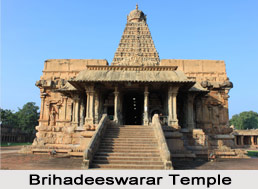 Brihadeeswarar Temple is the world`s first complete granite temple. It is an excellent specimen of architecture of the Chola dynasty. It is dedicated to Lord Shiva. The temple stands amidst fortified walls which were an additionally created in the sixteenth century. The temple`s vimana is the tallest of its kind in the world.
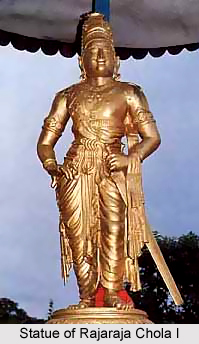 History of Brihadeeswarar Temple, situated in