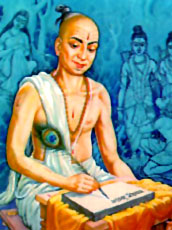
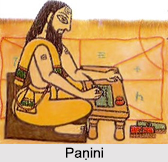
 Panini is described in the Indian history as the greatest known grammarian of ancient India. He is known for his text ` Ashtadhyayi ` which is a sutra-style treatise on Sanskrit grammar.
Panini was ranked among the Rishis and at a later period of Sanskrit literature, was supposed to have received the fundamental rules of his work from Lord Shiva himself. He lived in the northwest Indian subcontinent during the Mahajanapada era. Panini gave a complete and scientific theory of phonetics, phonology and morphology. Sanskrit was the classical literary language of the Indian Hindus and Panini is considered the founder of the language and literature.
Panini is described in the Indian history as the greatest known grammarian of ancient India. He is known for his text ` Ashtadhyayi ` which is a sutra-style treatise on Sanskrit grammar.
Panini was ranked among the Rishis and at a later period of Sanskrit literature, was supposed to have received the fundamental rules of his work from Lord Shiva himself. He lived in the northwest Indian subcontinent during the Mahajanapada era. Panini gave a complete and scientific theory of phonetics, phonology and morphology. Sanskrit was the classical literary language of the Indian Hindus and Panini is considered the founder of the language and literature.
Early Life of Panini
Panini lived during the sixth or fifth century BCE and was born in Shalatula, a town near to Attock in present day Pakistan. Nothing certain is known about Panini"s personal life. Panini is mentioned in Indian fables and ancient texts like The "Panchatantra". According to the "Mahabhasya" of Patanjali, his mother"s name was Daksi. According to later traditions, his maternal uncle"s name was Vyad. Some scholars suggest that his brother"s name was Pingala. His father"s name has been given as Panina, from which the name Panini derives.
Literary Works of Panini
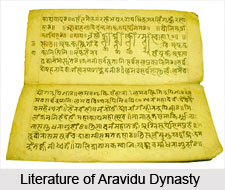
Panini"s work has had quite an impact on the modern linguistics. Among Panini"s works, the most famous and major one is "Astadhyayi". It is a thesis that consists of eight chapters and each chapter is subdivided into quarter chapters. The "Ashtadhyayi" is the oldest surviving complete linguistic and grammar text of Sanskrit and Paini refers to previous texts and authors such as the Unadisutra, Dhatupatha, and Ganapatha some of which have not survived. This treatise chiefly highlights the difference between the language of sacred texts and the language used for communicating in normal lives. A basic set of rules and definitions was given to describe Sanskrit grammar. Starting with about 1700 basic elements like nouns, verbs, vowels, consonants, he explained the use of them and divided them into classes. He then went on to explain the construction of sentences and the use of compound nouns and tenses. Panini"s construction is very similar to the principles and function of mathematics defined today.
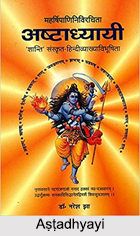 Panini`s grammar consists of eight "Adhyayas", or books. Each book comprised of four Padas, or chapters, and each chapter a number of Sutras or aphoristically rules. The arrangement of these rules differ completely from what a European would expect in a grammatical work, for it is based on the principle of tracing linguistic phenomena, and not concerned in the classification of the linguistic material as to the so-called parts of speech. A chapter, for instance, treating of prolongation of vowels, will deal with such a fact whenever it occurs, be it in the formation of bases, or in conjugation, declension, composition and many more. The rules of conjugation and declension are, for the reason, not to be met with in same chapter or in the same order in which European grammars would teach them; nor would any single book or chapter, however apparently more systematically arranged.
In a universal way, Panini`s work called a natural history of the Sanskrit language, in the sense that it has the strict tendency of giving an accurate description of facts, instead of making such a description subservient to the theories according to which the linguistic material is usually distributed by European grammarians. As the method of Panini requires in a student the power of combining many rules scattered all over the work, and of combining, also, many inferences to be drawn from these rules, it exercises, moreover, on the mind of the student an effect analogous to that which is supposed to be the peculiar advantage of the study of mathematics.
Katyayana disapproved the grammatical rules of Panini. Many authors commented the rules of Panini. The best existing commentary on them is that called the Kasikavritti, by Vamana Jayaditya, which follows these rules in their original order. At a later stage attempts were made to arrange the rules of Panini in a manner which approaches more to the European method; the chief work of this category is the Siddhanta Kaumuti, by Bhattojidikshita. Panini mentions, in his Sutras, several grammarians who preceded him, amongst others, Sakatayana.
At present, Panini`s work still remains the oldest existing grammatical work of India, and probably of the human race. Panini`s use of transformations and recursion together make his grammar as rigorous as a modern Turing machine. Panini`s grammar can be considered to be the world`s first formal system. To design his grammar, Panini used the method of `auxiliary symbols`, in which new affixes are designated to mark syntactic classes and the control of grammatical derivations. This technique was rediscovered by the logician Emil Post and is now a standard method in the design of computer programming languages.
The "Aadhyayi" is the central part of Paini`s grammar and by far the most complex. It is the oldest surviving complete linguistic and grammar text of Sanskrit and Paini refers to previous texts and authors such as the "Unadisutra", "Dhatupatha" and "Ganapatha" some of which have not survived. It complements the Vedic ancillary sciences such as the "Niruktas", "Nighantus", and "Shiksha". It consists of 3,959 sutras or "aphoristic threads" in eight chapters.