Introduction
 Panchatantra is a compilation of inter-woven series of tales in prose and poetry, mostly animal fables. Tales of this ancient Indian work, the original texts of which is now long lost, portray the origins of the subcontinent"s language and primitive lifestyle. The collection of fables in Panchatantra reveals the basic knowledge of wisdom that makes one"s life "richer, happier and fuller".
Panchatantra is one of India"s most influential contributions to world literature. Through cross-border mutations, adaptations and translations, the Panchatantra remains the most popular work of literature.
Origin of Panchatantra
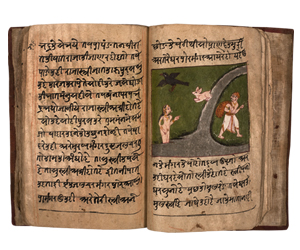 Origin of Panchatantra has been attributed to a city in southern India named Mahilaropya. The king in the city was Amarshakti. He in order to develop interest in his sons in knowledge and develop their minds gave Vishnu Sharma the responsibility. Vishnu Sharma took his three sons home. He had developed his lessons in interesting stories that were woven beautifully around animal characters.
The origin of Panchatantra as have been earlier said has been divided into four versions. Pahlavi is the first version of the Panchatantra that was created before A.D. 570. Though it is lost now it can be recreated from an Old Syrian and an Arabic version with the later texts based on the Arabic version. The second is the version produced in north-west India, which was interused in the version of Gunadhya`s Brhatkallui. The third is the two Kashmir versions styled Tantra khyayika and by two Jain texts. Fourth is the common ancestor of the Southern Panchatantra, the Nepalese Panchatantra and the Hitopadesha. The Nepalese Panchatantra and the Southern Panchatantra are derived from a version sister to the Southern Panchatantra now lost.
Hertel concluded that these four sources ought to be reduced to two, the Tantrakhyayika original and ` K`, the source of the other three groups. This is unlikely. There is no adequate ground for Hertel`s further assumption of another transitional archetype from which the Pahlavi, the Southern Panchatantra group are descended.
The sense of the term is uncertain. It is uncertain as to what the word Tantra mean. However it is likely that Panchatantra meant originally five subject-matters. It is a thesis dealing with five contents. It has been considered that it was written long after 200 B. C. It is sure that it has definitely been written after the Christian era though it is not correct to assign it to the second century A. D. Evidences suggest that it fell in the period of the Brahmanical restoration and expansion under the Gupta Empire.
It has also been considered that the author was a Brahmin. Vishnusharma is described as relating the tales to the sons of king Amarashakti of Mahilaropya in the Deccan as a sign of southern origin. According to Hertel this book was composed in Kashmiri. The places of pilgrimage mentioned are Pushkar, Gangadvara, Prayaga and Varanasi.
Compilation of Panchatantra
Panchatantra has been composed by Vishnu Sharma and is considered by most scholars to be dated around 3rd century BCE. It is based on older oral traditions. Panchatantra was compiled in Sanskrit and Pali languages.
Divisions of Panchatantra
Many colourful fables have been inter-woven in Panchatantra. It starts with an introduction about the author. The rest of the composition is shown as a narration to the princes that constitute five parts.
Each of these parts contains a main story known as the frame story which again contains several stories in it. It is like one character narrating a story to another. The characters quote various epigrammatic verses in order to make their point. The Panchatantra consists of 5 parts which are as follows:
1. Mitra-Bheda: Separation of Friends (The Lion and the Bull)
2. Mitra-Labha or Mitra-Samprapti: Gaining of Friends (The Dove, Crow, Mouse, Tortoise and Deer)
3. Kakolukiyam: War and Peace (The Crows and Owls)
4. Labdhapranasam: Loss of Gains (The Monkey and the Crocodile)
5. Apariksitakarakam: Rash deeds (The Brahman and the Mongoose)
Mitra-Bheda: In Mitra-Bheda, the lion (Pingalaka) who is the king of the forest and a bull (Sanjivaka) become friends. Karataka and Damanaka are two jackals who are retainers to the lion. Damanaka breaks the friendship between the lion and the bull as he became jealous. This has around thirty stories that have been narrated by the two jackals. It is the longest of the five books.
Mitra-Labha or Mitra-Samprapti: In Mitra-Samprapti the story of the crow has been narrated. The crow upon seeing the favour the rat did to the dove and her companions, decides to be a friend of the rat despite the rat objecting initially. The friendship grows and it also includes the turtle and the fawn. They team up to save the fawn when he is trapped as well as later work together to save the turtle that falls in the trap.
 Kakolukiyam: Kakolukiyam deals with a war that takes place between crows and owls. One of the crows pretends that he is an outcast from his own group. He does this so that he can gain entry into the rival owl group and thereby can gain access to their secrets and learn of their exposure. He later tells his group of crows to set fire on all entrances to the cave where the owls live.
Labdhapranasam: Labdhapranasam deals with the artificial symbiotic relationship between the monkey and the crocodile. The crocodile conspires to acquire the heart of the monkey to heal his wife. When the monkey comes to know of this he avoids this severe destiny.
Apariksitakarakam: In Apariksitakarakam, a Brahman leaves his child with a mongoose friend of his. When he returns he finds blood on the mongoose`s mouth, he kills it. Later he comes to know that the mongoose actually protected his child from a snake.
Panchatantra is a unique collection that has equally delighted the young and the old, educated and uneducated, rich and poor, high and low – for over two thousand years. It has triumphed over the greatest obstacles of language, custom and religion and continues to delight everyone to this very day.
Each of these parts contains a main story known as the frame story which again contains several stories in it. It is like one character narrating a story to another. The characters quote various epigrammatic verses in order to make their point. The Panchatantra consists of 5 parts which are as follows:
1. Mitra-Bheda: Separation of Friends (The Lion and the Bull)
2. Mitra-Labha or Mitra-Samprapti: Gaining of Friends (The Dove, Crow, Mouse, Tortoise and Deer)
3. Kakolukiyam: War and Peace (The Crows and Owls)
4. Labdhapranasam: Loss of Gains (The Monkey and the Crocodile)
5. Apariksitakarakam: Rash deeds (The Brahman and the Mongoose)
Mitra-Bheda: In Mitra-Bheda, the lion (Pingalaka) who is the king of the forest and a bull (Sanjivaka) become friends. Karataka and Damanaka are two jackals who are retainers to the lion. Damanaka breaks the friendship between the lion and the bull as he became jealous. This has around thirty stories that have been narrated by the two jackals. It is the longest of the five books.
Mitra-Labha or Mitra-Samprapti: In Mitra-Samprapti the story of the crow has been narrated. The crow upon seeing the favour the rat did to the dove and her companions, decides to be a friend of the rat despite the rat objecting initially. The friendship grows and it also includes the turtle and the fawn. They team up to save the fawn when he is trapped as well as later work together to save the turtle that falls in the trap.
Kakolukiyam: Kakolukiyam deals with a war that takes place between crows and owls. One of the crows pretends that he is an outcast from his own group. He does this so that he can gain entry into the rival owl group and thereby can gain access to their secrets and learn of their exposure. He later tells his group of crows to set fire on all entrances to the cave where the owls live.
Labdhapranasam: Labdhapranasam deals with the artificial symbiotic relationship between the monkey and the crocodile. The crocodile conspires to acquire the heart of the monkey to heal his wife. When the monkey comes to know of this he avoids this severe destiny.
Apariksitakarakam: In Apariksitakarakam, a Brahman leaves his child with a mongoose friend of his. When he returns he finds blood on the mongoose`s mouth, he kills it. Later he comes to know that the mongoose actually protected his child from a snake.
Panchatantra is a unique collection that has equally delighted the young and the old, educated and uneducated, rich and poor, high and low – for over two thousand years. It has triumphed over the greatest obstacles of language, custom and religion and continues to delight everyone to this very day.