


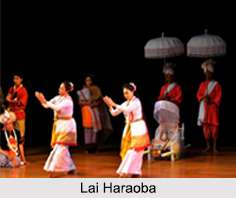
 Celebrated primarily among the Meitei community, the festival of Lai Haraoba is observed to honour the traditional deities of Sanamahism. It is one of the popular festivals of Manipur that is equally seeped in both religious rites and customs along with the Manipuri dance form. This spring festival is a harmonious blend of stylised and ritualistic dances for peace and prosperity. Celebrated primarily among the Meitei community, the festival of Lai Haraoba is observed to honour the traditional deities of Sanamahism. It is one of the popular festivals of Manipur that is equally seeped in both religious rites and customs along with the Manipuri dance form. This spring festival is a harmonious blend of stylised and ritualistic dances for peace and prosperity.
Origin of Lai Haraoba There are several legends associated to the origin of the festival of Lai Haraoba. First there is the legend of Guru Sidiba, who was known to be the Supreme God. He lived in a dark void but one day his room was illuminated with a rainbow. Seeing the myriad colours of the rainbow inspired him to create the world. This entire framework of creating mankind and the universe around is represented in the ritualistic dance form of Lai Haraoba. According to another legend, it is believed that the Lai Haraoba dance has originated from a Manipuri scripture called Leithak Leikharole. Performance of Lai Haraoba The festival of Lai Haraoba celebrates the process of creation and 12 events display the phases of creation and thus there are 12 different types of the dance. First is the Leikoba, which is performed by both men and women on the first day of the festivities. Then there is the Hailava followed by Aman Athou Kofaya, which is considered as an outburst of happiness of the performers as they worship the God. The 4th type of the Lai Haraoba dance is performed by a female devotee as it depicts the Great Guru sending a Goddess to a dangerous place during the time of creation. This way, the dance proceeds and finally comes the 11th type which is called the Ugri Hanjen and is a representation of the history of mankind. This is followed by the 12th and final type called the Leren Mathek, which means the zig-zag of a snake. The ritualistic dance of Lai Haraoba is performed by playing the famous folk song called Lai Haraoba Ishei. This song contains lyrics with veiled references to erotic mysticism. The main quality of the song is the rhythm in its tune. Musical Instruments of Lai Haraoba The musical instruments play an important role in the Lai Haraoba dance. The orchestra of Lai Haraoba comprises of a big drum, gongs, bamboo flutes, ‘Manjira or small cymbals and a ‘Pena’, which is a stringed instrument of Manipur. The instrument is made up of a coconut which is broken into two halves. Once the instrument is made, it produces a ‘Sarangi’ like effect. Costumes of Lai Haraoba The Lai Haraoba costume known as Aharya is based on the designs of Manipur. The dress patterns bear its reference to mythological customs of Manipur. The saree worn by them is a one piece long cloth which is tied at the waist. It has a dark green background with golden stripes and decorated borders. Along with the saree, satin half sleeved blouse is also worn. The head dress worn during the Lai Haraoba dance is made up of thick green velvet fur fabricated with golden ribbons. The females accessorize their outfit with attractive ornaments like necklaces, ear rings and bracelets. The long flowing hair that sways with the movement of the head adds charm to their looks. The male dancers do not wear an upper garment. Their dhotis are made up of a coloured silk cloth. They also accessorize their looks with ornaments like necklaces, armlets and rings. Before the advent of the Vaishnavism among the Manipuris, the Lai Haraoba had a prominent place among them. It was an important custom to perform the dance during the worship of their guardian deities like Thangjing, Wangbaren, Maijing, Koubru and Pakhangba the royal deity. The Lai Haraoba dance technique was later manifested into the Khamba and Thoibi dance pattern. |
| |||



Home > Art & Culture > Indian Festivals > Indian Regional Festivals > Festivals of Manipur , India > Lai Haraoba
Lai Haraoba
| The festival of Lai Haraoba is a popular festival in the state of Manipur that is observed by the Meitei community and is basically a ritualistic song and dance form which depicts the creation of the Universe. |
| ||||||||||||||||||||||||||||

