


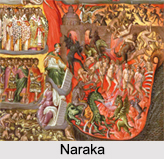
 Naraka is the Hindu concept of hell, where sinners are anguished after death. Naraka is a Sanskrit word which literally means ‘underworld’. Naraka is situated above Garbhodaka Ocean. It is also the residence of Yama, the god of Death. It is believed that Naraka is located in the south of the universe and under the earth. Naraka is the Hindu concept of hell, where sinners are anguished after death. Naraka is a Sanskrit word which literally means ‘underworld’. Naraka is situated above Garbhodaka Ocean. It is also the residence of Yama, the god of Death. It is believed that Naraka is located in the south of the universe and under the earth.
Even ‘Muktiyogyas’, where the souls are eligible for ‘mukti’ or ‘moksha’ and ‘Nitya-samsarins’ are forever transmigrating ones in ‘Dvaita’ theology can experience Naraka for punishment. After the completion of the punishment period, they are reborn on earth as human or animal bodies. Illustration of Naraka in Different Religions According to several religions like Hinduism, Sikhism, Jainism and Buddhism, Naraka means a place of suffering, or in simple words it means Hell. Following are the different types of representation of Naraka in different religions: 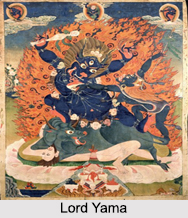 Hinduism: In Hinduism Naraka is compared to the Abrahamic concept of Hell. It is mentioned specifically in dharmasastras, itihasas and Puranas. The Shatapatha Brahmana is the first manuscript to mention the pain and suffering of Naraka in detail. The epics also explain Hell in broad terms as a dark forest without water and no rest. In the Hindu epic Mahabharata, the story of Naraka ends with Yudhishthira's visit to hell after being offered recognition into heaven. A social sound for Hinduism of reincarnation in Hell is apparent in the metric work of the Manusmriti. Manusmriti is a written discourse focused on the ‘rule of the social classes’. Moreover, Naraka is also mentioned in Vedic Sanhita, Aranyaka and Upanishads. In the Upanishads it is said that Naraka is 'darkness' instead of hell. A summary of Upanishads and Bhagavad Gita mentions hell in several times. Adi Sankara declared Naraka on Vedanta sutra. Hinduism: In Hinduism Naraka is compared to the Abrahamic concept of Hell. It is mentioned specifically in dharmasastras, itihasas and Puranas. The Shatapatha Brahmana is the first manuscript to mention the pain and suffering of Naraka in detail. The epics also explain Hell in broad terms as a dark forest without water and no rest. In the Hindu epic Mahabharata, the story of Naraka ends with Yudhishthira's visit to hell after being offered recognition into heaven. A social sound for Hinduism of reincarnation in Hell is apparent in the metric work of the Manusmriti. Manusmriti is a written discourse focused on the ‘rule of the social classes’. Moreover, Naraka is also mentioned in Vedic Sanhita, Aranyaka and Upanishads. In the Upanishads it is said that Naraka is 'darkness' instead of hell. A summary of Upanishads and Bhagavad Gita mentions hell in several times. Adi Sankara declared Naraka on Vedanta sutra.
The names of Naraka is common in Hinduism namely Tamisra (darkness), Andhatamisra (blind-darkness), Raurava (fearful), Maharaurava (great-fearful), Kumbhipaka (cooked in a pot), Kalasutra (thread of Time/Death), Asipatravana/Asipatrakanana (forest of sword leaves), Shukaramukha (hog's mouth), Andhakupa (well with its mouth hidden), Krimibhojana/Krimibhaksha (worm-food), Sandansa/Sandamsa (hell of pincers), Taptasurmi/Taptamurti (red-hot iron statue), Vajrakantaka-salmali (silk-cotton tree with thorns like thunderbolts), Vaitarni/Vaitarna (to be crossed), Puyoda (water of pus), Pranarodha (obstruction to life), Visashana (murderous), Lalabhaksa (saliva as food), Sarameyadana (hell of the sons of Sarama), Avici/Avicimat (waterless/waveless), Ayahpana (iron-drink), Ksarakardama (acidic/saline mud/filth), Raksogana-bhojana (food of Rakshasas), Shulaprota (pierced by sharp pointed spear/dart), Dandasuka (snakes), 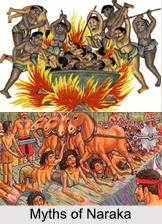 Avata-nirodhana (confined in a hole), Paryavartana (returning), Sucimukha (needle-face), Rodha (obstruction), Sukara (hog), Tala (padlock), Taptakumbha (hot pots), Taptaloha (hot iron), Mahajwala (great-fire), Lavana (salt), Vimohana (the place of bewildering), Krimisha (hell of insects), Vedhaka (piercing), Adhomukha (head-inverted), Puyavaha (where matter falls), Rudhirandha (wells of blood), Krishna (dark/black), Vahnijwala (fiery flame) and Shwabhojana (food of dogs). Avata-nirodhana (confined in a hole), Paryavartana (returning), Sucimukha (needle-face), Rodha (obstruction), Sukara (hog), Tala (padlock), Taptakumbha (hot pots), Taptaloha (hot iron), Mahajwala (great-fire), Lavana (salt), Vimohana (the place of bewildering), Krimisha (hell of insects), Vedhaka (piercing), Adhomukha (head-inverted), Puyavaha (where matter falls), Rudhirandha (wells of blood), Krishna (dark/black), Vahnijwala (fiery flame) and Shwabhojana (food of dogs).
Buddhism: In Buddhism, Naraka is described as the dreadful sufferings of human beings in the several bottomless layers of Narakas. Interestingly, Hell is also a condition of consciousness and this torment does not take place after the death of beings, when the soul vacates the physical body, but it takes place during incarnation. It is well associated with the law of karma where one’s inner self and outer actions bear their fruits sooner or later. Jainism: Naraka in Jainism is the name that is given to dominion of survival in Jain cosmology having immense pain. The teachings of Jainism state that the length of stay of a human being in a Naraka is not eternal. Naraka is a straight end result of his or her previous actions of body, mind and speech that is karma, and dwells there for a limited time span until the karma has attained its complete result. The Jain texts also mention that these hells or Narakas are placed in the seven grounds basically at the inferior portion of the universe and these are - Naraka, as a whole, is known by several names conveying that it is the empire of Yama called ‘Yamaloka’ or ‘M?ityuloka’ - the plane of Death. Yama is helped by his minister Chitragupta, who keeps a record of all good and evil actions of every living being. Yama-dhutas are also assigned the job of executing the punishments on sinners in the different hells. |
| |||



Naraka
| Naraka or the hell is the place of torment. The concept of Naraka is defined in teachings of Buddhism, Hinduism, Sikhism and Jainism. |
| ||||||||||||||||||||||||||||

