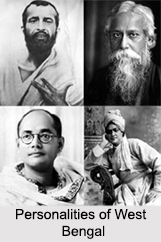
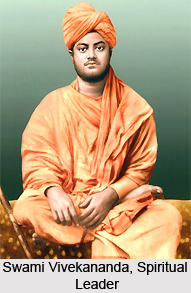
 Swami Vivekananda formerly known as Narendranath Dutta was one of the most influential spiritual leaders of the philosophies of Vedanta and Yoga and a major figure in the history of Hinduism and India. He was highly revered in the west as well. He was the chief disciple of Ramakrishna Paramahansa and the founder of Ramakrishna Math and Ramakrishna Mission. Vivekananda was the first known Hindu Swami to visit the West, where he introduced Eastern thought at the World`s Parliament of Religions, in connection with the World`s Fair in Chicago, in 1893. Vivekananda in Chicago delivered a speech which placed India firmly at the world platform, and he was well taken and appreciated not just in Chicago, but elsewhere in America as well. The year 2014 marks the 151st birth anniversary of the legendary Indian leader Swami Vivekananda, and on his 150th birth anniversary, a film known as `The Light: Swami Vivekananda` had been made by the Bengali movie director Utpal Singh (Tutu), to commemorate the life events of Swami Vivekananda.
Early Life of Swami Vivekananda
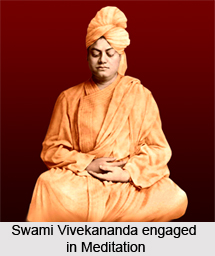
Narendranath Dutta was born in Shimla Pally, Kolkata, West Bengal, and India on January 12, 1863 on a Makar Sankranti day. He was the son of Viswanath Dutta and Bhuvaneswari Devi. Swamiji was sent to a local school in his earlier days. If on one hand, little Narendranath was extremely naughty then on the other he was known for his penchant for dissolving into deep meditations. So much so that even a snake or a lizard could not shake him up from his deep meditation state. When Narendra stepped into boyhood, his naughtiness grew. He was a natural leader of the children in the neighbourhood. His companions bowed to his decision always. Even as a child Narendra had great respect for `Sannyasis` or ascetics. He would give away anything to anybody if asked for. On his birthday, he would wear new clothes but if a beggar asked for alms he would give away the new clothes.
 From that day, his mother would lock him up in a room whenever a beggar passed by the house. But every beggar knew Narendra`s nature very well. So beggars would stand near the window of Narendra`s room. He would throw to them anything he had. The spirit of sacrifice and renunciation was already blossoming in him. In 1879, Narendranath entered the Presidency College, Kolkata for higher studies. After one year, he joined the Scottish Church College, Kolkata and studied philosophy. During the course, he studied western logic, western philosophy and history of European nations. Narendranath`s philosophies were based on the concept of Upanishad and `Sannyas` or ascetic renunciation.
Swami Vivekananda and Ramakrishna Paramahansa
At a time, when India faced the growing issues of differences in ideologies and caste system, the acquaintance between Ramakrishna and Vivekananda was considered exemplary. While, Vivekananda was a product of modern university, widely travelled and acutely aware of the raging issues of his days, Ramakrishna was an illiterate Brahmin who took little or no interest in contemporary problems. In fact, Vivekananda and his guru are two exactly opposite characters with less similarity. Later in his teachings Vivekananda states that his master was his strong anchorage and that without him he would have never understood his own life as also of the larger world. After the death of Sri Ramakrishna, the young disciples went to live in a rented house in Baranagar. It was very close to the tomb of Sri Ramakrishna. So, the Ramakrishna Math or monastery was opened there.
Swami Vivekananda at Chicago
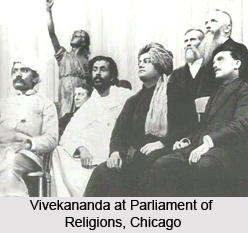
"Sisters and Brothers of America, It fills my heart with joy unspeakable to rise in response to the warm and cordial welcome which you have given us. I thank you in the name of the most ancient order of monks in the world; I thank you in the name of the mother of religions; and I thank you in the name of millions and millions of Hindu people of all classes and sects. My thanks, also, to some of the speakers on this platform who, referring to the delegates from the Orient, have told you that these men from far-off nations may well claim the honour of bearing to different lands the idea of toleration. I am proud to belong to a religion which has taught the world both tolerance and universal acceptance..." is an excerpt from the magical speech that Swamiji made in the Conference of World Religions held at Chicago.
 The conference started on 11th September 1893. Thousands of delegates belonging to deferent countries of the world had gathered at the conference. Vivekananda was the youngest of them all. When it was his turn to speak, his throat went dry. Besides, he did not have, like the other delegates, a prepared speech. However, when he began his address in his pleasing voice with the words "Sisters and Brothers of America," there was a thunderous applause which continued for a full three minutes. When it subsided at last he continued his short speech. He said that people born in different religions finally reach the same God, as river born in different places finally reaches the sea. He empathetically stated that no religion is superior or inferior.
Everyone was impressed by Swamiji`s speech. Meanwhile, Swamiji received pressing invitations from England. A rousing reception awaited him in London when he arrived there. The newspapers were all praise for the Hindu Yogi`s oratory and outlook, which were never witnessed in other Indian Yogis. Many became his disciples. Among them was Margaret Nivedita. She came to India and settled here and came to be known as Sister Nivedita. Swami Vivekananda returned to India after his foreign tour lasting four years.
Swami Vivekananda`s Rediscovery of India
Swamiji`s rediscovery of India could be divided into two phases. The first phase begins after the unfortunate demise of his guru Ramakrishna. Vivekananda renounced the worldly pleasures and travelled throughout India as a wandering monk. It was at this time when he changed his name from Narendranath to `Vivekananda`. Though committed to the Ramakrishna Math, Vivekananda did not want to remain confined within the organisation. `Bharat` had now become his abode and Indians his brothers and sisters. He set out to wipe the tears of the unfortunate. His only possessions were - a saffron robe, `Kamandalu` (an ascetic`s water pot) and `danda` (staff). The experiences that he gained during his journey were invaluable and enabled him to set practical limits on his ideals.
His second phase began in 1897 when he returned back from tour of the west, which was Swami Vivekananda`s first trip to the west. In this period Swamiji not only received bouquets but also brickbats from the Indian society. Though Vivekananda received accolades for his works on the international front, he was equally criticized by the Kolkata orthodox society. To them the most outrageous issue was the Kayastha origin of Vivekananda, which in their opinion disqualified him both as a sannyasi and a legitimate spokesman for Hinduism. To make matters worse for Swamiji, there was growing dissent against him among the disciples. This had to do with the way in which Vivekananda was running the Mission.
The Math was established at a formal gathering of monks in May 1897, where Vivekananda was made the general president and Swami Brahmananda and Yogananda, the president and vice-president respectively. The year 1899 also saw the realization of Swamiji`s cherished dream of setting up a monastic retreat up in the Himalayas. Thus began the Monastic life of Vivekananda. There was also a growing involvement of in social service observed through a network of `Sevashrams`. Volunteers were seen nursing the sick and attending to the flood victims. Thus, Vivekananda reinforced his long-term belief that: service to mankind is the service to God.
It appears that whereas the belief in Ramakrishna`s avatar status had gradually begun to permeate his fellow Sannyasis, Vivekananda continued to disagree. The matter had reached to a state that some devotees severed connections with the Belur Math and established a parallel organization called the `Garib Ramakrishna Sabha`. To put to rest the increasing criticism, Vivekananda celebrated the Durga Puja in 1901 in an orthodox fashion, using Rituals of Tantra and the local Brahmins were lavishly fed. It was then that the orthodoxy relented and was convinced that the monks were indeed Hindu sannyasis. Vivekananda established the Ramakrishna Math and Mission.
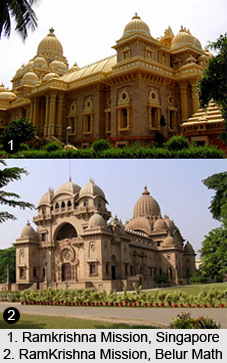 Swami Vivekananda`s Works and Teachings
Vivekananda left a body of philosophical works. His books on the four Yogas (Raja Yoga, Karma Yoga, Bhakti Yoga, Jnana Yoga) are very influential and still seen as fundamental texts for anyone interested in the Hindu practice of Yoga. His letters are of great literary and spiritual value. His language is very free flowing. His own Bengali writings stand testimony to the fact that he believed that words - spoken or written should be for making things easier to understand rather than show off the speaker or writer`s knowledge. Teachings of Swami Vivekananda is extensive and comprises of various philosophical teachings.
Swami Vivekananda belonged to that branch of Vedanta that held that no one could be truly free until all of us are. Even the desire for personal salvation has to be given up, and only tireless work for the salvation of others is the true mark of the enlightened person. Vivekananda did not feel that religion, nor, any force for that matter, should be used forcefully to bring about an ideal society, since this was something that would evolve naturally by individualistic change when the conditions were right. He was of the opinion that an ideal Indian is one who combines the good virtues of all the four caste system namely, Brahmin knowledge, Kshatriya culture, Vaisya efficiency and the egalitarian Shudra ethos. Swamiji was also a perfect blend of western and eastern culture. He was of the opinion that Indians should learn the art of reasoning out just as the westerners do. He was terribly upset that people in India were fooled under the pretext of preaching Vedanta.
Swami Vivekananda on his Last Days
On July 4, 1902 at Belur Math near Kolkata, he taught Vedanta philosophy to some pupils in the morning. Vivekananda died suddenly later that day at an age of 39. In the course of a short life of 39 years (1863-1902), of which only ten were devoted to public activities-and those, too, in the midst of acute physical suffering-he left for posterity his four classics: Jnana-Yoga, Bhakti-Yoga, Karma-Yoga, and Raja-Yoga, all of which are outstanding treatises on Hindu philosophy. In addition, he delivered innumerable lectures, wrote inspired letters in his own hand to his many friends and disciples, composed numerous poems, and acted as spiritual guide to the many seekers, who came to him for instruction. He also organized the Ramakrishna Order of monks, which is the most outstanding religious organization of modern India.
His life and teachings are of inestimable value to the West for an understanding of the mind of Asia. William James, the Harvard philosopher, called the Swami the `model of Vedantists` Max Muller and Paul Deussen, the famous Orientalists of the nineteenth century, held him in genuine respect and affection. Although Swamiji is no longer with us, his words live. His message has continued to inspire millions of his countrymen.