


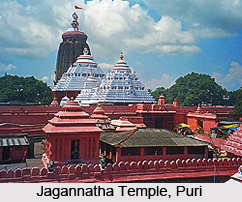
 Jagannath Temple of Puri is regarded as the sacred temple in Eastern Ganges Dynasty. Jagannath Temple was built in the 12th century along with ruins by the progenitor of the Eastern Ganga dynasty, Anantavarman Chodaganga Deva. The symbol of universal love and brotherhood - Lord Jagannath is worshipped in the Temple along with Balarama and Subhadra. Jagannath Temple of Puri is regarded as the sacred temple in Eastern Ganges Dynasty. Jagannath Temple was built in the 12th century along with ruins by the progenitor of the Eastern Ganga dynasty, Anantavarman Chodaganga Deva. The symbol of universal love and brotherhood - Lord Jagannath is worshipped in the Temple along with Balarama and Subhadra.
Jagannath Temple of Puri is the abode of Lord Jagannath, the universal lord of the Universe. Jagannath Temple of Puri is situated by the sea shore of Bay of Bengal in the state of Orissa. It is one of the four holy kshetras of India, the other three being Sringeri in South India, Dwarka in Saurashtra, and Badrinath in the Himalayan Mountain Range in India. A number of major festivals are celebrated in the honour of Lord Jagannath in the temple the most prominent being Ratha Yatra. Jagannath Temple has made Puri one of the sacred pilgrimages for the Hindus. It is believed by the worshippers that praying to the lord Jagannath grants all wishes of the worshippers. The temple of Jagannath was popularised by the famous Vaishnava saint Chaitanya. Mythological History of Jagannath Temple After much toil and tactic, Vidyapati succeeded in locating Neel Madhab. However Indradyumna failed to catch a glimpse of the deity. However, the King's determination to have a glimpse of the deity was rewarded by the Gods with an oracular dream in which he was instructed to worship Jagannath Dev. He was asked to build the idol with a piece of Neem wood that would be found at the seashore. True to the prophecy, the King found the neem wood at the seashore and requested Lord Vishwakarma, the heavenly mason, to model the Jagannath idol. Vishwakarma accepted the offer but put one condition, that nobody should disturb him or a steal a look until he had finished doing his work. The King promised to follow his wishes and Vishwakarma began modelling the Jagannath idol. However, curiosity being an irresistible urge, the King could not help stealing a glance at Vishwakarma's work. The idol was still incomplete and Vishwakarma was infuriated. At that time all except the arms of the deities were finished. Vishwakarma, exasperated at the King's audacity, left without completing his work. Thus came Lord Jagannath with his incomplete limbs, his brother Balabhadra and sister Subhadra. The three deities were installed in the temple of Puri. Amusingly, the wooden images being worshipped are renewed during special occasions. The new deities of Lord Jagannatha, Balarama and Shubhadra have been installed in the years 1863, 1893, 1931, 1950, 1969 and 1977. Early History of Jagannath Temple The history of the Temple dates back to the 12th century when the rulers of Ganga Dynasty were ruling the land of Odisha. The temple was constructed by Chodagangadeva of the Ganga dynasty. A lot of attempts have been made to destroy the temple through the various ages but due to destiny's grace the temple till today stands with its unequalled grace. Architecture of Jagannath Temple The enormous temple complex of Lord Jagannatha occupies an area of over 4, 00,000 square feet, and is hemmed in by a 20 feet high-fortified wall. The complex contains about 120 temples and shrines and the shikhara of the Jagannath temple soars to a height of 192 feet. Structurally the temple consists of four chambers. The outermost is the Bhogmandir, the next is the Nata-mandir pillared hall for music and dance, and then follows the Jagamohana - or the mandapa where devotees gather for worship and the final is the sanctum or the Deul preserving the deities. 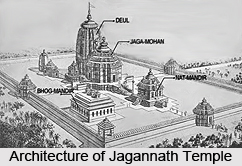 Deities in Lord Jagannath Temple
Jagannath was entitled "Purusottama" since his origin at Puri or Purusottam - Kshetra (the abode of Purusottam) ever since pre-historic times. The Rig Veda refers to him as the Daru (sacred log of wood) of Purusottama, afloat on the eastern sea. The name "Jagannath" (Lord of the Universe) is consistently a communal representation of the Triad (Jagannath - Balabhadra - Subhadra) and has been in use since the dawn of the previous millennium. Jagannath- Dharma supposes in the Rig Vedic concept of the Supreme Truth. The Triad, conceived as one, represents the three attributes of creation, maintenance and destruction. The use of OM Mantra in the worship is a reflection of the Vedic strain. Sudarshana, the Jyoti Brahma, represents the indistinct and along with the Triad is conceived as one. The Supreme is shown as surpassing contradiction in his infinite perfection. He consists of multiform manifestations. He is Shiva or Bhairava and goddess Vimala is Bhairavi. Shaivism and Saktism are merged into him. The use of "Klim" mantra in worship offers him a tantric image. The Triad is deified by the Jainas as manifestation of the Jaina "Tri-ratna" (three gems of Jainism) representing right knowledge, right thought and right perception. Lord Jagannath is identified with Lord Buddha. His iconographic representation without hands and feet is approximating to the meditating Buddha. The Triad is illustrated as Buddha, Dharma and Sangha - the three gems of Buddhism. Some Buddhists also find discernible affinity of the car-festival with Buddhist festivals. The Tooth-relic of Buddha is supposedly within the images of the triad and is known as "Brahma-Padartha" (Divine-Matter). Administration of Jagannath Temple The Jagannath Temple of Puri is administered according to the Sri Jagannath Temple Act of 1954. Generally the temple is administered by a group of twelve members. The daily management of the temple is carried on by the members of the Management Committee and the rituals are carried on by the Sevaks of the temple. Rituals and Daily Worship of Jagannath Temple The ritual of Jagannath Temple says that Lord Jagannath, Sri, Devi, Bhudevi and Sudarshana are worshipped by the same puja Panda and Nilmadhava is also not worshipped separately as he is considered identical with Lord Jagannath. Lord Balarama and Goddess Subhadra are worshipped by two separate puja Pandas. The daily worship of the temple is carried three times a day with 5 upacharas during other times of the day. The daily activities of the temple include Dwarapitha Mangalarathi, Mailam, Abakash, Mailam, sahanmela, Beshalagi, Rosha Homa, Surya Puja, Dwarapala Puja, Gopala Ballav Bhoga, Sakal Dhupa, Mailam and Bhoga Mandap, Madhyana Dhupa, Madhyahna Pahuda, Sandhya Arati, Sandhya Dhupa, Mailam and Chandanlagi, Badasingar Vesha, Badasinghar Dhupa and Khata Sejalagi Pahada. Some the necessary daily routines of the temple are waking up the lord, cleaning the temple, worshipping the associates of the lord, offering various upacharas of the lord, changing the dress of the lord and continuous offering to the lord at various parts of the day. Food Offerings in Jagannatha Temple Everyday, fifty-six varieties of prasada are presented to Lord Jagannath. The preparations are made traditionally and no onion, garlic, chillies are used in the Prasada. These Offerings after being made to Lord Jagannath are in turn again offered to Goddess Bimala Devi in the temple precincts and then becomes Mahaprasadam. This Mahaprasadam is considered efficient for spiritual liberation. One is said to respectfully honor the Mahaprasadam sitting on the floor. This Mahaprasadam is available daily after 3 -5 pm and sold outside the sanctorum area but within the temple premises. The Mahaprasadam is said to remain hot for a long time as it is kept in the same earthen pots, which are used for cooking them. Festivals of Jagannath Temple 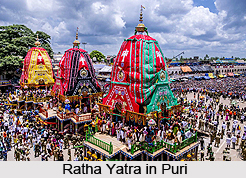 Elaborate reverence services are carried out in the temple throughout the day. There are as many as 24 festivals each year, the most important one of them being the Ratha Yatra or the Chariot festival in the month of June - July. The extravagant chariot festival involves the procession of three colossal chariots bearing the images of Jagannath, Balarama and Subhadra through the streets of Puri. Jagannath's chariot is a 35 feet square, rising to a height of 45 feet, with 16 wheels, 7 feet in diameter. More than 4000 people haul the chariot. Thousands of people from all over the country gather to witness this festival. The chariot is dragged to the deity's summer abode where the deities are worshipped for a week, and then a re-enactment of the chariot festival, where they are brought back in procession takes place. New chariots are prepared every year for the procession.
Tourism in Jagannath Temple Jagannath Temple has become the central attraction of Puri. Thousands of pilgrims crowd the temple premise throughout the year to have a glimpse of the Lord and to offer their worship to Lord Jagannath. |
| |||



Jagannath Temple in Puri
| Jagannath Temple of Puri is one of the greatest architecture of Eastern Indian Eastern Ganges Dynasty. This temple is dedicated to the Lord Jagannath and it is regarded as the part of Char Dham pilgrimages that a Hindu is expected to make in one`s lifetime. |
| ||||||||||||||||||||||||||||

