 High Courts of India are at the top of the hierarchy in each state, but are below the Supreme Court. Below the High Courts are secondary courts such as the civil courts, family courts, criminal courts and district courts. These courts have control over a state, a union territory or a group of states and union territories. According to Article 214 of the Constitution of India, there shall be a High Court for each state of India. Article 231 of the Constitution empowers the Parliament to set up one High Court for two or more states. For example, Guwahati High Court has jurisdiction over the state of Tripura and some other states of North- East India, besides its jurisdiction over the state of Assam. High Courts are established under Part VI, Chapter V of the Constitution of India. High Courts are the principal courts of original jurisdiction in the state, and can try all offences, including those punishable with death. There is variation in the precise jurisdiction of each High Court in India.
Different High Courts in India
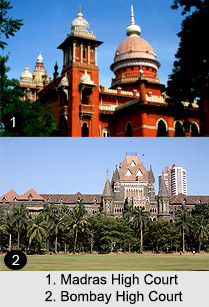
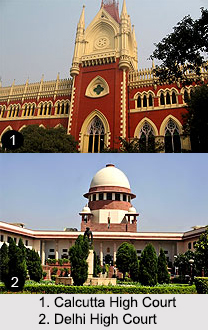
The High Court is a Court of Record. This means that all records regarding all cases that come to the High Court are kept with extreme care possible and these records are later referred to, in dealing with other cases. The names of the oldest four High Courts in India are the Madras High Court (Chennai), Bombay High Court (Mumbai), Calcutta High Court (Kolkata) and Allahabad High Court (Allahabad). Listed below is the chart of all the High Courts in India with the necessary details:
| Court | Established | Chief Justice |
| Allahabad High Court | 1866 | Govind Mathur |
| Bombay High Court | 1862 | Naresh Harishchandra Patil |
| Calcutta High Court | 1862 | Debasis Kar Gupta |
| Chhattisgarh High Court | 2000 | Ajay Kumar Tripathi |
| Delhi High Court | 1966 | Rajendra Menon |
| Guwahati High Court | 1948 | A.S. Bopanna |
| Gujarat High Court | 1960 | Anantkumar Surendraray Dave |
| High Court of Judicature at Hyderabad | 1954 | Thottathil B. Radhakrishnan |
| Himachal Pradesh High Court | 1971 | Surya Kant |
| Jammu and Kashmir High Court | 1928 | Gita Mittal |
| Jharkhand High Court | 2000 | Aniruddha Bose |
| Karnataka High Court | 1884 | Dinesh Maheshwari |
| Kerala High Court | 1956 | Hrishikesh Roy |
| Madhya Pradesh High Court | 1936 | Sanjay Kumar Seth |
| Madras High Court | 1862 | Vijaya Tahilramani |
| Manipur High Court | 2013 | Ramalingam Sudhakar |
| Meghalaya High Court | 2013 | Mohammad Yaqoob Mir |
| Odisha High Court | 1948 | Kalpesh Satyendra Jhaveri |
| Patna High Court | 1916 | Amreshwar Pratap Sahi |
| Punjab and Haryana High Court | 1947 | Krishna Murari |
| Rajasthan High Court | 1949 | Pradeep Nandrajog |
| Sikkim High Court | 1975 | Vijay Kumar Bist |
| Tripura High Court | 2013 | Sanjay Karol |
| Uttarakhand High Court | 2000 | Ramesh Ranganathan |
Composition of High Courts of India
A High Court is composed of a Chief Justice and as many other judges as the President of India may from time to time deem it necessary to appoint. The President can appoint additional judges for a maximum period of two years. The number of judges in a court is decided by dividing the average institution of main cases, during the last five years by the national average. The average rate of disposal of main cases per judge per year is also taken into consideration. The judge of a High Court must be an Indian citizen and must have 10 years of experience in adjudication or in legal practice. Ordinarily, the judges remain in office till the age of 62 years, but may resign from their posts prematurely, by applying in writing to the President. The judges of a High Court may be transferred to another High Court of another state or the Supreme Court. Besides, the judges of a High Court can be removed from office on various grounds like misdemeanour and corruption. To ensure independence of the judiciary, a special mode of removal of the judge has been prescribed in the Constitution of India. The proposal of removal of the judges must be passed by a two thirds majority of the members present in the Legislature. The proposal then shall have to be sent to the President for his assent. The President will then ask the judge to resign. In appointing the Chief Justice of High Court, the President consults the Governor and the Chief Justice of the Supreme Court. In appointing other judges, the President consults the Chief Justice of the Supreme Court and the Chief Justice of the High Courts of India.
 Powers of High Courts of India
Work of most High Courts consists of appeals from lower courts and summons and petitions in terms of Article 226 of the Constitution of India. A High Court of India acts as a Court of Original Jurisdiction and the Court of Appellate Jurisdiction at the same time. As a Court of Original Jurisdiction, the High Court can try original cases. The Constitution has vested the High Court with the power of trying revenue cases also. The High Court in every state is the highest court of appeal with respect to any criminal or civil case of the state. The High Court may either give its verdict on constitutional point only and leave it to the lower court concerned to pass verdict on other issues or try the case as a whole.
The Union Parliament has been empowered to either enlarge or restrict the jurisdiction of the High Court. The High Courts of India have the power of superintendence over all the lower courts of a state, except the Military Tribunals. The High Court can also issue various writs in order to safeguard the fundamental rights of the citizens of India. The writs are in the nature of Habeas Corpus, Mandamus, Prohibition, Quo Warranto and Certiorari. Apart from these, the High Court has the authority of making laws in relation to the appointment of its own officials and other internal affairs. As the head of the judiciary in the state, the High Court has administrative control over the subordinate in the state. The 42nd Amendment Act of 1976 had curtailed the jurisdiction of the High Courts in various spheres. However, the 44th Amendment Act of 1979 restored the original jurisdiction and position of the High Courts.
Appointment of Judges of High Courts in India
The High Court is headed by the Chief Justice of that Court who is appointed by the President of India with the consultation of the Chief Justice of the Supreme Court and the Governor of the State. The other judges are appointed by the will of President, Governor and the Chief Justice of High Court. Originally, the tenure of a High Court judge was until he reached the age of 60 but in accordance to the 15th amendment of the Constitution it was raised to 62 in 1963.