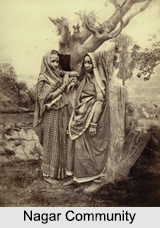
 Nagar Community are recognised as one of the oldest groups of Brahmins occupying a special place in the social, educational, cultural and religious life of Gujarat. There are more than 15,000 Nagar families in India. Gujarat is the home of the Nagars but many Nagar families are settled in Uttar Pradesh, West Bengal and Punjab as well.
History of Nagar Community
They have a history going back to Puranic times. Some historians say that the Nagars are of the purely Aryan origin belonging originally to Southern Europe or Central Asia. According to one theory they journeyed from the Hindu Kush to Tibet and then through Kashmir into India and settled down around Kurukshetra. They have also been regarded to be of Graeco-Scythian or Dravido-Scythian origin.
According to one opinion they are of Scythian-Turkish descent, perhaps the descendants of a class of priests in the invading armies. It is said that they were purified at a historic fire sacrifice in Mount Abu and were received as a new set of Brahmins. Recent research points to their Aryan origin from Hatak or the modern Ladakh.
Legends of Nagar Community
The earliest reference to the Nagar is in the Skanda Purana. Lord Shiva, who created them in celebration of his marriage to Goddess Uma, is said to have granted them the land of Hatheshwar. The Saunka Smriti also mentions them.
Legends narrate that while on a hunt, King Chamatkar of Anarta killed a deer suckling her young. The deer cursed him and as a result he developed Leucoderma. The Brahmins who lived in those parts cured him with herbs and he rewarded them with gifts of money and land that they refused, being men of high principles. But the queen persuaded 68 of the 72 wives to accept the gift. The four families who refused the reward went away to the Himalayas but the other 68 Brahmins stayed on and are believed to be the founders of the 68 gotras of the Nagars.
According to another version, the king showed his gratitude by renovating an old city for them and consecrating a temple to Hatkeshwar, the new city there being named Chamatkarpur. With the passage of time it came to be known by various names such as Madanpur, Skandapur, Anartapur, Anandpur, Nagar, Vrudha Nagar and lastly Vadnagar. The Brahmins who lived here came to be known as Nagars.
Society and Religion of Nagar Community
Nagar women have enjoyed a privileged status since ancient times. In the home, they participate equally with men in religious and family affairs and monogamy is practised strictly. The birth of a girl is greeted with the same joy as that of a boy. A widow can be sure of a secure and respectable place in the family.
Profession of Nagar Community
Though Brahmins follow orthodox practices, the Nagar Brahmins have a martial tradition. They also became diwans of princely states and have been outstanding administrators, diplomats, poets and musicians.