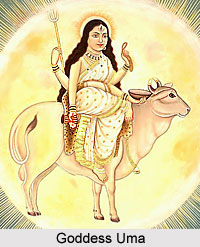
 Worship of Goddess Uma has also been elucidated in a detailed manner. It has been said that the worship of the Goddess gives a better turn to one`s fortune, and grants enjoyment in this life and salvation in the next. The Fire God in his narration has mentioned the Mantras, the process of meditation, the mystic diagram, the Mudras and the rites of Homa which are involved in the worship of goddess Uma.
The Mantras which are involved in the worship consists of Vijas technically known as the Chatrabhanu, Shiva, Kala, and the Maha Shakti Vijas. The other forms are the Mantra is known as the Dwarakas. It has been said that the Asanam should be spread out for the deity with a repetition of the Pranava-Mantra, while the rite of Murti nyasa should be performed by repeating the Hrid Mantra. The rite of Vyapaka-Nyasa should be performed with the Mantra, consisting of the Vijas.
Agni Purana states that the five manifestations of the goddess should be likewise worshipped. The companion goddesses of the deity, such as Lalita, Subhaga, Gouri and Kshovana should be worshipped at the angular points of the Mandalam, commencing from the south-east. The goddesses such as Vama, Jestha, Kriya, and Jnan, should be worshipped at the cardinal points of the circle commencing from the east. The subtle presence of the God Shankara should be worshiped to the left of the proper cushion of the Goddess who should be represented as possessed of two eyes two or four hands, and riding on a lion or a leopard, placed on the lotus-shaped diagram. In the alternative, the Goddess should be contemplated as possessed of eighteen hands.
It has been said that the Mandalam, or the mystic diagram, to be used in the ceremony, should be a square-shaped one, being one of the class, technically known as the Chatarasra-Mandalam. The Mandalam should measure four cubits, furnished with the image of a three-petalled lotus, drawn to embellish its centre, and occupying the four rectilinear chambers described about the same.
The votary should worship the Goddess with the composition known as the Pancha-Gavya, and make offerings of red flowers to it. Then he should sit with his face turned towards the north, and pour down the customary libations. The man, who can manage to pour down the final libation in connection with the present Homa, is sure to attain the highest Siddhis.