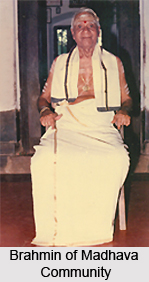
 The Madhavas are Vaishnava Brahmins. They have been named after the, Madhava (1238-1317) who propounded the dualistic principle. He was a Tuluva Brahmin. He is one of the world`s greatest theistic philosophers. His theism stands for the recognition of God or Brahman as the one and only independent being to which all else is subordinated.
The Madhava community is spread over Karnataka, Tamil Nadu, Andhra Pradesh and parts of Maharashtra. They are generally peace loving, intellectual and scholarly. The Tuluva and Tamil Nadu Madhavas are light complexioned and well built.
Social life of the Madhavas
Most Madhavas are erudite. They rarely intermarry with other sects. Madhava men can be recognised by their distinctive Vaishnava caste marks, such as, the `akshata` (round dark mark) and the `angara` (a vertical central charcoal-black line drawn on the forehead), the additional sandal paste caste marks on the arms, chest and abdomen representing the sankha (conch), padma (lotus) and the like. At home the women and girls worship the tulsi plant daily. But in custom, tradition and dress the Madhavas can hardly be distinguished from Maharashtra Brahmins. The mother tongue of many Madhava families of Madras and Tanjavur is Marathi.
Religion of the Madhavas
The Dvaita philosophy is essentially rooted in the Bhakti cult of a supreme God, which emerged, with the advent of the Alvar and the Nayanamar saints. They lived from the 6th to the 10th century in the Tamil country. Ramanuja (1037-1137) who preached Vasishtadvaita (qualified monism) established the Vaishnava Bhakti cult as a faith but it was Madhava`s intellect, learning and inspiration that led him to propound a system which defied the concepts of maya (illusion) and `jivabrahmaikya` (the oneness of God and the individual soul). Later another great mind, Jayatirtha (Tika) interpreted the sayings of Madhava in detail to consolidate the Dvaita belief.
Madhava established the Krishna Temple, Udupi in Karnataka and initiated eight balabrahmacharis to continue the worship of the Lord and to propagate the Dvaita philosophy. Each swami was to serve the temple for two years without leaving it. In course of time each of the eight swamis attracted their own followers and eight maths became established. 3 important maths have also played a significant part in upholding and spreading the message of Dvaita: the Uttaradi in Bangalore; the Raghavendraswami in Nanjangud and the Vyasaraya in the South. A great Madhava guru, Satyadhanatirtha of the Uttaradi math, also made an outstanding contribution to this faith.
The catholicity of Madhavas and their tolerance and admiration for other faiths can be gauged from the fact that even now Anantasvara`s ratha (chariot) precedes that of Krishna in all major festivals at Udupi in spite of the fact that the Madhavas are staunch Vaishnavites.
Purandaradasa has composed the best devotional hymns inspired by Madhava`s philosophy but out of over four lakh bhajans in praise of the Lord, only about nine hundred are still to be found. With him, Vijaya-Vithala, Jagannathadas, Mohandas, Seshadas and Kankadasa (a Kuruba shepherd) form the `dasakuta.`
The sacred temples for Tuluva Brahmins or Madhava community are the 7th and 8th century Shiva Temples. The Anantheshvara Temple of Udupi is quite famous with this community. Mookambika Temple of Kollur and 7 other temples in Subramanya, Gokarna, Kumbasi, Koteshvara and Shankaranarayana are famous places of pilgrimages. These are also known as the Mukti Sthalas. Apart from this there is the Mangala Devi Temple in Mangalore.