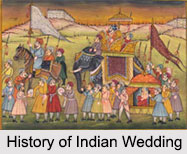
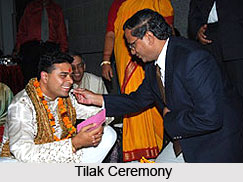
 Indian religious weddings exhibit a great variety and different parts of the country follow different rituals during these ceremonies. With deep tradition and rich mores each of Indian religious weddings crafts a distinct connotation while mirroring the tradition of India to a great extent. In addition to this, they also contribute to the vibrant cultural heritage of the country.
Sikh Wedding
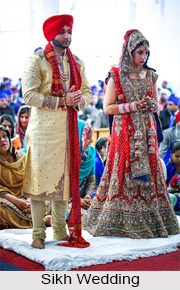
Sikhs refers to a wedding as Anand Karaj or a ceremony of bliss. It is a joyous and festive event which is entirely family orientated and informal in its ambiance. Sikh marriages are usually approved by the families first, which act as little more than prologue services. The ultimate selection is always left to the girl and boy. In some cases the boy and girl select each other first and then ask for their parents consent and blessings. The distinct division of pre wedding, wedding and post wedding rituals further makes the Sikh wedding complete. A Sikh wedding usually takes place before noon. The families of the bride and the groom assemble at the `Gurudwara`. Raagis sing the morning hymn. Then the couple is made to sit in front of the Adi Granth. A priest first tells them about the obligations of married life. Then he sings the hymns of marriage from the Granth Sahib.
Sindhi Wedding
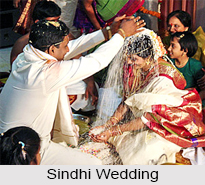 This ceremony is an amalgamation of Hinduism and Sufism and Sindhi weddings are based on Vedic rites. The day for Sindhi wedding is usually fixed on an auspicious day such as the Satyanarayan Chandsi or the new moon day. The marriage begins with the "thread ceremony" of the groom if he has not done it before. The bride and groom are seated next to each other and then the bride`s mother washes the feet of the couple placed on a plate while the Pundit chants mantras. The couple then takes the `pheras` round the holy fire. At this point, unlike Hindu marriages, there is an option for the number of pheras. The couple can take three, four or seven pheras. The marriage comes to an end after parents and elders bless the couple.
Parsi Wedding
Fire is the most sacred element in the Parsi community and practically no ritual is complete without the use of fire. A Parsi wedding is full of gaiety and laughter. The "achoo meecho" (removing the evil eye) is performed before every single ceremony. The auspicious days to conduct weddings are either the first day of the month ("Hormazd Roe") or the twentieth day of the month ("Behram Roj"). It is believed that on "Behram Roj" the angel of victory or "Behram" presides over the ceremonies. Most Parsi weddings take place in the evening, a little after sunset. Nahan is the day of the lagan. On this day the staircase, doorway and gate is decorated with beautiful decorative designs of rangoli. For the marriage ceremony the bride dresses in her "madhavate", the white, ornate wedding sari given by her parents, while the groom wears the traditional Parsi "dagli and feta", a white kurta like garment and a black cap.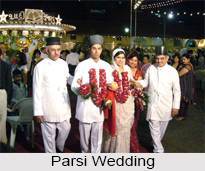
Buddhist Weddings
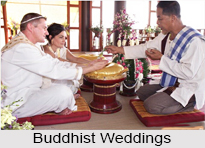
Buddhists are strict conventionalist in case of ceremonies and rituals. The expansion of the pre-wedding rituals is to manifest the formality of asking the bride`s family for their consent by the groom`s family. The monk called Lama decides the auspicious day for the wedding. The betrothal ritual follows this ceremony. The lama recites the prayers and then a concoction called the "madyan" is served to the guests, which is considered as a religious drink. The astrologer or the monk carries out the rites on the auspicious day for the wedding. In the early morning, the bride`s and the groom`s families arrive at the temple. The groom`s family bring many trays containing fruits, wine, traditional cake, tea, meat and most importantly jewellery that the bride will be getting as dowry. The trays are necessary to be either six or nine in number. Seven or eight are considered unlucky numbers amongst the Buddhists. One of the trays also contains a pair of candles, which are lit either by the bride and the groom or their parents; the tradition varies with places and countries. The lighting up of the two candles symbolizes the unification of the two families.
Jain Wedding
 Jains regard marriage as more or less a sophisticated affair. Marriage and family raising are not compulsory to all the Jain Shravakas as Jainism preaches the peaceful co-existence and communication of two different living beings in mutual beneficence or mutual reliance. In the ceremony, a grand public announcement is made for the soon-to-be bride and groom, to live together for their entire life. Life is interpreted as a gift to be shared together, helping each other to live and grow. The wedding rituals consist of fulfilment of ceremonies like Phere, Kanyavaran, Havan and Granthi Bandhan. The Jain brides wear saris only and they prefer red or any other bright colour. The Jain grooms wear the traditional Kurta Pajama or the Dhoti Kurta.
Jewish Wedding
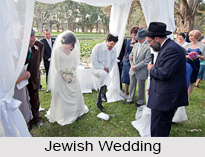
Judaism considers marriage to be the perfect state of personal existence; a man without a wife, or a woman without a husband, is believed to be incomplete. Marriage is considered to be an integral part of the Jews; they consider the unmarried individuals to be incomplete beings of the society. The Jewish marriage is a reflection of their tradition and beliefs. The holiest day for the Jewish marriages of the year is Yom Kippur, the Day of Atonement. This is a fast day on which each person remembers in depth all of his past actions. The wedding ceremony takes place under the open sky. When the couple arrives at the Chupah, the bride and family circles round the groom seven times.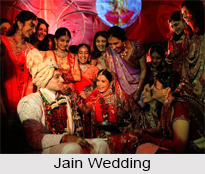
Christian Wedding
Christian wedding usually is conducted in a church. Christian weddings usually are quiet and beautiful affair. The bride is dressed in white attire with a veil on her head covering her face and groom in a suit. The bride also wears a graceful tiara or a bunch of white flowers and she holds a flower bouquet in her hand. The Christina wedding is graceful yet simple and involves the exchange of wedding bands and marriage vows by the bridal couple. The marriage ceremony is preceded by a group of choir singers. Unlike any other Indian wedding, the Christian wedding witnesses a ceremony of welcoming the bride. Groom sends a car to pick up the bride and waits for her outside the church. Following the tradition, when the bride arrives, the Best Man welcomes her with a kiss on either cheek and hands her a bouquet of flowers.
Hindu Wedding
 In a Hindu arranged marriage there are various Hindu marriage rituals and customs. According to Hindu Shastra there are four stages of life. The second stage is Grihastha Ashram or the householder stage, which denotes married life and it begins when a man and a woman marry. Marriage is treated as an institution, which teaches the real values of life. The bride`s father offers his daughter to the groom amidst the recitation of sacred mantras. The holy fire ceremony, ascertaining that all auspicious undertakings began in an ambiance of purity and mysticism, is indeed a vital part of the Hindu marriage ceremony. Marriage knot symbolized by tying one end of the groom`s scarf with the bride`s dress further symbolizes the union of two souls after marriage. `Saptapadi` is a very important part of the Hindu marriage ritual where the bride and the groom take seven steps that represent nourishment, strength, affluence, contentment, progeny, long life, harmony and understanding.
Muslim Wedding
Muslim wedding rituals are celebrated in a grand way over a period of five days. Muslim culture all over the world is known to be one of the best in inviting and welcoming guests. Muslim wedding is celebrated in a grand way over a period of five days. It is also known as Nikaah and can take place at any convenient time. Nikah can be conducted at the home of the bride or the groom, or at any other convenient venue. The Nikaah ceremony is presided over by the Qazi or law officer.