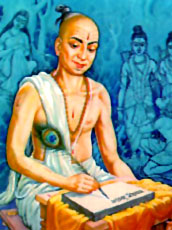
Ponna was one of the greatest Kannada poets of the 10th century AD. Ponna, along with two other literary greats -Pampa and Ranna- formed the three greats of Kannada literature known as the `Ratna-Traya` meaning three gems. Ponna achieved the heights of his literary success when the rulers of the Chalukya dynasty were ruling over the ancient Karnataka area. Ponna was considered as the first Kavi-Chakravartin i.e, emperor of poetry. Ponna was positioned as the royal poet in the court of the Rashtrakuta King Krishna III. He also achieved the title of `Kavichakravarthi`. Thus he got lucrative sponsorship and patronage. He got this title for his prowess and domination over the Kannada literary circles of that time. Ponna was also honoured with the title Ubhayakavi Chakravarti i, e, master of two languages for his command over Sanskrit as well. It is believed that Ponna belonged to Vengi, located in modern day in Andhra Pradesh. Following his conversion to Jainism, he migrated to Manyakheta in the Gulbarga district of modern day Karnataka.
Literary Works of Ponna
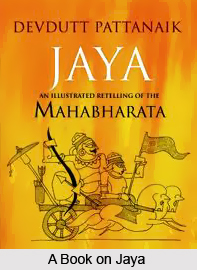
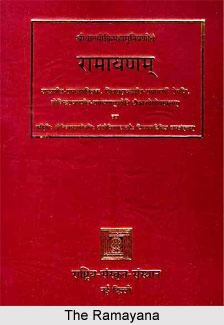
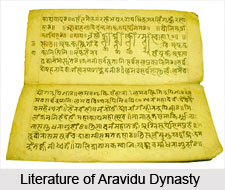
One of the greatest works of Ponna is the Shanti Purana. It is the life history of the sixteenth Jain Tirthankara named Shanti Natha. Shanti Natha is said to have ruled from Hastinapura (the homeland of Pandavas) over a huge part of India. It has been written in the Champu style. The work was written in order to commemorate the attainment of nirvana ("salvation") of a Jain guru called Jainachandra Deva. The work comprises a total of twelve sections called ashwasas of which nine focus on Shanti Natha`s eleven previous births. The other three give biographical details of the protagonist. His other important works include Bhuvaniaka-Ramabhyudaya, a eulogical writing, and Jinaksharamale, a Jain Purana and an acrostic poem written in praise of noted Jain saints and Tirthankars (Jainas) in 39 chapters (kandas). It is uncertain whether another of his works, Gatapratiagata was written in Kannada or Sanskrit. The `Bhuvanaika-Ramabhyudaya` is yet to be recovered. This was based on the Ramayana in 14 chapters. The `Jainaksaramale` is a Jain Purana, which was written with dignity and style. The formal and technical aspects of it are quite well-developed. He has also summarized the Mahabharata in his poem and the title of his poem is `Gada-Tuddba`. It indicates his focus on the mace-fighting episodes of Bhima whom he has chosen as the hero of his poem.
Style of Writing of Ponna
The style of writing of Ponna, as also Pampa and Ranna, was the champu style. This was a mixed prose-verse classical composition style inherited from Sanskrit. Even though he stood strictly by the classical Sanskritic models (margam), there is found a great use of the native composition styles of Kannada language, such as the tripadi (three-line verse).
In his writings can be found impressive Sanskrit-derived verses along with prose, highlighting and praising the virtues of his protagonist. The protagonists were often compared to the heroes from Hindu epics. Most of Ponna`s works are found to be original. But he is greatly indebted to the Sanskrit poet Kalidasa as Ponna translated 200 verses of his work. But it is said that he himself had announced it boldly that he was four times superior to Kalidasa.
Ponna was undoubtedly very learned in the traditional lore of his times and was rather proud of it. He still is one of the literary greats of Kannada literature.