


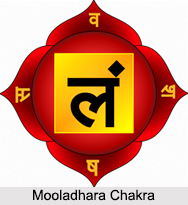
 Mooladhara Chakra is also known as the ‘Root Chakra’. It is the first chakra of the Kundalini Chakras that begins at the base of the spine. This is the foundation of the entire system. It can be said that this is the building block on which all the other chakras must rest. So this chakra is of crucial importance. It is the manifestation of consciousness in its final form i.e. solid and tangible. Mooladhara Chakra is also known as the ‘Root Chakra’. It is the first chakra of the Kundalini Chakras that begins at the base of the spine. This is the foundation of the entire system. It can be said that this is the building block on which all the other chakras must rest. So this chakra is of crucial importance. It is the manifestation of consciousness in its final form i.e. solid and tangible.
Appearance of Mooladhara Chakra Mooladhara Chakra is visualized as a deep, vibrant red, the colour of beginning. This center is depicted, as a lotus of 4 petals within which is a square. These 4 petals also reflect the 4 elements of the material kingdom. Within this square there is a small triangle pointing downward from a column of energy representing the Sushumna Nadi. This represents the earth-oriented downward force of the chakra. Within the triangle there is the Kundalini serpent wrapped around the Shiva lingam, which points upward. This chakra is the home and resting place of Kundalini. Below the triangle there is a seven-trunked elephant, named Airavata, representing the heavy, matter-like quality of this chakra and the 7 pathways out of it. These correspond to the seven chakras as well. The elephant-headed God, Ganesha can be associated with Lord of Obstacles, with this center, as he is grounded, full-bellied, and happy with his physicality.  Other deities depicted in the square are the five-faced Child Brahma, dispelling fears, and the female Dakini, the manifestation of Shakti at this level. She is carrying spear, sword, cup, and skull. Other deities depicted in the square are the five-faced Child Brahma, dispelling fears, and the female Dakini, the manifestation of Shakti at this level. She is carrying spear, sword, cup, and skull.
Position of Mooladhara Chakra In the body, Mooladhara Chakra is situated below the sacrum bone in which resides the Kundalini. It is located at the base of the spine, or more accurately, the perineum, midway between the anus and the genitals. It corresponds to the section of the spine called the coccyx, as well as the coccygeal spinal ganglion and the lower lumbar vertebrae. From the point this ganglion sprouts. In keeping with the correlation to solid matter, this chakra relates to the solid part of the body, especially the bones, the large intestine, and the fleshy body as a whole. Awakening of Mooladhara Chakra Mooladhara Chakra gives a feeling of being physically aware of one-selves and their surroundings. When awakened, one feels comfortable in situations, secure, stable, well balanced and sensible. Exercises for Mooladhara Chakra Yoga Asanas should be performed regardless of the activity level of the chakra, and to help balance and keep Mooladhara balanced. Since Mooladhara chakra corresponds with the earth element, activities which bring one in contact with the earth like gardening or hiking are good activities to help balance this chakra. |
| |||



Mooladhara Chakra
| Mooladhara Chakra is situated at the base of spine is connected with red colour that dominates the materialistic senses. |
| ||||||||||||||||||||||||||||

