


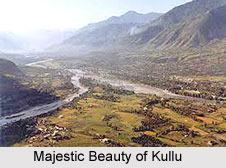
 Kullu is a popular hill station in Kullu District of Himachal Pradesh. Kullu is a popular hill station in Kullu District of Himachal Pradesh.
Location of Kullu Kullu lies well guarded by the Pir Panjal range of the Himalaya Mountains. Kullu is wonderfully gifted by the nature. The marvellous landscapes, hospitable, peaceful and co-operative people having distinct life style and culture are some of the points that separate Kullu from rest of the hill stations. History of Kullu A number of legends are associated with the origin of Kullu. It is believed that the Hindus in primitive eras considered Kullu to be the furthest limitation of human tenancy 'Kulantapitha' and its original name also has been mentioned in the great Indian epics like the Ramayana, Mahabharata, Brihat Samhita and also in the ancient scripture of the Vishnu Purana. Kullu is considered as one of the most ancient places after Kashmir and Kangra valleys. As per legends, Manu landed on Kullu after the deluge and resided here. Hence the place was also referred to as Manu-Alaya or the present day Manali. The history of Kullu also mentions Behangamani Pal. Geography of Kullu Kullu is located in the banks of Beas River at an elevation of 4469 feet. The gurgling Beas River flows throw the stony river bed even as the semi-tropical forests spell mystery and beauty in the valley. Lying almost 240 kilometres from Shimla, Kullu has its location on the west side of majestic Himalayas. The primary attraction of this hill station is its awe-inspiring splendour. A wide mountainous ridge including some temples bounds the eastern side of Kullu. Towns of Mandi and Bhuntar bound the southern part of the Kullu. Another very popular town of Manali is located in the north of Kullu. Since it is a hill station, the summers in the Kullu district are pleasant with the temperature rising to a maximum of 20 degree Celsius while the minimum remains 18 degrees. 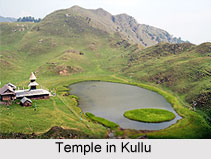 Kullu has its share of summer from March to June. Winter sets in from October and stays till February. These months are cold and dry with the temperature falling to 5 degree Celsius and the maximum temperature is 16 degrees. The mountainous landscape is not devoid of rain. The rainy season sets in July and Kullu enjoys the rainy spells will September. The monsoon is largely responsible for its semi-tropical vegetation as well. The average rainfall is 80 cm. Snowfall occurs during the winters. Although a mountainous region but the terrain of Kullu is suitable for agriculture as well. Horticulture is an important source of sustenance for the inhabitants of Kullu. Apples are grown is large quantities in Kullu. Besides, the natives here are also engaged in handloom industries. Kullu has its share of summer from March to June. Winter sets in from October and stays till February. These months are cold and dry with the temperature falling to 5 degree Celsius and the maximum temperature is 16 degrees. The mountainous landscape is not devoid of rain. The rainy season sets in July and Kullu enjoys the rainy spells will September. The monsoon is largely responsible for its semi-tropical vegetation as well. The average rainfall is 80 cm. Snowfall occurs during the winters. Although a mountainous region but the terrain of Kullu is suitable for agriculture as well. Horticulture is an important source of sustenance for the inhabitants of Kullu. Apples are grown is large quantities in Kullu. Besides, the natives here are also engaged in handloom industries.
Administration of Kullu The town of Kullu is the administrative capital of Kullu District. The offices of the Deputy Commissioner, Superintendent of Police, Additional District Manager and the district courts are situated here. The administrative units of Kullu district include tehsils, sub-tehsils, blocks, towns and villages. In addition to this there are three Assembly Constituencies and these are Anni, Kullu and Banjar. Tourism in Kullu 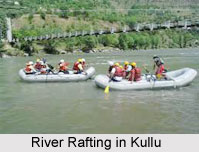 Kullu has also become the centre of many adventure activities like trekking, mountaineering and river-rafting. There are many places of pilgrimage like Manikaran, Hadimba, Bijli Mahadev, Vashishta, etc. in Kullu. Kullu, with its ethnic traditions and culture, ancient history, pristine nature and picturesque beauty attracts numerous tourists from around the world. There is no scarcity of interesting tourist places and panoramic spots in Kullu for the national and international level tourists. In fact these are sufficient to amuse the tourists. There are a number of ancient temples in Kullu. Vaishno Devi Temple, Raghunathji Temple and Bijli Mahadev Temple are some of the popular temples in Kullu. Besides the Kullu valley, the one can explore the Lug valley, the picturesque Naggar, Rohtang Pass, Jagatsukh, Nehru Kund, Manikaran, Arjun Caves and others.
|
| |||



Kullu
| Kullu is located in Kullu District of Himachal Pradesh. Kullu is one of the most beautiful hill stations of the country. Kullu is popularly known as the Valley of Gods owing to its temples and divine beauty. |
| ||||||||||||||||||||||||||||

