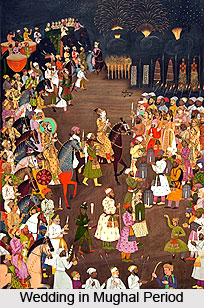
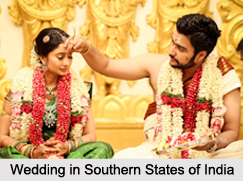
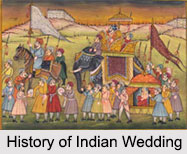
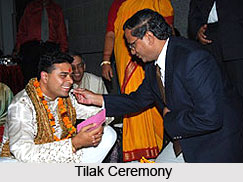
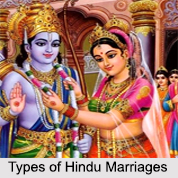
 Types of Hindu Marriages are described in Hindu mythology as eight types. Some of the marriages from among the eight types were practiced in ancient culture according to Hinduism. Among the eight different types of marriages, all are not religiously sanctioned but it has been said that the people belonging to the ancient India were followers of these Hindu marriages.
As per the Hindu philosophy, marriage is not just a process of coming together of the individuals but it is also a holy bond and a commitment which lasts a lifetime. Even the holy scriptures of the Vedas suggest that an individual should enter the phase of "Grihastha" after his or her student life. Thus, it can be said that marriage is almost a mandatory custom in the life of all the Hindus. Marriage is considered to be a religious ceremony by a Hindu. It is accompanied by the holy Yajna and Vedic mantras in order to wish a happy life to the couple. The ritual of marriage is generally performed by a priest or the Brahmin.
The concept of caste plays an important role in a Hindu marriage. As per Manu Smriti there are mainly eight types of marriages that are prevalent in the Hindu philosophy. The eight different types of Hindu Marriages are described below:
 Brahma Marriage
Among all the eight types the Brahma form of marriage holds a supreme position and this system of marriage does not involve any system of dowry. Brahma Marriage takes place only after the completion of student hood of a boy and in this system the bride"s father ensures that the prospective groom has acquired the knowledge of the Vedas reliably.
Daiva Marriage
Daiva Marriage, on the other hand is regarded to be inferior to the Brahma marriage since in this system a woman has to look for her groom that in turn is considered a demeaning practice for a woman. In this form of Hindu Marriage, the Hindu girl is married during a sacrifice to a priest. After waiting for a reasonable period to get a suitable man for their daughter when they fail to find anyone, the girl"s parents go looking for a groom in a place where a sacrifice is being conducted.
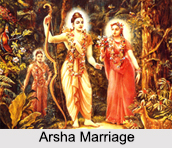
Arsha Marriage
The word Arsha means Sage or Rishi in Sanskrit language and hence, Arsha Marriage suggests marriages with the sages or rishis. In this form of marriage, the bride is exchanged for two cows received from the groom. This type of marriage took place because the parents of the bride couldn`t afford the expense of their daughter`s marriage at the right time according to the Brahma rite and therefore the girl is married to an old sage.
Prajapatya Marriage
Unlike the Brahma form of marriage, kanyadan and any kind of monetary transactions do not form an important part in the Prajapatya Marriage. In this form there takes place the joint performance of sacred duties by a man and a woman. This kind of marriage may be similar to that of the Brahma Marriage, but with subtle differences.
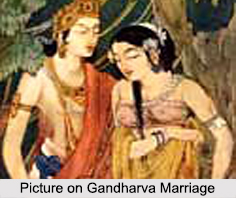
Gandharva Marriage
The Gandharva form of marriage is somewhat similar to the present day love marriage. Those couples, who are not permitted by their families to get united, seek refuge in this form of Hindu marriage. The Gandharva Marriage involves simple exchange of garlands upon which the sanctity of the marriage is confirmed. Reference to this type of marriages is found in a number of epics and mythological texts.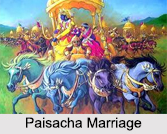
Asura Marriage
Asura Marriage takes place when an unsuitable bridegroom approaches the family of the bride and offers as high price as he is able to afford to get married to the girl. It could thus be looked upon as a bribe for getting the girl; the boy desires even if he is in no way a match for the girl. This system of marriage was not a much desirable form because it involved the commoditization of women.
Rakshasa Marriage
The Rakshasa Marriage is also not a desirable form of marriage because it involves the use of force to woo a girl. In this type of Hindu marriage, the groom fights and wins over the family of the bride and carries away the bride and then persuades her to marry him. Thus, it can be said that the Rakshasa form of marriage involves improper use of force.
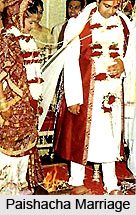
Paishacha Marriage
The last and the eighth type of Hindu Marriages is the Paishacha Marriage. This type of marriage is considered the most inferior form of Hindu marriage and has been prohibited in the later ages. In this form of marriage, the girl is captured and is forced to marry even against her desires. It was considered that men were permitted to marry those women in this form of marriage, whom they had seduced when the woman was intoxicated, asleep or insane. Thus, the Paishacha Marriage was later prohibited.
Hence, it can be summed up in saying that the Hindu philosophy encompasses eight different forms of marriages which are very different from each other and had a unique taste of their own. The ultimate aim of all these forms of marriage is to unite the two individuals. The rituals and rites of these marriages are different from each other and some of these marriages are still in practiced in Hinduism.